Edinburgh’s Art Deco Heritage 15: Narcissus, London Road
Posted in Architecture, Art Deco, Edinburgh at 12:00 on 19 May 2016
Posted in Edinburgh, War Graves at 20:00 on 20 April 2016
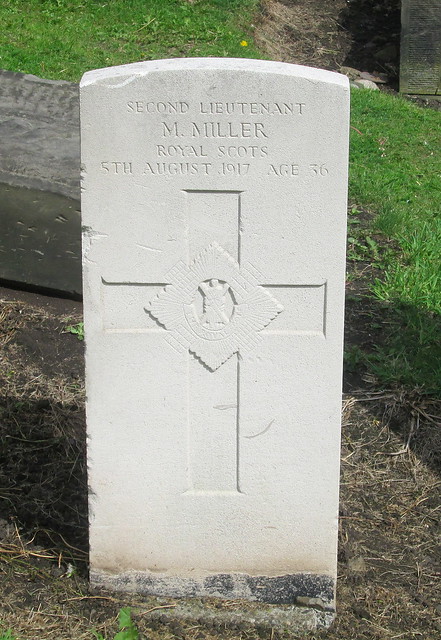
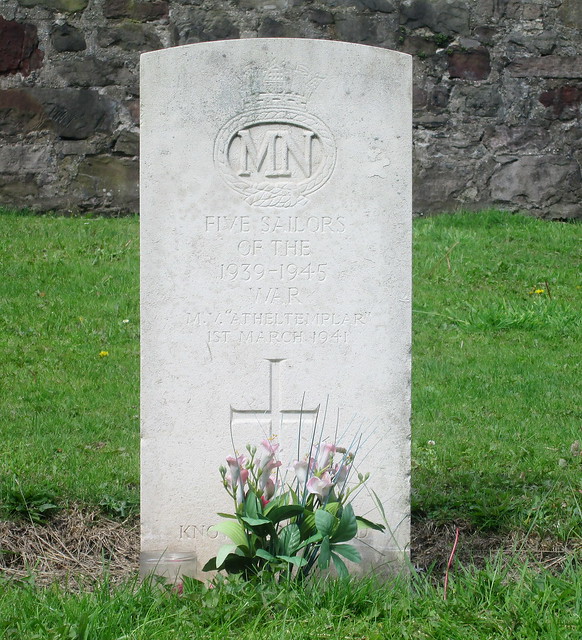
These were both in New Calton Burial Ground, Edinburgh.
M Miller, Royal Scots, 5/8/1916, age 36.
There was an unusaul communal gravestone for seamen of the Merchant Navy Merchant Navy inscribed, “Five Sailors of the 1939-45 War, MV Atheltemplar, 1/3/1941.”
On 1/3/1941 the Atheltemplar was attacked by Heinkel 111s off the Aberdeenshire coast. A total of 12 crewmembers died. This stone commemorates the five who were unidentified.
Posted in Edinburgh at 20:00 on 26 March 2016
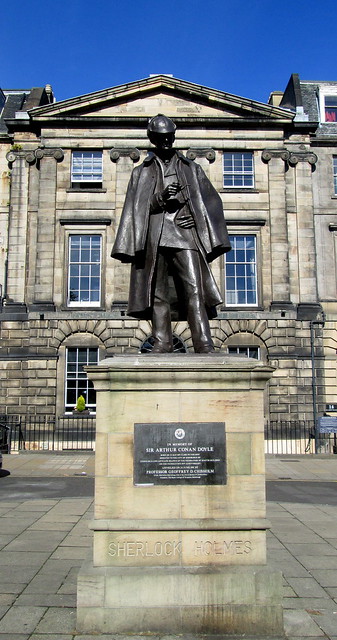
In the loosest sense.
This is one of the many sites in Edinburgh associated with men of letters of which the most prominent is of course the Scott Monument.
It’s the statue of Sherlock Holmes which stands in Picardy Place; erected in memory of his creator Arthur Conan Doyle who was born in 1859 near to this site. The Conan Doyle Pub is just over the road in York Place. The childhood home of Robert Louis Stevenson is less than a stone’s throw away from here.
Posted in Edinburgh, History at 12:00 on 21 March 2016
This is the Napoleonic Eagle captured at the Battle of Waterloo by Ensign Ewart.
The eagle is usually kept in Edinburgh Castle but I photographed it in its temporary home at the Museum of Scotland, Chambers Street, Edinburgh. You can see my faint reflection in the glass of the museum case
Posted in Edinburgh, War Memorials at 10:00 on 8 November 2015
Posted in War Memorials at 10:00 on 25 June 2015
Further to my post about the War Memorials on Edinburgh Castle Esplanade one of which was for the men of the Scottish horse the last time I was in Dunkeld I noticed this memorial on one of the walls in the town square:-
Again it commemorates the South African War (Second Boer War.)
Posted in Edinburgh, War Memorials at 12:00 on 23 June 2015
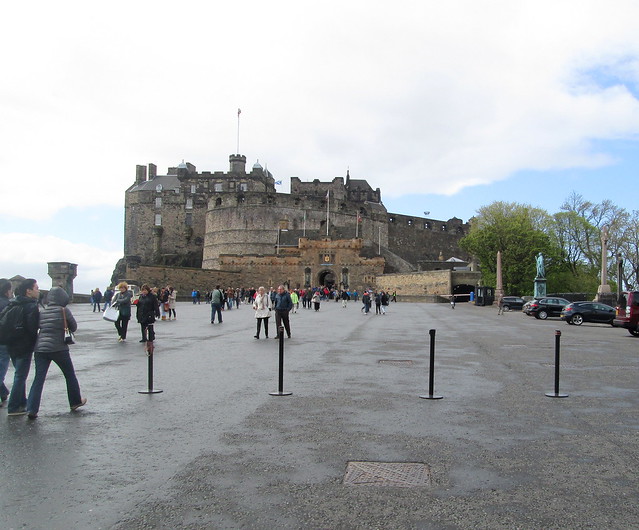
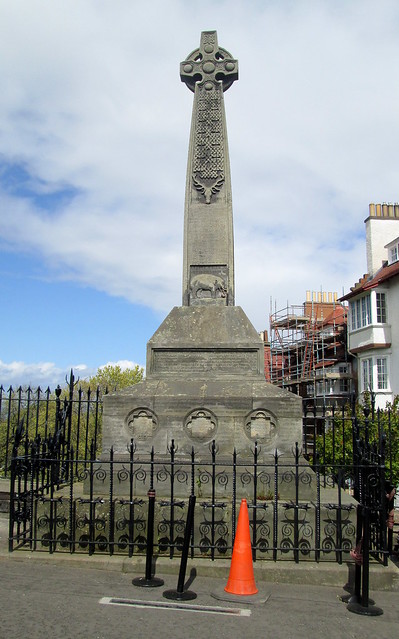
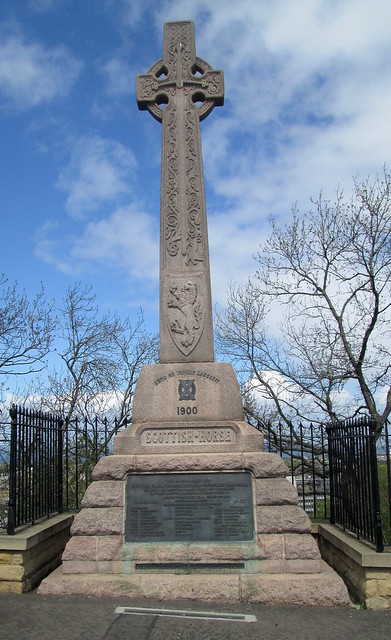
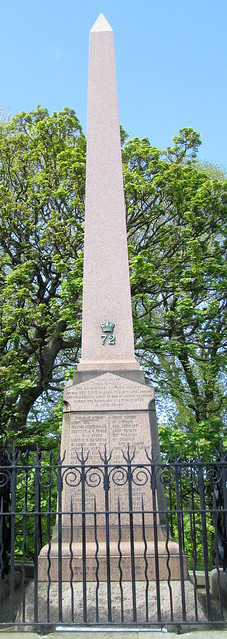
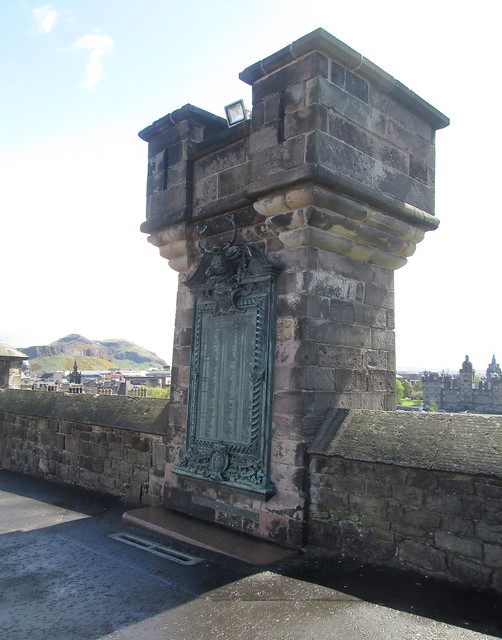
As well as the Ensign Ewart Memorial there are four other memorials to British (make that Scottish) regimental involvements in various wars. Three of them can be seen on the right and one on the left in this view of the castle from the esplanade.
The first was erected in 1861 to the memory of the 256 men from all ranks of the 78th Highlanders (78th Regiment of Foot) who died during the Indian Mutiny. Pity about the traffic cone in the foreground!
The second was erected in memory of the men of the Scottish Horse who died in the South African War (the Second Boer War.)
The thinnest one is to the memory to the men of the 72nd Highlanders who died in the Afghan War 1878-80. That was the Second Anglo-Afghan War. (Despite “Never Invade Afghanistan” being Harold MacMillan’s first rule of politics there have now been no fewer than four Anglo-Afghan Wars.)
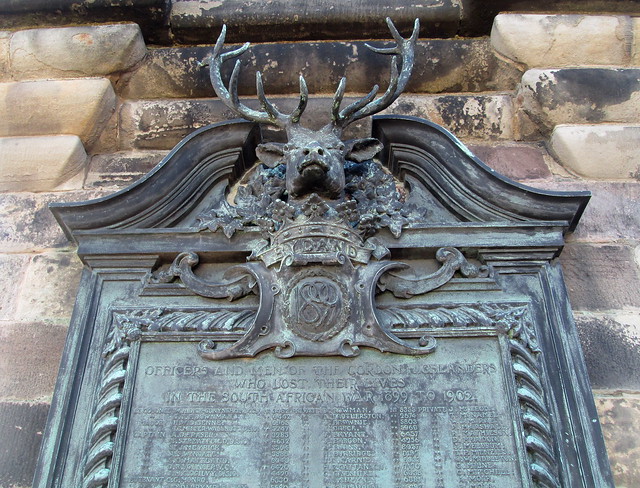
The Memorial on the south wall of the castle Esplanade is to the Gordon Highlanders who died in the Second Boer War, the South African War, 1899-1902.
This detail shows a fine stag’s head.
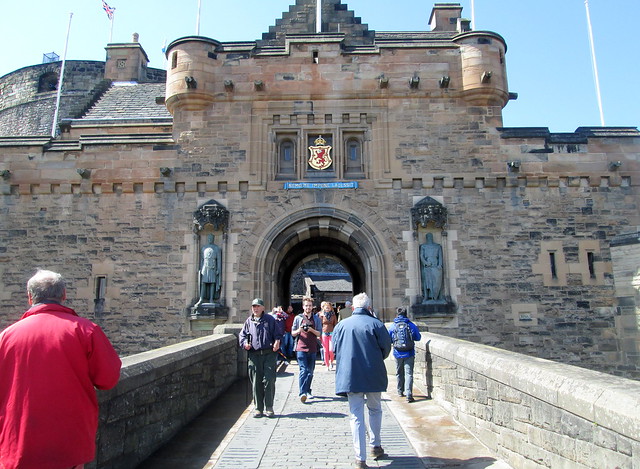
The entrance to the castle itself is flanked by statues to Scotland’s two great warrior heroes, Bruce and Wallace,and surmounted by the Royal Emblem (the Lion Rampant) and motto, Nemo Me Impune Lacessit.
Posted in Reading Reviewed, Scottish Fiction at 12:00 on 20 June 2015
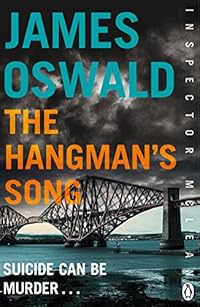
Penguin, 2014, 321 p.
This is the third of Oswald’s Inspector McLean books. For my reviews of the previous two see here and here.

Part of the background to The Hangman’s Song is the move from regional Police Forces to an integrated whole Scotland Police Service. Among other factors this produces in complicating a policeman’s lot it has meant McLean’s bête noire, Acting Superintendent Duguid, has been temporarily promoted to commanding officer, and has seconded McLean to work with the Sex Crimes Unit while still having a normal case load. The ongoing chaos to Edinburgh’s traffic caused by the installation of the new tram system mirrors the disorganisation within the force. In the meantime, McLean’s love interest, Emma, has only just recovered from the coma in which she ended the last book and has lost her memory, or at least the recent portion of it.
The novel starts off with an incident engaging the Sex Crimes Unit but the main plot concerns a series of suicides by hanging about which McLean harbours doubts. On this point (possible spoiler) it stretches credulity a little that once again people known to McLean in his personal life are tied up with the crimes. (Clues for this appear very early on.) Another repetition is that hints of the supernatural intrude into the narrative. (I would argue these are always unnecessary in a crime novel, tending to absolve the humans of responsibility for their actions.) McLean of course solves the crimes to his satisfaction – what else is detective fiction for? – but the world isn’t quite set to rights so there is ample scope for further novels
It is very readable stuff, though.
There’s an extract from the fourth Inspector McLean book Dead Men’s Bones making up the last 32 pages of this volume. Is there a point to this naff practice beyond the wasting of paper and shelf space? Anyone who wants more like this will most likely buy that book or read it anyway, anyone who doesn’t, won’t.
Pedant’s corner:- “the top of her piling system” (the context implies filing system, but if it was intended as a portmanteau coinage for “piled high set of files” it’s brilliant.) Otherwise:- shrunk, mementos (mementoes,) tie-died (tie-dyed,) medieval, “there were no franking mark or stamps” (I’d be happier with “was no franking mark” and a comma before the “or”,) “Aren’t I? (the Scottish usage is “Amn’t I?”) “None of the names were repeated” (none is singular, so that verb should be “was”,) sprung (x 2,) rung off (rang off,) “Let it go and move one” (on,) care off (care of,) elevator (lift,) the whole of Lothian and Borders were crawling (again; whole is singular, so “was crawling”,) a team were working (a team is singular so “a team was”,) “sixth form” (in McLean’s case, since he went to a public school in England, this is fine, but the character speaking to him ought to know the Scottish term is “sixth year”,) for you information (your.)
Posted in Art, History, War Memorials at 10:00 on 18 June 2015
200 years ago today the last battle of the Napoleonic Wars was fought at Waterloo. Famously remembered as a “close-run thing” (though the quote is apparently “It has been a damned nice thing — the nearest run thing you ever saw in your life,”) it was a bloody nightmare. A total of around 48,000 men were killed inside 10 hours.
Last month I visited Edinburgh Castle. Among the memorials on its esplanade is this one, erected in 1938, to Ensign Charles Ewart, of the Royal North British Dragoons (more commonly known as the Scots Greys,) who captured the Imperial Eagle of the French 45th infantry regiment during the battle.
The Eagle itself is normally on display in the relevant Regimental Museum in the castle grounds but it wasn’t on the day I visited. I think it’s on loan to the National Museum of Scotland at the moment. I did find, though, this Memorial to the men of the Scots Greys who died in the Great War.
Also, inside the Castle’s Great Hall, there is a painting, executed by Richard Ansdell some thirty years or so after the event, of the moment of the Eagle’s capture. Titled “The Fight for the Standard” the picture is huge – 13 ft by 11 ft. It is somewhat triumphal in tone and perhaps ridiculously sentimental given the likely conditions of the actual battle.
![]()
Picture from Eric Gaba at Wikimedia Commons.
Perhaps a more famous painting of the Battle of Waterloo is “Scotland Forever!” by Elizabeth Thomson, Lady Butler.
![]()
The original is in Leeds Art Gallery but a reproduction is in the Regimental Museum.
Posted in Reading Reviewed, Scottish Fiction at 12:00 on 14 April 2015
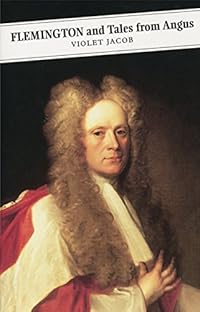
In Flemington and Tales from Angus, Canongate, 2013, 291 p, including 16 p introduction, 1 p each Acknowledgements, Note on the Text and Author’s Note, 14 p Notes and 6 p Glossary.
Another from the 100 Best Scottish books list. Again from a local (well, 9 miles away) library. The novel was first published in 1911.
As soon as the years in which this is set, 1745-6, are discovered certain expectations might arise, a focus on Bonnie Prince Charlie or his entourage, following the rising tide of his fortunes from the standard raising at Glenfinnan through his initial triumphs to Edinburgh and on down to England before the fatal loss of nerve at Derby and thence to his downfall. Jacob, however, is more subtle than this. The events of that last Jacobite rebellion are present here, to be sure, (the Battle of Prestonpans – here rendered as Preston Pans – the advance to and retreat from Derby, the Battles of Falkirk and of Drummossie Moor, otherwise known as Culloden, the bloody and vengeful aftermath of that final battle on British soil) but they occur offstage. Jacob’s focus is relentlessly on individuals, not the broad sweep of history or “great events”. Though the Duke of Cumberland does appear in Flemington’s pages as a character (and not in a flattering portrait) the Young Chevalier never does, except as the driving force for the dilemma into which our titular protagonist falls. The action takes place exclusively in the county of Angus and specifically in the area linking the towns of Forfar, Brechin and Montrose. It is in Montrose harbour that the sole military engagement described in the book – a fictionalisation of a very minor naval incident in the ’45 rebellion – takes place.
To prevent his mother compromising Prince Charlie, protagonist Archibald Flemington’s father was badly used by the Old Pretender in exile at St Germain. Archie was subsequently orphaned and put in the care of his grandmother who, due to those earlier experiences, is now a full supporter of the Hanoverian dynasty. Flemington is a painter but also a government spy trying to discern the plans of the rebel James Logie; to which end he turns up at the door of Logie’s brother, a retired judge. While Flemington is still undercover Logie reveals to him a personal confidence – unrelated to any Jacobite sympathies. This engenders in Flemington a sympathy for Logie which he will not thereafter compromise and so the central tragedy of the story unfolds.
The novel is full of well-drawn and memorable characters: Flemington; his grandmother; Skirlin’ Wattie, the no-legged bagpiper who travels about on a cart drawn by dogs; Callander, the Government Army officer who is dutiful to a fault. Despite his confidence granted to Flemington, James Logie is a shadowier character, though his brother Balnillo is portrayed in all his preposterousness. Wattie is the only one who speaks broad Scots. The context provides clarity enough but the glossary is there if needed.
One chapter begins, “April is slow in Scotland, distrustful of her own identity, timid of her own powers. Half dazed from the long winter sleep, she is often bewildered, and cannot remember whether she belongs to winter or to spring.” How true – especially redolent when reading it in Scotland, in April, and the passage is characteristic of Jacob’s writing which is especially strong on landscape description.
Flemington is an illustration on an individual human scale of the dislocations and traumas, the disruptions, which a Civil War brings in its train and of how character can both resist circumstances and be a victim of them.
I took the precaution of not reading the introduction before the story. Wisely, as the usual spoilers in such things were present.
Pedant’s corner:- I found the reference to English parents strange in a passage contrasting the thoughts of a Scots woman who had spent a long time in France with those who hadn’t. Also mentioned were English dragoons at Culloden. (I haven’t checked. Any dragoons may have been English, though certainly a large part of Cumberland’s army was Scots.) Dulness with one ‘l’?