Archives » Alternate History

Speculative Fiction Not SF Shocker

They give with one hand and take away with the other….

Also in Saturday’s guardian review was the first part of the Guardian Book Club feature on Robert Harris’s Fatherland, wherein John Mullan says “Speculative fiction” might once have been synonymous with SF but now more strictly refers to an alternative, but plausible, historical scenario.

More strictly? There is a definition of speculative fiction which excludes SF?

This seems to me to be a dismissal of the more explicitly SF altered histories. Is Mullan attempting to distance his preferred examples from what he sees as less worthy; or am I too sensitive?

Nevertheless I had to laugh when Mullan immediately wrote that a modern classic of speculative fiction is Philip Roth’s The Plot Against America. That book not only failed as a novel, it failed as an Altered History (for my review see here). Can a story where history is restored swiftly to the “right” path really be considered speculative? Is it not then an author’s ill-thought out musings, onanistic even?

I’ve not read Fatherland but from the description it seems to invest more into its scenario than Roth ever did in his.

In that extent Fatherland is SF, and Roth’s book isn’t.

Midnight In Paris

At the local “Art Cinema”, the Adam Smith Theatre. Whoopee! No round trip to Dunfermline just to see a film. (Still on tonight, 14/2/12, if anyone wants to go.)

This is a Woody Allen film and many of his tropes are present. The lead character, Gil, is typically Allenish with his verbal mannerisms, we have the fascination with the past (Zelig; Broadway Danny Rose) and an intrusion of the fantastic (Play It Again, Sam; Broadway Danny Rose.)

Gil is a writer on a trip to Paris with his fiancee and her awful parents; a moneyed couple, snobbish and intolerant, with no redeeming features. But none of these four are really sympathetic. There is a fine cameo by Michael Sheen as a friend of the fiancee, with just the right degree of irritating know-allness.

To escape this lot, Gil walks through Paris and gets lost. At midnight he is invited into an old car cruising the streets. He is taken to a party where he encounters Cole Porter, Scott and Zelda Fitzgerald and Ernest Hemingway. On subsequent nights he meets Gertrude Stein (Alice B Toklas has a small name check,) Pablo Picasso and his mistress, Salvador Dali, Louis Buňuel and Man Ray. Gil is delighted as he is fascinated by the 1920s, his perfect time. He is also much taken with Picasso’s mistress who thinks the Belle Époque was the best era to be alive.

If at times this all seemed a bit too overloaded it is the sort of stuff with which Allen can have a bit of fun, as when Gil suggests a film scenario to Buňuel.

Stein agrees to read Gil’s novel manuscript. At one point she describes it as Science Fiction (it is set in her future.) I was dubious at this usage and checked; the term apparently wasn’t in common use until 1929.

Gil is drawn more and more into the 1920s milieu and strolling with Picasso’s mistress one night they are invited into a horse-drawn cab and end up in the Belle Époque. Cue Toulouse Lautrec, Degas and Gauguin. Here Gil realises that no-one likes their own time and the past isn’t necessarily a better place.

But he determines to stay in (present day) Paris and chucks his girlfriend.

It was the fantastic element that I found most satisfying, the going into the past aspect is the sort of thing that makes Altered History (or Alternative/Alternate History if you must) so intriguing, but the present day characters were just so crass; apart from Carla Bruni as a tour guide and a female seller of old records Gil bumps into on a shopping trip.

This was minor Allen but entertaining enough, with quite a few laughs. I enjoyed it.

Music, in a Foreign Language by Andrew Crumey

Dedalus, 2004, 243p

 Music, in a Foreign Language cover

Not being a straightforward narrative, this is a difficult novel to describe. Tenses shift within sections, there are stories within stories, false starts, rewritten chapters, repetitions of scenarios and the narrator is at pains to point out the fictionality of it all, indeed at times it reads more as a disquisition on literary efforts than an attempt at one. Yet, for all these strictures, it was immensely readable.

The tricksiness begins early as the novel starts with Chapter 0, where the narrator is thinking post coital thoughts about two characters who meet on a train and about whom he intends to write a novel. The bulk of Music, in a Foreign Language deals with the back story of one of these, a young man called Duncan, and the events leading up to the death of his father, Robert Waters. Waters and his friend Charles King had at the time been involved in slightly subversive activity in a Soviet style post-war Britain. This was the first appearance of that altered history in which Crumey also set parts of Mobius Dick and Sputnik Caledonia. The compromises such a society demands, the paranoia it engenders – and the betrayals it necessitates – are allowed to emerge organically from the story. Despite the title, music as a motif appears sparingly.

My one minor caveat is that the female characters are not as fully rounded as they might be, but the book’s main focus is on the friendship between Waters and King, so perhaps that is understandable.

I was equally as impressed by this, Crumey’s debut novel, as I was by both others of his I have read. If you like well written, thoughtful – even playful – novels you could do worse than give Crumey a try.

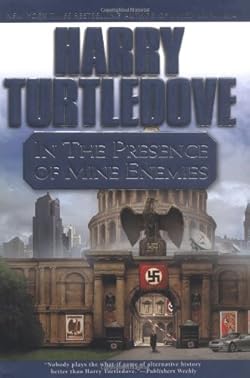
In The Presence Of Mine Enemies by Harry Turtledove

New American Library, 2003, 454 p.

Germany won the Second World War and twenty years later a Third. In 2009, the US, like most of Europe, is a vassal state, paying reparations to avoid the panzers rolling out from their bases in US cities. The British Union of Fascists holds sway in a Britain also in thrall to Germany.

In Berlin, the Gimpel family lets its eldest daughter into a secret. They are Jews, and must keep their origins hidden, speaking of it only to those in their immediate circle. Meanwhile the old Führer, a character whose real world model is only thinly disguised by the name Kurt Haldweim, has died and the new one, Heinz Buckliger, starts to loosen the strings of dictatorship. This strand of the plot hinges on textual differences between the first and subsequent editions of Mein Kampf, a subject on which I have to take Turtledove on trust.

Parallels with our world are one of the delights of altered histories. Nice touches here are a stage production featuring the baddies Churchill and Stalin which is so awful that it’€™s a smash hit and a delegation from the Protectorate of Bohemia and Moravia, asking for autonomy for the region, being led by a grey-haired Czech playwright.

(Slight spoiler alert:-

The thousand year Reich (had it survived World War II) would no doubt have collapsed under its internal contradictions at some point long before a millennium had passed but perhaps not quite so quickly and easily as portrayed here. The parallel with the Soviet Union of our own world which Turtledove implicitly outlines by having the Gauleiter of Berlin face down SS tanks in front of his residence does not really hold. In the world of the novel there was no Cold War to sap and counter its ideology -€“ Japan is not presented as too great a rival to Germany – and hence any decay would likely have been much slower.)

This may be the story Turtledove always wanted to tell -€“ Jewishness has unsurprisingly featured prominently in his altered worlds and this is the ultimate scenario to deploy in order to explore it. I’€™m afraid his writing does not do this particular theme justice, though. It has his usual multiple viewpoints, but all are Jewish here. Other familiar traits are too prevalent; the tendency to reiterate characters’€™ thoughts or peccadilloes, to labour a point, and here he doesn’€™t so much foreshadow future events as telegraph them. Plus he is too kind to his viewpoint characters and the book’s Nazis are cardboard -€“ all the really evil deeds are in the novel’s past – which is a shame because this could have been a powerful indictment of man’s inhumanity to man.

The idea for In The Presence Of Mine Enemies worked much better at the short story length in which it first appeared in 1992.

End Of The Beginning by Harry Turtledove

ROC, 2005. 519p

A Churchill reference for the title this time rather than a Roosevelt one but it remains the same Turtledove.

The inhabitants of Hawaii are still coming to terms with the Japanese occupation which occurred in Days Of Infamy. Food is scarce, much of Hawaii’€™s land is now given over to growing rice, but for the US POWs it is less than scarce; plus they are being worked to death. Despite the harassment by submarine of the supply shipping from their home islands – at one point Turtledove alludes to the US breaking of Japanese codes which makes this easier – the Japanese forces are confident of holding off any further US attempts to retake the islands. On all sides, Japanese, native Hawaiians and US citizens alike, there is a sense of marking time – or holding on – until the inevitable renewed US attack. Meanwhile in the US there is a steely determination to regain the islands.

The lack of jeopardy to the characters which seemed to pervade Days Of Infamy is more than made up for here. In retrospect that may have been because the former book was an exercise in setting up this one, characters needed to be in place. End Of The Beginning explores the earlier book’s ramifications, one of which is that the fate you always felt Turtledove had in store for Jane Armitage (which was not so much foreshadowed as put up in lights) indeed comes to pass.

The US onslaught, when it comes, is of course overwhelming. (Admiral Yamamoto’€™s knowledge – and fear – of US industrial might and Japan’€™s relative lack of preparedness to withstand it is discussed more than once.)

The naval battle scenes are reasonably convincing and seem to pass quickly. The treatment of the Japanese resistance on Oahu feels a bit perfunctory, though. We hear about it but don’€™t witness much of it.

SPOILER ALERT.
Turtledove is undoubtedly correct in not ignoring the Japanese enslavement of “comfort women.”€ Also reflecting the nineteen forties there is an element of misogyny – and maybe racism too – in the post-liberation treatment of the woman of Chinese origin who kept house in their brothel in Wahiawa. While two males suspected of being guilty of collaboration escape relatively freely, she does not.

Overall the book is curiously readable. Whether it was more familiarity with the characters and scenario or due to more incident it seemed to flow more freely than Days Of Infamy. But both books are marshmallow reading, very little thought is required.

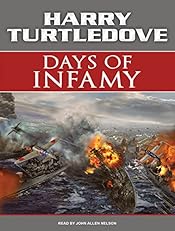
Days Of Infamy by Harry Turtledove

Roc, 2005. 520p

Once more from the sublime (Lavinia) to the ridiculous. This book covers what might be termed the natural twentieth century US Altered History scenario but which I don’€™t believe anyone else has tackled. What if Japan had not just raided Pearl Harbor but actually invaded and taken Hawaii?

Days Of Infamy has the usual Turtledove modus operandi familiar from his Great War, American Empire, Settling Accounts, World War and Colonisation series which all had multi-stranded narratives, each thread from a different viewpoint character. The twist this time is we get a few Japanese to follow.

The format has the usual faults, too. The cuts between viewpoints make the flow jumpy, some characters are merely irritating and others appear solely in order to push the story on. Some of them indeed are more or less the same cardboard people from those other series (Fletch Armitage for instance is only a transplanted Sam Carsten) and too often they repeat thoughts they’ve had previously.

Offstage, the Japanese still over-run Malaya and Burma – though surely that would have been a serious overstretch (which arguably was the case in reality, even without Hawaii) – but Turtledove has of course rearranged some things to suit his narrative. Here, for example, General Yamashita is on Hawaii and not at Singapore. He gets to say similar things at the US surrender of Hawaii as he did in the real 1942, though. There is too, a nice twist on the Doolittle Raid, now launched on Hawaii and not the Japanese home islands.

Most of the viewpoint characters are actually rather uninteresting but the beach surfer type is an unusual choice of voice. In the Great War series I remember Turtledove killing off at least one of his narrators. A major fault with Days Of Infamy is you never feel any of the narrators are in real jeopardy. Only incidental characters die.

There’€™s only one more in this series though.

At least so far.

Departures by Harry Turtledove

Del Rey, 1993. 352p.

This is a collection of short stories varying considerably in length. All are divertissements, some much more light-heartedly intended than others.

While some are future based SF, many are historically rooted (in the counterfactual sense) but some are fantasy rather than SF -€“ one features a werewolf, another the Devil. Two have scenarios involving baseball; one of these -€“ a Ring Lardner pastiche apparently -€“ is almost incomprehensible to someone not au fait with the game’€™s idiosyncrasies, or indeed Ring Lardner’€™s oeuvre.

The most intriguing premise has a certain religion’€™s main prophet becoming instead a Christian monk and (whisper it) Islam failing to be born. This was a universe Turtledove mined extensively for his Agent Of Byzantium stories the seventh of which, Pillar Of Cloud, Pillar Of Fire (otherwise uncollected?) appears here.

In passing it’€™s nice to know that the Lizards from Turtledove‘€™s World War:Balance and Colonisation books were actually inspired by ancient Persians (see Potsherds, the first story in this book.)

Departures is light reading only-€“ which I need at this time of year.

What If? America. Edited by Robert Cowley. Eminent historians imagine what might have been.

Macmillan, 204, 298p

This volume is a companion piece to What If? and More What If? and is the sort of speculative stuff which I just love. (I don’t much care whether it is as fiction or as historical rumination. Both illuminate how we got here and how it could have been different.) The professional historians call the medium counter-factual, while it is known in speculative fiction as Alternative History. (My preferred term is Altered History.)

This book concentrates mainly on the history of the US. So we have:-
The Mayflower landing in Virginia instead of Massachusetts and so less religious influence on the US.
Pitt the Elder avoiding the American Revolution.
George Washington being trapped by British troops in Brooklyn before the War of Independence gets fully into stride.
No incorporation of Texas into the Union – and no Vice Presidents automatically succeeding on a President’s death.
No loss of Lee’s cigar-wrapped orders before Antietam and hence a Union defeat in the Civil War.
No (possibly unjust) blaming of a certain Civil War Union general for a near catastrophe. (That circumstance eventually gave us Ben-Hur and all the cultural efflorescences that followed from it.)
A second secession (of Mid-West States) during the Civil War.
Andrew Johnson being assassinated along with Lincoln.
A class war in the 1870s.
A US-Britain war in 1896 (over a border dispute in South America!)
FDR delaying the Pacific War.
Eisenhower taking Berlin before Zhukov and Konev get there.
Joe McCarthy as a Soviet agent. (Not too big a leap for the imagination if you apply the old saying “cui bono” to that Senator’s activities.)
A thawing of the Cold War because Gary Powers’s U-2 mission is cancelled.
The Cuban missile crisis is not resolved safely.
An unassassinated JFK reconciling with Cuba (and resisting embroilment in Vietnam.)
Watergate as only a minor scandal.

All fascinating stuff – if perhaps sometimes the historians assume nothing too much would change thereby.

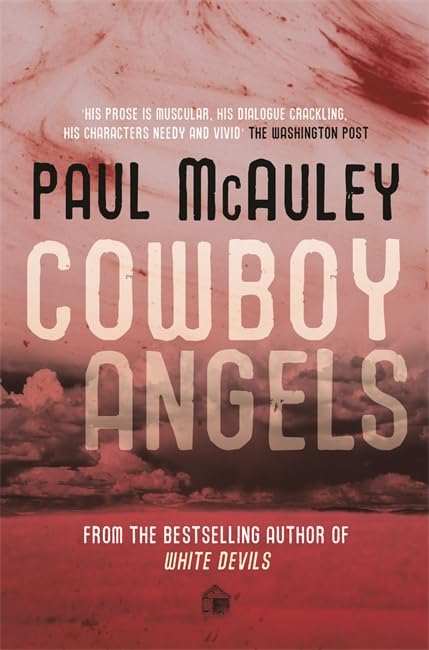
Cowboy Angels by Paul McAuley

Penguin, 2007. 390p

In a timeline known as the Real, machines called Turing Gates allow movement between different worlds. Adam Stone was once employed with The Company, a US government agency which carried out undercover operations in the other realities, here known as sheaves, to bring them into line with, and effectively subject to, the Real. The select band he was part of made up the Cowboy Angels of the title. Following the 1980 Presidential election a change of government leads to the abandonment of this policy in favour of a more cooperative approach to other sheaves.

A prologue chapter reveals tensions between some of the Cowboy Angels, and inside the Company generally, arising from this. The remainder of the book is set mainly in 1984, where, as well as the Turing Gates, the Real has technology akin to that of the twenty first century in our world, the likely equivalent to which in the book is known as the Nixon sheaf. For those who enjoy such speculaton there is also an American Bund sheaf and one where the US is communist.

Stone is working in an agricultural sheaf when he is called out of Company retirement as his old colleague Tom Waverly has been killing the various different sheaf versions (doppels) of a woman named Eileen Barrie and only Stone will be able to contact him.

Cowboy Angels starts off as an apparently gung-ho right wing tract but by the end of Part One the characters have begun to doubt the worth of interference in other sheaves and of the projection of power at the point of a gun. As a commentary on the invasion (in the reader’s world) of Iraq and the aftermath of that conflict this is pretty acute.

McAuley’s treatment of the Altered History scenario is explicitly Science Fictional as it involves a mechanism for movement between (and sometimes creation of) different sheaves. I liked the nod he made to previous authors who dealt with different worlds or realities by naming some minor characters variously Philip Kindred, Leinster and Laumer.

The unravelling of the plot leads to the revelation of a greater conspiracy within the Company and the efforts of Stone and Waverly to combat it, in the course of which a further SF McGuffin makes its appearance in the shape of a time key which alters the operation of the Gates.

As you might expect from the scenario there is plenty of violence dispersed through the book but the characters, especially Adam Stone, are rounded enough. However, there is perhaps too much over-complication of the plot and I found the resolution unsatisfactory.

I would, though, recommend this to anyone who wants their brain bent (a little) by the contemplation of paradoxes.

Mobius Dick by Andrew Crumey

Picador, 2004, 312p

This book was not marketed as Science Fiction but in any straightforward reading of the term would be so, as it is fiction about Science, specifically quantum mechanics and wave functions. Science Fiction as understood, though, is not generally thought of in this light but rather as extrapolative. However, Mobius Dick fits the bill in this sense also, as its background involves a set of experiments to produce a vacuum array which can generate energies in excess of 1000 Eka-electronvolts which could lead to wave functions not collapsing on being observed and the end of the world as we know it. Fear not if you know nothing about the behaviour of subatomic particles, the necessary details are lucidly set out by Crumey in the appropriate places. (Or did I just find it lucid because I had encountered most of these ideas already? Studied them, even, when a student.)

The narrative is multi-stranded, beginning with an enigmatic text message to a physicist, John Ringer, reminding him of a lost love. Another strand is set in a hospital where patients are being treated for Anomalous Memory Disorder, AMD, a condition in which they appear to have false memories. A third contains extracts from a book by a certain “Heinrich Behring” but which is copyrighted “the British Democratic Republic 1954” and which focuses on Erwin Schrödinger. An Altered History too, then.

It is, as well, a consciously literary endeavour featuring in addition to the above; Bettina von Arnim, the composer Schuman and a letter from an unsuccessful Herman Melville to Nathaniel Hawthorne. No surprise it’s not marketed as Science Fiction. The John Ringer sections are Ballardian in tone and when he ventures into rural Scotland also have a tint of the testament of Gideon Mack, which I reviewed recently.

Crumey never pushes the connections between the sections. We are left to ourselves to infer that AMD is a manifestation of superimposed quantum states and the many worlds of uncollapsed wave functions. The characters, on opening doors etc, by and large treat any incursions into or from other worlds as if they are hallucinations, which interpretation is also entirely adequate.

The afterword, also by “Heinrich Behring,” like the sections featuring Schrödinger and Schumann, is written from the perspective of a world where Goebbels replaced Hitler, Britain was invaded but after liberation became a socialist/communist state and neither Melville nor Thomas Mann achieved critical acclaim. “Behring” depicts Schrödinger – who never amounted to much in this altered history – finding his famous (in our world) equation HΨ = EΨ in the scribblings of a madwoman.

What makes Mobius Dick ineluctably Science Fiction (whether it is labelled as such or not) is this looking in at our world, where a woman can become Britain’s PM, an actor President of the US and the many worlds theory is taken seriously, and finding it absurd.

But to label the book at all is to do it an injustice. It hums with ideas and wit, and not a few literary puns.

I haven’t been so impressed by an author new to me for a long time.

free hit counter script