Posted in War Memorials at 21:50 on 14 July 2015
Killin stands at the head of Loch Tay on what used to be Perthshire but it is now in Stirling District. Its War Memorial is a dignified statue of a Higland soldier. It’s in a lovely setting by the River Dochart just above the falls.
From the village. WW1 names:-

Front View. Upper plaque for WW1, the lower plaque is for WW2:-

Looking towards the village. WW1 Names:-

No Comments »
Posted in History, War Memorials at 15:00 on 25 June 2015
As at Edinburgh Castle there are War Memorials on the esplanade of Stirling Castle.
Again there is one to the Indian Mutiny, this one dedicated to the men of the 75th Stirlingshire Regiment who died at Seringapatam, Delhi and in the Relief of Lucknow.

The other side of the memorial names the officers (1 colonel, 2 captains, 6 lieutenants and 1 surgeon) but only gives the total numbers of other ranks (13 sergeants, 9 corporals, 3 drummers and 216 privates) – all of the 75th Stirlingshire Regiment – who died in the mutiny, 1857-8.
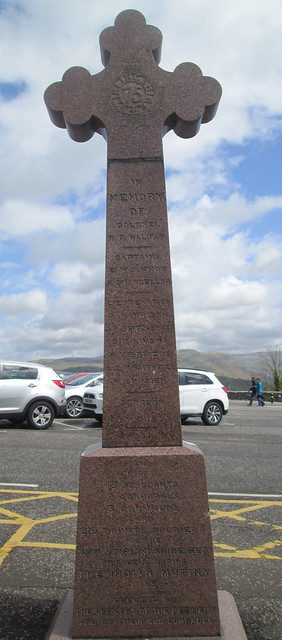
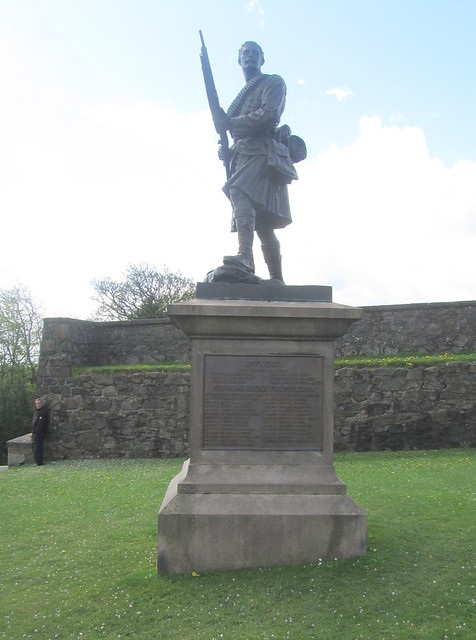
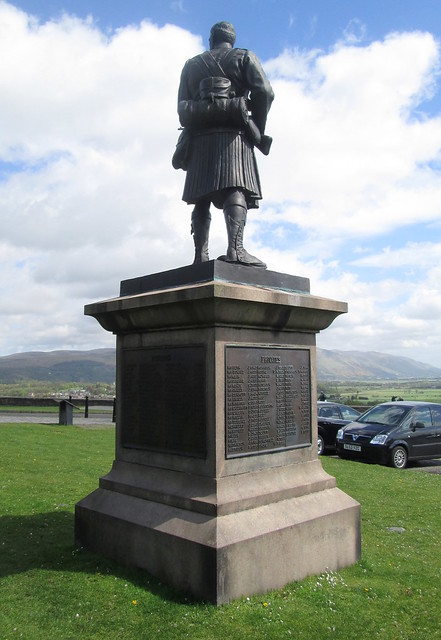
Again too there is a Memorial to the South African War (Second Boer War) dedicated to the men of the 1st Battalion (Princess Louise’s) Argyll and Sutherland Highlanders

The plaque here gives the names of the officers and non-commissioned officers who died:-
The plaques on these two sides give the names of the privates:-
Staring out towards the scene of his great victory at Bannockburn is a statue of Robert Bruce.

No Comments »
Posted in War Memorials at 10:00 on 25 June 2015
Further to my post about the War Memorials on Edinburgh Castle Esplanade one of which was for the men of the Scottish horse the last time I was in Dunkeld I noticed this memorial on one of the walls in the town square:-

Again it commemorates the South African War (Second Boer War.)
No Comments »
Posted in Edinburgh, War Memorials at 12:00 on 23 June 2015
As well as the Ensign Ewart Memorial there are four other memorials to British (make that Scottish) regimental involvements in various wars. Three of them can be seen on the right and one on the left in this view of the castle from the esplanade.
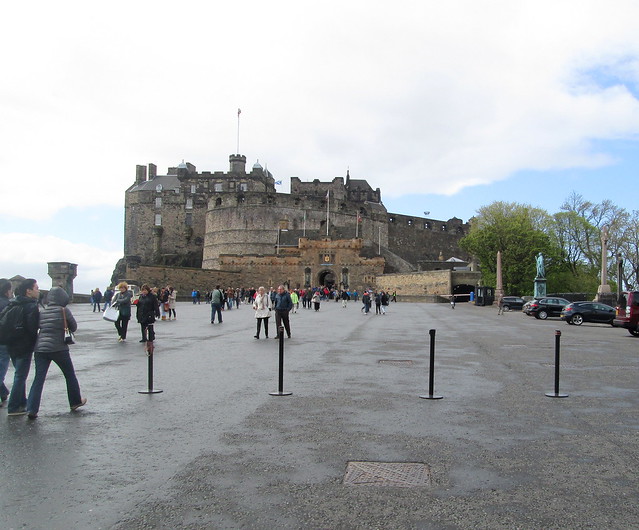
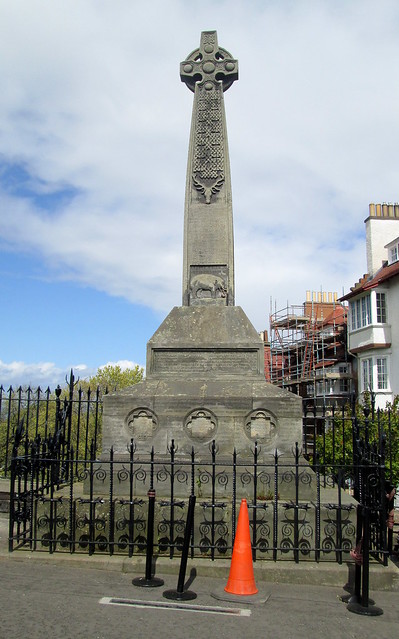
The first was erected in 1861 to the memory of the 256 men from all ranks of the 78th Highlanders (78th Regiment of Foot) who died during the Indian Mutiny. Pity about the traffic cone in the foreground!
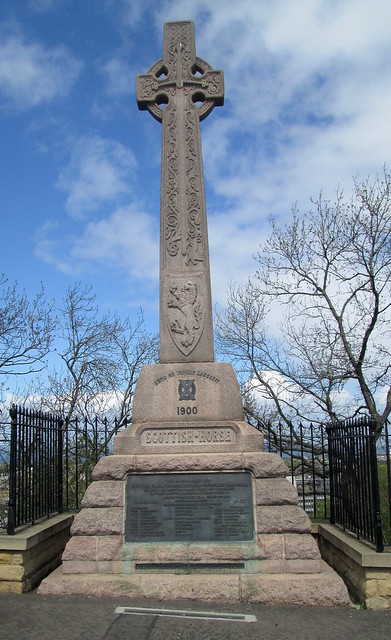
The second was erected in memory of the men of the Scottish Horse who died in the South African War (the Second Boer War.)
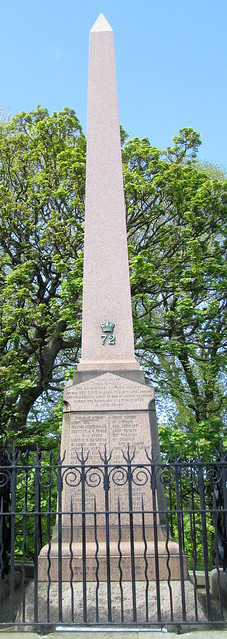
The thinnest one is to the memory to the men of the 72nd Highlanders who died in the Afghan War 1878-80. That was the Second Anglo-Afghan War. (Despite “Never Invade Afghanistan” being Harold MacMillan’s first rule of politics there have now been no fewer than four Anglo-Afghan Wars.)
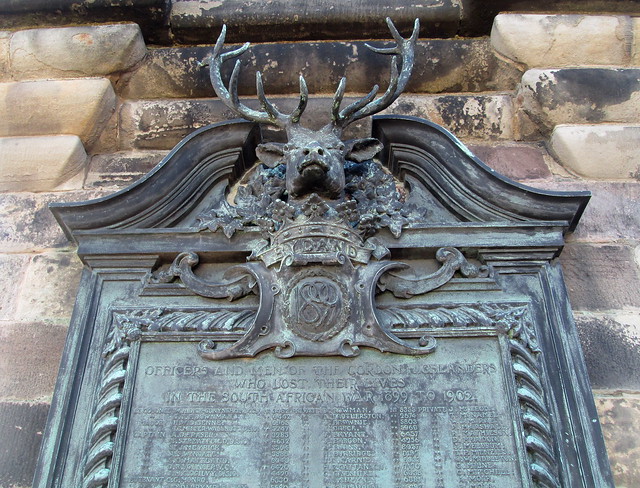
The Memorial on the south wall of the castle Esplanade is to the Gordon Highlanders who died in the Second Boer War, the South African War, 1899-1902.
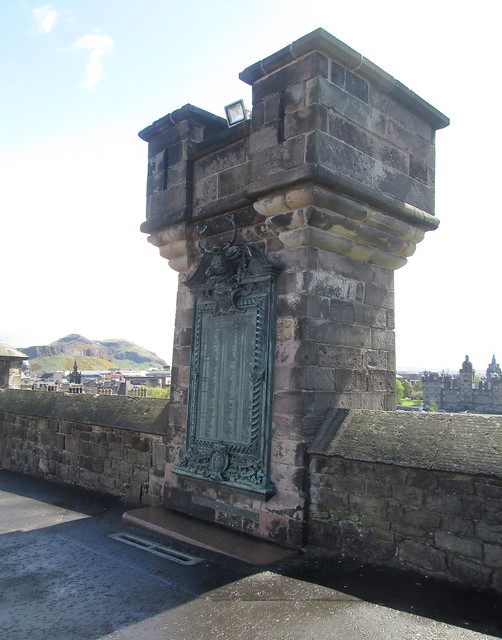
This detail shows a fine stag’s head.
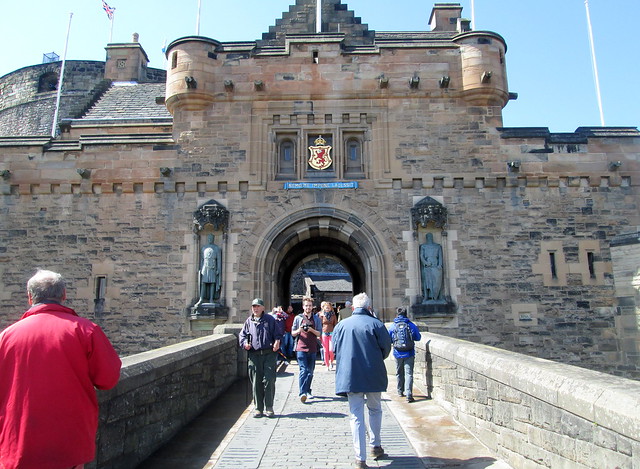
The entrance to the castle itself is flanked by statues to Scotland’s two great warrior heroes, Bruce and Wallace,and surmounted by the Royal Emblem (the Lion Rampant) and motto, Nemo Me Impune Lacessit.
No Comments »
Posted in Art, History, War Memorials at 10:00 on 18 June 2015
200 years ago today the last battle of the Napoleonic Wars was fought at Waterloo. Famously remembered as a “close-run thing” (though the quote is apparently “It has been a damned nice thing — the nearest run thing you ever saw in your life,”) it was a bloody nightmare. A total of around 48,000 men were killed inside 10 hours.
Last month I visited Edinburgh Castle. Among the memorials on its esplanade is this one, erected in 1938, to Ensign Charles Ewart, of the Royal North British Dragoons (more commonly known as the Scots Greys,) who captured the Imperial Eagle of the French 45th infantry regiment during the battle.

The Eagle itself is normally on display in the relevant Regimental Museum in the castle grounds but it wasn’t on the day I visited. I think it’s on loan to the National Museum of Scotland at the moment. I did find, though, this Memorial to the men of the Scots Greys who died in the Great War.

Also, inside the Castle’s Great Hall, there is a painting, executed by Richard Ansdell some thirty years or so after the event, of the moment of the Eagle’s capture. Titled “The Fight for the Standard” the picture is huge – 13 ft by 11 ft. It is somewhat triumphal in tone and perhaps ridiculously sentimental given the likely conditions of the actual battle.

Picture from Eric Gaba at Wikimedia Commons.
Perhaps a more famous painting of the Battle of Waterloo is “Scotland Forever!” by Elizabeth Thomson, Lady Butler.

The original is in Leeds Art Gallery but a reproduction is in the Regimental Museum.
No Comments »
Posted in War Memorials at 20:23 on 9 June 2015
This stone is inlaid into the paving round the Doulton Fountain outside The People’s Palace, Glasgow Green.

It commemorates Henry May, the Cameronians (Scottish Rifles,) 2/10/1914.
Was this the first WW 1 casualty from Glasgow?
Edited to add (13/6/15):- I’ve just noticed the insignia inscribed on the stone is of a Victoria Cross. I presume therefore that Henry May won that medal hence his commemoration.
No Comments »
Posted in Glasgow, War Memorials at 12:00 on 8 June 2015
My pictures of this memorial from last December were taken in the dark.
This was in daylight. Shows the flanking lions off well:-

Obelisk and horizontal sculpture:-

The sculpture resembles the fossil of a creature’s skeleton. The latin word “Pax” (peace) can be seen to its right here:-

No Comments »
Posted in Trips, War Memorials at 21:56 on 20 May 2015
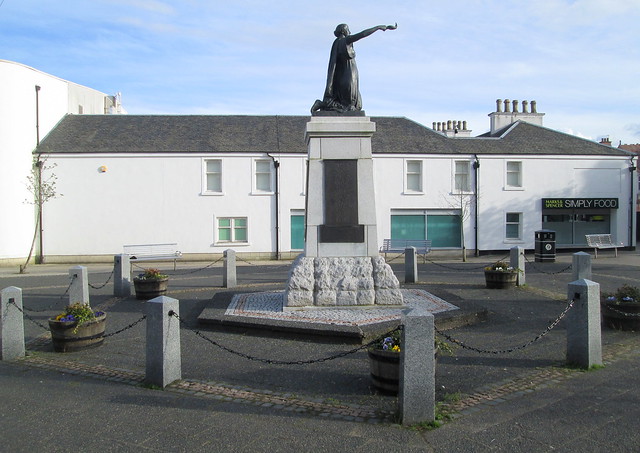
I photographed the War Memorial for Milngavie and District when I was over in Dunbartonshire for the Raith game at the end of the season.
The memorial is set in a sort of square just off the town centre. The inscription reads, “Nobly they kept alight the lamp of liberty.”

I think the figure is holding a dove of peace in her hand but it’s hard to be sure.
No Comments »
Posted in War Memorials at 12:00 on 30 April 2015
This is situated by the A 907 across the road from West End Park.
Here is a close-up of the inscription:-
This is the reverse view:-
The central plaque lists the names of the dead, 5 killed in action, 3 of wounds, 3 of disease:-
No Comments »
Posted in Eric Brown, History, War Memorials at 12:00 on 26 April 2015
Recently I have been travelling quite frequently up and down the A1 from Edinburgh to Dunbar, mainly to visit Eric Brown.
I had always wondered what the prominent hill with the flag on it just off the road a few miles east of Edinburgh was. A few weeks ago detouring into Prestonpans on the return I found out. Coincidentally I was reading Violet Jacobs’s Flemington at the time.
On the B 1361 into Prestonpans there was a sign pointing to the Battlefield of Prestonpans, 1745, the first battle of the Jacobite Rebellion of that year. I had previously thought the battlefield would lie somewhat closer to the Firth.
The prominent hill is the battlefield viewpoint, a converted coal bing, seen here from its foot.
The flag flying at the summit is Bonnie Prince Charlie’s battle standard.
There is a cairn at the side of the B 1361 erected in memory of the dead of the battle:-
According to the information boards on the Battlefield Viewpoint this is the site of the 1745 battle:-
This is the approximate Jacobite position at the battle’s start. It has a golf range on it now.
The battle itself was over in about fifteen minutes. Most of the relatively inexperienced Hanoverian force fled at the first charge of Bonnie Prince Charlie’s Highlanders. This left the more hardened government troops sandwiched between the rebel wings. After suffering heavy casualties they gave way. Their commander Sir John Cope led some stragglers down a lane which to this day is named Johnnie Cope’s Road, but couldn’t get them to fight and left the field.
The song Hey Johnnie Cope Are Ye Wakin’ Yet? was written – by Adam Skirving, a namesake of the good lady – to commemorate the Jacobite victory.
This version, by the Corries, is preceded by an account of the first singing of the fourth verse of the UK National Anthem – the one which is no longer officially recognised.
No Comments »

