Archives » Altered History

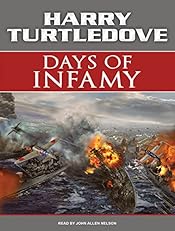
Days Of Infamy by Harry Turtledove

Roc, 2005. 520p

Once more from the sublime (Lavinia) to the ridiculous. This book covers what might be termed the natural twentieth century US Altered History scenario but which I don’€™t believe anyone else has tackled. What if Japan had not just raided Pearl Harbor but actually invaded and taken Hawaii?

Days Of Infamy has the usual Turtledove modus operandi familiar from his Great War, American Empire, Settling Accounts, World War and Colonisation series which all had multi-stranded narratives, each thread from a different viewpoint character. The twist this time is we get a few Japanese to follow.

The format has the usual faults, too. The cuts between viewpoints make the flow jumpy, some characters are merely irritating and others appear solely in order to push the story on. Some of them indeed are more or less the same cardboard people from those other series (Fletch Armitage for instance is only a transplanted Sam Carsten) and too often they repeat thoughts they’ve had previously.

Offstage, the Japanese still over-run Malaya and Burma – though surely that would have been a serious overstretch (which arguably was the case in reality, even without Hawaii) – but Turtledove has of course rearranged some things to suit his narrative. Here, for example, General Yamashita is on Hawaii and not at Singapore. He gets to say similar things at the US surrender of Hawaii as he did in the real 1942, though. There is too, a nice twist on the Doolittle Raid, now launched on Hawaii and not the Japanese home islands.

Most of the viewpoint characters are actually rather uninteresting but the beach surfer type is an unusual choice of voice. In the Great War series I remember Turtledove killing off at least one of his narrators. A major fault with Days Of Infamy is you never feel any of the narrators are in real jeopardy. Only incidental characters die.

There’€™s only one more in this series though.

At least so far.

War Memorials

In Great Britain there are War Memorials – mainly to the Great War and the Second World War – in even the smallest towns and villages. Sometimes when you’re driving along in the countryside there will be one at the edge of a field; covered in names even though there appears to be no habitation worthy of the name round about.

I’ve also come across them on walls in churches, police and railway stations (does anyone know what happened to the memorial at Dumbarton East when they demolished the old buildings?) and Post Offices commemorating the former workers who “gave their lives.”

It’s always striking that the number of dead for World War 1 outstrips that of World War 2 – perhaps a reflection of the fact that, after 1916 till late 1918, the greater burden of the Allies in the Great War lay on Britain and its Empire, while in WW2 most of the fighting after 1941 was done by the USSR and the US.

I spent a fortnight in Germany 30 years ago and was tremendously saddened by the war memorial in the town where I was staying. The sacrifice seemed even more poignant because they lost (and, of course, in WW2 had no shred of excuse nor reason to fight.)

I have already posted pictures of Kirkcaldy’s War Memorial.

There is another war memorial in Kirkcaldy, though, one which is fairly unusual.

It is to the local dead of the Spanish Civil War; members of the International Brigade who came from Fife or the Lothians. That conflict preceded and presaged the greater anti-fascist fight of WW2. Arguably had France and Great Britain taken the government side in that war then the later, bigger war might have been averted. But Britain at least was in no mood to fight (think of all those names on the WW1 memorials) and was also unprepared (no Spitfires for example.) This was still more or less true by the time of the Munich crisis in 1938. But failure to stand up to him on both those occasions and also during the remilitarisation of the Rhineland in 1936 and the 1938 Anschluss encouraged Hitler to believe we never would.

Here is the memorial in situ. It stands just off Forth Avenue, quite near Kirkcaldy railway station.

Spanish Civil War Memorial

The main plaque is inscribed as below.

Plaque

These are the names just above the plaque.

Memorial front names

There are more on the plinth below the shield.

Memorial top names

This is the shield. The mounted knight is an old emblem representing Fife.

Memorial shield

It’s strange to think that had the Western European powers fought in Spain and helped the Spanish Republic to victory, a Nazi Germany would, paradoxically, likely have survived long past 1945.

Departures by Harry Turtledove

Del Rey, 1993. 352p.

This is a collection of short stories varying considerably in length. All are divertissements, some much more light-heartedly intended than others.

While some are future based SF, many are historically rooted (in the counterfactual sense) but some are fantasy rather than SF -€“ one features a werewolf, another the Devil. Two have scenarios involving baseball; one of these -€“ a Ring Lardner pastiche apparently -€“ is almost incomprehensible to someone not au fait with the game’€™s idiosyncrasies, or indeed Ring Lardner’€™s oeuvre.

The most intriguing premise has a certain religion’€™s main prophet becoming instead a Christian monk and (whisper it) Islam failing to be born. This was a universe Turtledove mined extensively for his Agent Of Byzantium stories the seventh of which, Pillar Of Cloud, Pillar Of Fire (otherwise uncollected?) appears here.

In passing it’€™s nice to know that the Lizards from Turtledove‘€™s World War:Balance and Colonisation books were actually inspired by ancient Persians (see Potsherds, the first story in this book.)

Departures is light reading only-€“ which I need at this time of year.

What If? America. Edited by Robert Cowley. Eminent historians imagine what might have been.

Macmillan, 204, 298p

This volume is a companion piece to What If? and More What If? and is the sort of speculative stuff which I just love. (I don’t much care whether it is as fiction or as historical rumination. Both illuminate how we got here and how it could have been different.) The professional historians call the medium counter-factual, while it is known in speculative fiction as Alternative History. (My preferred term is Altered History.)

This book concentrates mainly on the history of the US. So we have:-
The Mayflower landing in Virginia instead of Massachusetts and so less religious influence on the US.
Pitt the Elder avoiding the American Revolution.
George Washington being trapped by British troops in Brooklyn before the War of Independence gets fully into stride.
No incorporation of Texas into the Union – and no Vice Presidents automatically succeeding on a President’s death.
No loss of Lee’s cigar-wrapped orders before Antietam and hence a Union defeat in the Civil War.
No (possibly unjust) blaming of a certain Civil War Union general for a near catastrophe. (That circumstance eventually gave us Ben-Hur and all the cultural efflorescences that followed from it.)
A second secession (of Mid-West States) during the Civil War.
Andrew Johnson being assassinated along with Lincoln.
A class war in the 1870s.
A US-Britain war in 1896 (over a border dispute in South America!)
FDR delaying the Pacific War.
Eisenhower taking Berlin before Zhukov and Konev get there.
Joe McCarthy as a Soviet agent. (Not too big a leap for the imagination if you apply the old saying “cui bono” to that Senator’s activities.)
A thawing of the Cold War because Gary Powers’s U-2 mission is cancelled.
The Cuban missile crisis is not resolved safely.
An unassassinated JFK reconciling with Cuba (and resisting embroilment in Vietnam.)
Watergate as only a minor scandal.

All fascinating stuff – if perhaps sometimes the historians assume nothing too much would change thereby.

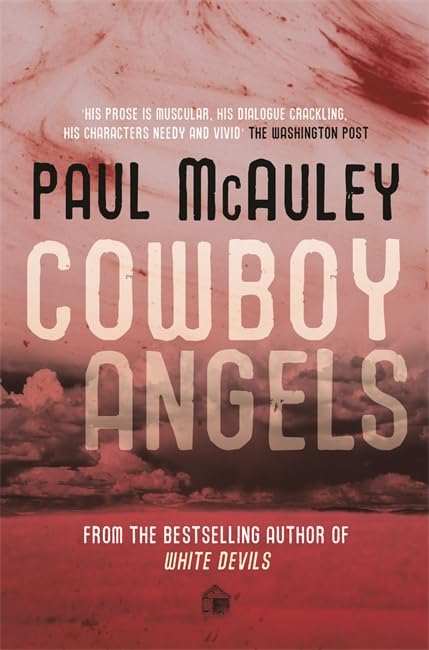
Cowboy Angels by Paul McAuley

Penguin, 2007. 390p

In a timeline known as the Real, machines called Turing Gates allow movement between different worlds. Adam Stone was once employed with The Company, a US government agency which carried out undercover operations in the other realities, here known as sheaves, to bring them into line with, and effectively subject to, the Real. The select band he was part of made up the Cowboy Angels of the title. Following the 1980 Presidential election a change of government leads to the abandonment of this policy in favour of a more cooperative approach to other sheaves.

A prologue chapter reveals tensions between some of the Cowboy Angels, and inside the Company generally, arising from this. The remainder of the book is set mainly in 1984, where, as well as the Turing Gates, the Real has technology akin to that of the twenty first century in our world, the likely equivalent to which in the book is known as the Nixon sheaf. For those who enjoy such speculaton there is also an American Bund sheaf and one where the US is communist.

Stone is working in an agricultural sheaf when he is called out of Company retirement as his old colleague Tom Waverly has been killing the various different sheaf versions (doppels) of a woman named Eileen Barrie and only Stone will be able to contact him.

Cowboy Angels starts off as an apparently gung-ho right wing tract but by the end of Part One the characters have begun to doubt the worth of interference in other sheaves and of the projection of power at the point of a gun. As a commentary on the invasion (in the reader’s world) of Iraq and the aftermath of that conflict this is pretty acute.

McAuley’s treatment of the Altered History scenario is explicitly Science Fictional as it involves a mechanism for movement between (and sometimes creation of) different sheaves. I liked the nod he made to previous authors who dealt with different worlds or realities by naming some minor characters variously Philip Kindred, Leinster and Laumer.

The unravelling of the plot leads to the revelation of a greater conspiracy within the Company and the efforts of Stone and Waverly to combat it, in the course of which a further SF McGuffin makes its appearance in the shape of a time key which alters the operation of the Gates.

As you might expect from the scenario there is plenty of violence dispersed through the book but the characters, especially Adam Stone, are rounded enough. However, there is perhaps too much over-complication of the plot and I found the resolution unsatisfactory.

I would, though, recommend this to anyone who wants their brain bent (a little) by the contemplation of paradoxes.

Mobius Dick by Andrew Crumey

Picador, 2004, 312p

This book was not marketed as Science Fiction but in any straightforward reading of the term would be so, as it is fiction about Science, specifically quantum mechanics and wave functions. Science Fiction as understood, though, is not generally thought of in this light but rather as extrapolative. However, Mobius Dick fits the bill in this sense also, as its background involves a set of experiments to produce a vacuum array which can generate energies in excess of 1000 Eka-electronvolts which could lead to wave functions not collapsing on being observed and the end of the world as we know it. Fear not if you know nothing about the behaviour of subatomic particles, the necessary details are lucidly set out by Crumey in the appropriate places. (Or did I just find it lucid because I had encountered most of these ideas already? Studied them, even, when a student.)

The narrative is multi-stranded, beginning with an enigmatic text message to a physicist, John Ringer, reminding him of a lost love. Another strand is set in a hospital where patients are being treated for Anomalous Memory Disorder, AMD, a condition in which they appear to have false memories. A third contains extracts from a book by a certain “Heinrich Behring” but which is copyrighted “the British Democratic Republic 1954” and which focuses on Erwin Schrödinger. An Altered History too, then.

It is, as well, a consciously literary endeavour featuring in addition to the above; Bettina von Arnim, the composer Schuman and a letter from an unsuccessful Herman Melville to Nathaniel Hawthorne. No surprise it’s not marketed as Science Fiction. The John Ringer sections are Ballardian in tone and when he ventures into rural Scotland also have a tint of the testament of Gideon Mack, which I reviewed recently.

Crumey never pushes the connections between the sections. We are left to ourselves to infer that AMD is a manifestation of superimposed quantum states and the many worlds of uncollapsed wave functions. The characters, on opening doors etc, by and large treat any incursions into or from other worlds as if they are hallucinations, which interpretation is also entirely adequate.

The afterword, also by “Heinrich Behring,” like the sections featuring Schrödinger and Schumann, is written from the perspective of a world where Goebbels replaced Hitler, Britain was invaded but after liberation became a socialist/communist state and neither Melville nor Thomas Mann achieved critical acclaim. “Behring” depicts Schrödinger – who never amounted to much in this altered history – finding his famous (in our world) equation HΨ = EΨ in the scribblings of a madwoman.

What makes Mobius Dick ineluctably Science Fiction (whether it is labelled as such or not) is this looking in at our world, where a woman can become Britain’s PM, an actor President of the US and the many worlds theory is taken seriously, and finding it absurd.

But to label the book at all is to do it an injustice. It hums with ideas and wit, and not a few literary puns.

I haven’t been so impressed by an author new to me for a long time.

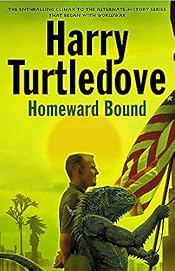
Homeward Bound by Harry Turtledove

Hodder and Stoughton, 2005, 597p.

This is really Colonisation:4. Many of the “characters”€ from the Colonisation series reappear here.

This is the book, though, where we finally get to see the Lizards’ original world, Home. A US starship, with the aid of cold sleep technology adapted from that of the Lizards’€™ has been sent there to try to negotiate a basis of equality with them.

There are some sly asides about the US Ambassador to Home, referred to solely as the Doctor, who can only be meant to be Henry Kissinger. Unfortunately he does not wake up from the cold sleep necessary for the transit so one of our previous Colonisation acquaintances is pitched into the ambassadorial role. Also a character named Nicole Nichols is surely a nod to the communications officer of the original Star Trek.

There was one typo I thought was brilliant. “€œBuildings gradually got farther and father apart.”

Homeward Bound is an effortless, light read. Turtledove’€™s narrative goes down smoothly, as it always does, but the characterisation is still weak and repetition of information and attitudes far too frequent. He leaves open the possibility of yet more sequels.

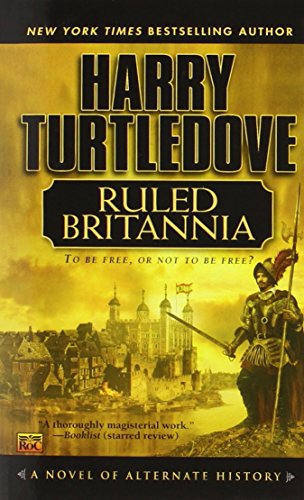
Ruled Britannia by Harry Turtledove

Roc, 2003, 560p

It’€™s a weakness, I know, but I can’t resist Altered History.

This one is set in a world where the Spanish Armada wasn’t scattered by Protestant winds but instead succeeded in deposing Elizabeth of England who is now languishing in the Tower of London.

Aside: The invasion did not go beyond the Scottish border. How likely that would have been given that at the time the Scots were, to Spanish eyes, even more heretical than the English, is questionable. While it does make the title appropriate as the Romans used the word Britannia to describe the parts of (Great) Britain they held, it is not Turtledove’s focus.

Our main narrator is none other than William Shakespeare – a brave move by Turtledove as any comparisons can only be invidious. Cue, though, lots of Shakespearian allusions said by, or mostly to, the character in the book. The narration is shared with one of the Spanish invaders, Félix Lope De Vega y Carpio – a historical figure, a playwright himself, in Spanish literature second only to Cervantes and of whom, to my shame, I had never previously heard – who in the book thus admires Shakespeare but is also an inveterate ladies’ man. Another agonist is, of course, Christopher Marlowe. Yet more references accrue. There are walk-on parts for Elizabeth, Robert Cecil, William Cecil and Francis Bacon. Throughout, there is ample opportunity to indulge in a series of Elizabethan and Spanish epithets, botchy core, mooncalf, louse of a lazar, callet, trull, cunning woman, maricón, bruja, puta and phrases such as aroint thee, etc.

The plot concerns the secret engagement of Shakespeare by Robert Cecil (Lord Burghley) into writing a play, Boudicca, set in a previous invaded Britannia, the performance of which is intended to ignite a revolt against the Spaniards when the time is ripe. At the same time he is commissioned by the conquerors to write King Philip, a play in praise of the ailing Spanish King.

During all the subsequent strutting and fretting (Turtledove’€™s got me at it now) some of the characters wax a bit too poetical, often long-windedly, which tends to break up what flow there is. An English law enforcer, Constable Strawberry, constantly mangles his words – even more than Mrs Malaprop – as in the character Dogberry from Much Ado About Nothing, an affectation that in Turtledove’s hands I found tiresome.

Things do speed up markedly, though, when the old King dies, the time comes for the play to be put on and the inevitable revolt begins. It may not be a coincidence that there is little opportunity for blank versification in this portion of the novel.

Ruled Britannia is not anything other than a read for entertainment. A passing, or indeed close, acquaintance with Shakespeare, Marlowe and De Vega’€™s works may heighten the experience but, overall, don’€™t look for insight such as you would find in even the most minor of their efforts.

After writing this review I found a rather good summation of the book, its faults and felicities at http://laughingmeme.org/2003/03/26/ruled-britannia/.

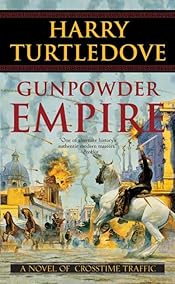
Gunpowder Empire by Harry Turtledove.

Tor, 2003

At this time of the year I’€™m knackered and not up to reading anything demanding. I wasn’€™t going to post about this one as I only read it to see how Turtledove dealt with a juvenile. However, I was amused to note that he gets rid of the parents by the end of chapter four. Classic children’€™s tale scenario.

It isn’€™t quite an Altered History story. The book’€™s young heroes are part of a culture that can travel to parallel worlds (known as Crosstime Traffic) to exchange trade goods slightly technologically advanced of those in the market world in return for grain which their own society processes into oil substitutes. They of course find themselves stranded in one of these worlds -€“ a heavily bureaucratised descendant of an altered Roman Empire -€“ and caught up in a siege. Turtledove is careful not to place them in too great danger, however.

In many ways Turtledove’€™s style is ideally suited to this sort of book as the prose is functional and undemanding but to my mind, even taking account of the target market, information is still repeated too often and his elaborations of the differences between the cultures are heavy handed. There was, though, a delightful explanation of the declension of nouns in Classical Latin plus a mention of the Ablative Absolute.

Though set in the late 21st century, the Crosstime Traffic culture appears not all that different from the present US -€“ it still has Home Depots and WalMarts, for example – with no hint of other countries in its world. Despite knowledge of resource depletion in its own timeline its attitude to the other worlds is merely exploitative – although the characters do think they’€™re lucky they haven’t yet met a parallel world more advanced than their own.

I hope Turtledove’€™s young readers aren’€™t superstitious. The book has thirteen chapters.

The Plot Against America by Philip Roth

Vintage, 2005

The Plot Against America cover

This is Roth’s Altered History, set in a 1940s America where Charles Lindbergh became President – apparently mainly as a result of taking to the air on the campaign trail in the Spirit of St Louis – then forged an understanding with Hitler and so kept the US out of World War 2. Given Roth’s lineage the book unsurprisingly deals with the implications of this outcome for America’s Jews, who are increasingly made to feel alien in their own land. As a result, the Roth trademarks from the other books of his that I have read (Portnoy’s Complaint and My Life As A Man,) viz masturbation, obsessive sexuality and male angst, are muted, if not absent.

The story is rendered more rooted than it might have been otherwise by the fact that our narrator is named Philip Roth. We are hence invited to believe that the family depicted is the author’s own from his youth, reimagined in the changed circumstances. This allows Roth the author, through the medium of Mr Roth the character, to express more forcibly the anger that any citizen must feel in being deprived arbitrarily of the benefits of citizenship.

Coming from a mainstream literary perspective Roth’s handling of this material is distinctive. A Science Fiction author would likely have approached the scenario from a completely different direction. And Roth does that rather annoying mainstream thing of giving us a potted biography of every character who happens to pop up whether we need this information or not. In this case it may be of everyone whom the actual young Roth met in the 1940s. There are also longueurs in the narrative which would be absent in a more plot driven Altered History.

At times, too, so much background is loaded into it that the novel reads more like a history book. Roth presumably believes that his setting is too far removed from the present day to be accessible without it. This approach culminates in the penultimate chapter where the book ceases to be a novel at all and instead descends into a – nevertheless thoroughly readable, Roth’s prose easily encompasses exposition – recitation of events and a farrago of ever wilder conspiracy theories all told by Philip at one remove, rather than experienced by him at first hand. The unlikely heroine of the piece (and this is not really a spoiler as there’s nothing there to spoil) turns out to be Mrs Lindbergh. That the impact of these events is brought home to Philip in the final chapter, through the medium of his fellow-travelling Aunt and some former neighbours, in no way remedies the egregiousness of this colossal info dump. Quite simply this is not the way to write a piece of fiction; high- or lowbrow.

It has to be said that not much in the way of jeopardy ever befalls the Roth family, most of it lies in Mr Roth’s mind. Yes, Mr Roth has to change his job to a poorer one; but there are no outrageous restrictions on civil liberties, no concentration camps – only the intermittent attentions of an inquisitive FBI man and a later series of riots spilling over into pogroms which don’t affect the Roth family directly.

Ultimately the book is really a long discourse on what it means to be American (that is, I feel obliged to say, being a citizen of the US rather than born in the continent in which that country lies) and the inclusiveness that entails. Here is where more of the doubts creep in. Whatever Lindbergh’s anti-Semitic views may have been – and Roth goes some way to exculpate his Lindbergh from them – a fascist takeover in the US would surely have had other, more obvious, targets for dehumanisation. In the end, perhaps because he is unwilling to believe the worst of his fellow countrymen or else as a sop to their sensibilities Roth rather lets the US off the hook. This, I note, is in stark contrast to what the English SF writer Keith Roberts did for the UK in his excellent short story of a Nazi-dominated Britain, Weihnachtsabend.

Is The Plot Against America a commentary on the recent Bush administration? On how easy it is for freedoms to be subverted; how the price of freedom is eternal vigilance? If so, it is rather too diffuse to be effective.

I was so, so disappointed in this book. Its central idea has the potential to be huge but in his tight focus on the family Roth the author renders it far too small. Mainstream literature sometimes prides itself on illustrating the universal by anatomising the particular. In this context choosing as the narrative voice a boy between the ages of 7 and 9 is too limiting. The themes simply cannot be dealt with adequately from the young Philip’s perspective.

Before reading this I would have contended that Altered History in and of itself is always a subset of Science Fiction. The Plot Against America, however, is not SF, since Roth, within his plot, falls too short, even implicitly – never mind explicitly – of contrasting his scenario with what actually happened, and the book is the poorer for it.

But after the novel finishes we are provided with postscripts on the actual lives of historical characters mentioned in the text. Part of the joy of reading Altered History is in recognising figures such as these in their new context; one of the drawbacks is you might miss a few in the passing. Roth’s end notes can only be there to bolster his fiction; to say, “Look at the research I did – or the prodigious memory I have.” Had the novel been written halfway adequately these notes would be superfluous.

free hit counter script