Archives » Altered History

Galileo’s Dream by Kim Stanley Robinson

Harper Voyager, 2009, 584p.

 Galileo's Dreamcover

I had been about to start this book when I received Robinson’s 2312 for review for Interzone. I don’t usually read books by the same author very close together so I slipped this one down the queue.

As the title suggests it features Galileo Galilei, who one day in early 17th century Venice encounters a strange man who informs him of the recent Dutch discovery of the magnifying power of two lenses fixed in a tube. Galileo soon improves the device markedly, sells it to the rulers of Venice and then, fatefully of course, turns his own towards the Moon and Jupiter.

It soon transpires that the stranger is from the far future, the 3020s, and is able to transport our hero forward in time where Galileo witnesses proof of his observation of the circulation of Jupiter’s four main moons. Here there is a plot involving human interference with sentiences in the oceans of Ganymede and Europa; and in Jupiter itself. Subsequent trips to the 3020s elaborate somewhat. Galileo’s memories of these trips are made hazy by an amnestic drug. There are strong indications that this is an altered history – or at least an alterable one as a faction among the Jovians wants Galileo to suffer martyrdom for the sake of Science. Indeed, Galileo is shown evidence of and experiences his own execution. However, the events in the end follow those in our timeline. Robinson follows modern interpretations of Galileo’s reputed remark, “Eppur si muove,” (“And yet it moves”) as being uttered well after his trial rather than directly on his recantation. There is also a nice touch when Robinson, paraphrasing Einstein, has Galileo refer to himself as “standing on the shoulders of dwarfs.”

The narrative voice is mostly third person, the tale apparently being told by Galileo’s assistant Cartophilus. Occasionally this opts for the first person plural and towards the end uses the singular I or me. Cartophilus is eventually revealed to be one of the long-lived Jovians though this is obvious to the reader very early on.

Despite the Science Fictional gloss the far future sequences are unconvincing while by contrast the scenes in Italy are absorbing and compelling. Galileo’s life and circumstances are admirably evoked as are the politics of the time. Those in the Jovian system come to seem a distraction from the real drama of the coming inquisitorial trial and the unfolding of Galileo’s life. Robinson has written an affecting and engrossing account of Galileo’s life. Perhaps, though, his publishers might not have accepted such a book from him without the tacked on Science Fiction elements.
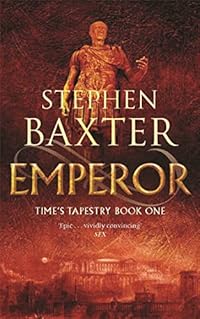
Emperor by Stephen Baxter

Time’s Tapestry Book One Gollancz, 2006, 302 p.

Emperor cover

In the prologue, set in pre-Roman Britain, a woman giving birth starts to speak in tongues. Handily there is someone on hand who has traded with Rome and not only understands the Latin phrases but can note down her words. These are later interpreted as a prophecy.

The main narrative is then structured round the descendants of those who attended the birth who pass the legend down the generations. The three main sections are set centuries apart; during the second Roman invasion of Britannia (Claudius’s undertaking,) Hadrian’s decision to build his wall between the Tyne and the Solway and Constantine’s visit to these islands. The families are moved to intervene at each of these critical junctures. One of the families interprets the prophecy as being the attempts of a Weaver of time pulling at the threads of its tapestry.

In the epilogue another birth is accompanied by a similar phenomenon but this time the words are in Saxon, so cueing Book Two.

I wasn’t quite sure whether to list Emperor under Altered History or not. Our history isn’t altered (of course a different history may have been) but there are discussions of the possibility of alteration. These discussions, while necessary for the overall arc of Baxter’s Time’s Tapestry sequence, seemed to me to be a bit too modern, jarring a little with the setting.

The style of the narrative unfortunately required a prodigious quantity of information dumping and historical description. Reading a novel is a relatively painless way to access history, though, and what I know of those times wasn’t contradicted by the narrative. There was also a strange mixture of British usages (shag and screw for example) and Americanisms (“fit” as a past tense.) Baxter also incorporates a mention of the iniquities both of wealth disparities and of excessive taxation, the first of which may be a relatively recent concern – in historical terms. The characterisation was sketchy, though adequate, but characterisation isn’t the main point in a book like this, the speculation is. Indeed at one juncture Baxter makes a defence of “imaginative” fiction in precisely these terms.

Emperor isn’t high literature but isn’t setting out to be. Enjoyable enough, though.

Harry Harrison

Another of the prominent Science Fiction writers of my youth and young adulthood, Harry Harrison, has died.

He was probably known best for his Stainless Steel Rat books and also for the stories of Bill, the Galactic Hero, whose title gives a flavour of Harrison’s sardonic wit. In these books Harrison played against the usual conventions of the SF action adventure.

Ouside the narrower SF world his most familiar work – via the film Soylent Green starring Charlton Heston – is probably the novel Make Room! Make Room!, one of the first to touch on overpopulation as an imminent problem. Harrison said the film, “at times bore a faint resemblance to the book.”

He was also one of the earliest purveyors of Altered History. His A Transatlantic Tunnel, Hurrah! was published in 1972, with his Eden trilogy, where dinosaurs never died out, following in the 1980s. The Stars and Stripes trilogy (1998- 2001) imagined a British intervention on the American continent during the American Civil War leading to war between a Reunited States and Britain. (The US won. Of course.)

He edited more than a few important SF anthologies with English SF author Brian Aldiss with whom he also helped introduce serious criticism to the genre.

Henry Maxwell (Harry) Harrison: 12/3/1925 – 15/8/2012. So it goes.

Halting State by Charles Stross

Orbit, 2010, 376p, plus author interview.

 Halting State cover

Since Christopher Priest’s bemoaning of the Clarke Award shortlist in which Halting State‘s sequel Rule 34 is included I bumped this up my reading list.

The usual caveat applies to this review. I did see an early version of the first chapter or so, back in the day. The author is a fellow member of the East Coast Writers’ Group and of Writers’ Bloc.

The setting is a near future independent Republic of Scotland in 2016 or so. A bank in an on-line game is robbed, despite the levels of encryption involved. A panicked employee of Hayek Associates (the Edinburgh company overseeing the game) calls the local police. This leads to the involvement of our first viewpoint character, Detective Sergeant Sue Smith. The other two narrators are Elaine Barnaby, an insurance fraud investigator, and Jack Reed, an IT specialist just sacked from his previous job and on a bender in Amsterdam. An unusual facet of the book is that all three strands are written in the second person – a notoriously difficult authorial trick to pull off. Here the conceit is mostly effective. It only falls down a few times and after a while becomes almost unnoticeable. (Sue Smith’s narrative voice jars, though, at the times when USian creeps in – Defence with an ‘s’, ‘out back’ for ‘out the back,’ ‘fit’ for ‘fitted’.) As the story proceeds layers of complication add in, as not all is what it seems, even in the real world.

The dangers of writing SF set in the near future are apparent even only four years after original publication (2008.) The banking-crash-induced recession and our present day austerity are entirely absent and the ubiquity of the location software, of driverless vehicles and so on feels a bit premature. Not to mention that a Scottish Republic is unlikely in the short term. However, if read as an Altered History (which will actually be necessary in five years’ time) these problems disappear.

Such technologies’ vulnerability to hacking/decryption is foregrounded, highlighting our growing dependence on such things. (I would add that they are equally vulnerable to a simple loss of electricity supply to servers etc.)

One of Christopher Priest’s complaints was that Stross uses ‘Och aye’ dialogue. On this ground I acquit him. The book is set in Scotland after all. Not being Scots born it is more than commendable that Stross makes the effort to convey local speech – he still lives in Edinburgh – even if sometimes his ear is not perfectly attuned. (Oh, and the word dreich doesnâ’t have a ‘t’ at the end.) He even has one of his narrators display the Edinburgher’s antipathy to all things Glaswegian.

The book is clearly aimed at a target audience of games players in addition to SF readers. Small portions consist of the MMORPG which was hacked into; these integrate well with the main thrust, as indeed does game playing. In this respect, pace Mr Priest, outright literary quality might be considered to be a drawback. Horses for courses. Halting State is not deep and not pretending to be, but I enjoyed it. Whether a ‘light’ novel like this deserves an award, though, is surely a matter of subjectivity.

Speculative Fiction Not SF Shocker

They give with one hand and take away with the other….

Also in Saturday’s guardian review was the first part of the Guardian Book Club feature on Robert Harris’s Fatherland, wherein John Mullan says “Speculative fiction” might once have been synonymous with SF but now more strictly refers to an alternative, but plausible, historical scenario.

More strictly? There is a definition of speculative fiction which excludes SF?

This seems to me to be a dismissal of the more explicitly SF altered histories. Is Mullan attempting to distance his preferred examples from what he sees as less worthy; or am I too sensitive?

Nevertheless I had to laugh when Mullan immediately wrote that a modern classic of speculative fiction is Philip Roth’s The Plot Against America. That book not only failed as a novel, it failed as an Altered History (for my review see here). Can a story where history is restored swiftly to the “right” path really be considered speculative? Is it not then an author’s ill-thought out musings, onanistic even?

I’ve not read Fatherland but from the description it seems to invest more into its scenario than Roth ever did in his.

In that extent Fatherland is SF, and Roth’s book isn’t.

Midnight In Paris

At the local “Art Cinema”, the Adam Smith Theatre. Whoopee! No round trip to Dunfermline just to see a film. (Still on tonight, 14/2/12, if anyone wants to go.)

This is a Woody Allen film and many of his tropes are present. The lead character, Gil, is typically Allenish with his verbal mannerisms, we have the fascination with the past (Zelig; Broadway Danny Rose) and an intrusion of the fantastic (Play It Again, Sam; Broadway Danny Rose.)

Gil is a writer on a trip to Paris with his fiancee and her awful parents; a moneyed couple, snobbish and intolerant, with no redeeming features. But none of these four are really sympathetic. There is a fine cameo by Michael Sheen as a friend of the fiancee, with just the right degree of irritating know-allness.

To escape this lot, Gil walks through Paris and gets lost. At midnight he is invited into an old car cruising the streets. He is taken to a party where he encounters Cole Porter, Scott and Zelda Fitzgerald and Ernest Hemingway. On subsequent nights he meets Gertrude Stein (Alice B Toklas has a small name check,) Pablo Picasso and his mistress, Salvador Dali, Louis Buňuel and Man Ray. Gil is delighted as he is fascinated by the 1920s, his perfect time. He is also much taken with Picasso’s mistress who thinks the Belle Époque was the best era to be alive.

If at times this all seemed a bit too overloaded it is the sort of stuff with which Allen can have a bit of fun, as when Gil suggests a film scenario to Buňuel.

Stein agrees to read Gil’s novel manuscript. At one point she describes it as Science Fiction (it is set in her future.) I was dubious at this usage and checked; the term apparently wasn’t in common use until 1929.

Gil is drawn more and more into the 1920s milieu and strolling with Picasso’s mistress one night they are invited into a horse-drawn cab and end up in the Belle Époque. Cue Toulouse Lautrec, Degas and Gauguin. Here Gil realises that no-one likes their own time and the past isn’t necessarily a better place.

But he determines to stay in (present day) Paris and chucks his girlfriend.

It was the fantastic element that I found most satisfying, the going into the past aspect is the sort of thing that makes Altered History (or Alternative/Alternate History if you must) so intriguing, but the present day characters were just so crass; apart from Carla Bruni as a tour guide and a female seller of old records Gil bumps into on a shopping trip.

This was minor Allen but entertaining enough, with quite a few laughs. I enjoyed it.

Music, in a Foreign Language by Andrew Crumey

Dedalus, 2004, 243p

 Music, in a Foreign Language cover

Not being a straightforward narrative, this is a difficult novel to describe. Tenses shift within sections, there are stories within stories, false starts, rewritten chapters, repetitions of scenarios and the narrator is at pains to point out the fictionality of it all, indeed at times it reads more as a disquisition on literary efforts than an attempt at one. Yet, for all these strictures, it was immensely readable.

The tricksiness begins early as the novel starts with Chapter 0, where the narrator is thinking post coital thoughts about two characters who meet on a train and about whom he intends to write a novel. The bulk of Music, in a Foreign Language deals with the back story of one of these, a young man called Duncan, and the events leading up to the death of his father, Robert Waters. Waters and his friend Charles King had at the time been involved in slightly subversive activity in a Soviet style post-war Britain. This was the first appearance of that altered history in which Crumey also set parts of Mobius Dick and Sputnik Caledonia. The compromises such a society demands, the paranoia it engenders – and the betrayals it necessitates – are allowed to emerge organically from the story. Despite the title, music as a motif appears sparingly.

My one minor caveat is that the female characters are not as fully rounded as they might be, but the book’s main focus is on the friendship between Waters and King, so perhaps that is understandable.

I was equally as impressed by this, Crumey’s debut novel, as I was by both others of his I have read. If you like well written, thoughtful – even playful – novels you could do worse than give Crumey a try.

In The Presence Of Mine Enemies by Harry Turtledove

New American Library, 2003, 454 p.

Germany won the Second World War and twenty years later a Third. In 2009, the US, like most of Europe, is a vassal state, paying reparations to avoid the panzers rolling out from their bases in US cities. The British Union of Fascists holds sway in a Britain also in thrall to Germany.

In Berlin, the Gimpel family lets its eldest daughter into a secret. They are Jews, and must keep their origins hidden, speaking of it only to those in their immediate circle. Meanwhile the old Führer, a character whose real world model is only thinly disguised by the name Kurt Haldweim, has died and the new one, Heinz Buckliger, starts to loosen the strings of dictatorship. This strand of the plot hinges on textual differences between the first and subsequent editions of Mein Kampf, a subject on which I have to take Turtledove on trust.

Parallels with our world are one of the delights of altered histories. Nice touches here are a stage production featuring the baddies Churchill and Stalin which is so awful that it’€™s a smash hit and a delegation from the Protectorate of Bohemia and Moravia, asking for autonomy for the region, being led by a grey-haired Czech playwright.

(Slight spoiler alert:-

The thousand year Reich (had it survived World War II) would no doubt have collapsed under its internal contradictions at some point long before a millennium had passed but perhaps not quite so quickly and easily as portrayed here. The parallel with the Soviet Union of our own world which Turtledove implicitly outlines by having the Gauleiter of Berlin face down SS tanks in front of his residence does not really hold. In the world of the novel there was no Cold War to sap and counter its ideology -€“ Japan is not presented as too great a rival to Germany – and hence any decay would likely have been much slower.)

This may be the story Turtledove always wanted to tell -€“ Jewishness has unsurprisingly featured prominently in his altered worlds and this is the ultimate scenario to deploy in order to explore it. I’€™m afraid his writing does not do this particular theme justice, though. It has his usual multiple viewpoints, but all are Jewish here. Other familiar traits are too prevalent; the tendency to reiterate characters’€™ thoughts or peccadilloes, to labour a point, and here he doesn’€™t so much foreshadow future events as telegraph them. Plus he is too kind to his viewpoint characters and the book’s Nazis are cardboard -€“ all the really evil deeds are in the novel’s past – which is a shame because this could have been a powerful indictment of man’s inhumanity to man.

The idea for In The Presence Of Mine Enemies worked much better at the short story length in which it first appeared in 1992.

Sputnik Caledonia by Andrew Crumey

Picador, 2008. 553 p.

In the first part of the novel a shy boy called Robbie Coyle is growing up in a village called Kenzie in 1960s Scotland with the ambition of going into space. Since his father is an ardent socialist and anti-American Robbie therefore wants to be a cosmonaut. A frequent attender at his local library, he devours knowledge about the Soviet Union and discovers that “Russian is a language where some letters are written back to front and others are completely made up.” Quotes such as this display Crumey’s excellent ability to inhabit the world of a pre-adolescent. As he matures he starts to hear a voice in his head. The section ends with that voice saying, “I guess we’re not in Kenzie any more.”

The story then flips into a scenario of a Soviet-style Britain where a young adult Robert Coyle has been recruited into a space project to reach, before the wicked capitalists do so, what is possibly a black hole travelling through the solar system. The secret “Installation” where Robert is in training is suitably grim, the illustrations of the many compromises people have to make in such a society convincing, though whether dissidents could flourish there is another question. Perhaps this exists in the same British Democratic Republic which featured in the author’s Mobius Dick.

This central section could be considered an Altered History novel where the Jonbar Hinge lies in whether or not a man named Deuchar died while trying to rescue twins from drowning many years before the time the action is set. Yet its juxtaposition with the preceding and following parts, set in the “real” world, argues against this. And Crumey’s treatment of his subject matter does not have the feel of SF. The Soviet section can be read to be implicitly a figment of Robbie’s imagination. The subtlety of the point of divergence also marks this out from SF treatments of Altered Worlds. While Crumey pushes credibility a little by having characters in the central section behave and speak, or have the same names as, those in the book-end segments he does certainly avoid the trap into which Philip Roth fell in The Plot Against America of restoring the altered world to normal by the end.

The coda, a (present day?) exploration of the situation of Robbie’s ageing parents and a young boy who meets a mysterious stranger on a mission (which he is unwilling to explain) provides counterpoint and a resolution of sorts.

Sputnik Caledonia is excellently written and engaging, with convincing characters, but not quite as full of verve as Mobius Dick. I will look out for more Crumey, though.

End Of The Beginning by Harry Turtledove

ROC, 2005. 519p

A Churchill reference for the title this time rather than a Roosevelt one but it remains the same Turtledove.

The inhabitants of Hawaii are still coming to terms with the Japanese occupation which occurred in Days Of Infamy. Food is scarce, much of Hawaii’€™s land is now given over to growing rice, but for the US POWs it is less than scarce; plus they are being worked to death. Despite the harassment by submarine of the supply shipping from their home islands – at one point Turtledove alludes to the US breaking of Japanese codes which makes this easier – the Japanese forces are confident of holding off any further US attempts to retake the islands. On all sides, Japanese, native Hawaiians and US citizens alike, there is a sense of marking time – or holding on – until the inevitable renewed US attack. Meanwhile in the US there is a steely determination to regain the islands.

The lack of jeopardy to the characters which seemed to pervade Days Of Infamy is more than made up for here. In retrospect that may have been because the former book was an exercise in setting up this one, characters needed to be in place. End Of The Beginning explores the earlier book’s ramifications, one of which is that the fate you always felt Turtledove had in store for Jane Armitage (which was not so much foreshadowed as put up in lights) indeed comes to pass.

The US onslaught, when it comes, is of course overwhelming. (Admiral Yamamoto’€™s knowledge – and fear – of US industrial might and Japan’€™s relative lack of preparedness to withstand it is discussed more than once.)

The naval battle scenes are reasonably convincing and seem to pass quickly. The treatment of the Japanese resistance on Oahu feels a bit perfunctory, though. We hear about it but don’€™t witness much of it.

SPOILER ALERT.
Turtledove is undoubtedly correct in not ignoring the Japanese enslavement of “comfort women.”€ Also reflecting the nineteen forties there is an element of misogyny – and maybe racism too – in the post-liberation treatment of the woman of Chinese origin who kept house in their brothel in Wahiawa. While two males suspected of being guilty of collaboration escape relatively freely, she does not.

Overall the book is curiously readable. Whether it was more familiarity with the characters and scenario or due to more incident it seemed to flow more freely than Days Of Infamy. But both books are marshmallow reading, very little thought is required.

free hit counter script