Archives » Interzone 277

The Book of Hidden Things by Francesco Dimitri

Titan Books, 2018, 384 p. Published in Interzone 277, Sep-Oct 2018.

 The Book of Hidden Things cover

Dimitri is an Italian fantasy author now living in London. This is his first novel in English but there is no awkwardness in the text to betray that circumstance. In fact he writes with more facility than many a published native speaker (for which he can be forgiven the few USianisms present.) The book’s setting, though, is deepest, darkest rural Italy, the Puglia region, a town called Casalfranco. Four friends, Tony, Fabio, Mauro and Art(uro) have a pact to meet up in their home town every year, kept to ever since they left school, despite mostly living elsewhere, abroad in one case. This year Art doesn’t turn up. The other three feel compelled to find out why.

Things are complicated by the fact that in their youth Art disappeared for a week (putting his friends under suspicion) and never gave a truly satisfactory explanation for his absence. Due to that legacy the Carabinieri aren’t interested in his latest disappearance and the three (musketeers?) are left to their own devices. Their investigation of Art’s home reveals an unsavoury aspect to his recent activities and, in his marijuana plantation, a likely source of conflict with the local mafia, the Sacra Corona Unita. The deeper into the web of Art’s life they delve the more they find his connections dangerous. For a dispensation, Art once cured a Corona chief’s granddaughter of leukaemia by mysterious means and in a previous conversation he raved about Hidden Things. He is also said to have been obsessed with a woman he called la Madama.

The bulk of the narrative is carried by first person, present tense sections narrated by one or other of the three and in which their present relationships and frustrations with their lives are revealed, with salient important incidents from the past drip-fed to the reader throughout the novel. Very little of this has the feel of fantasy and most of it reads more like a crime novel. In fact until Dimitri inserts his slice of the weird (and even afterwards to a great extent) The Book of Hidden Things felt as if it could easily have been a lost Iain Banks – without the M – novel written somewhere in the continuum between The Crow Road and Stonemouth. There is that same emphasis on home, and the gravitational pull of family and old friendships, not to mention one of our narrators’ fascination with a particular woman. Obviously some things are universal.

Up to now all might have served to illustrate the thought, “We think we are in control of our lives but we aren’t. Most of the time we don’t know what we’re doing.”

A start to resolution comes when they read the prologue to Art’s manuscript THE BOOK OF HIDDEN THINGS, a discourse about barriers and dry stone walls as boundaries.

Then, as before, the spanner in the works, Art returns, with a story about being drawn over the boundary into a world of hedonism, his rejection from it and desire to go back, which he accomplished. Even though Puglia lies under “a long-forgotten curse that makes change, any change, impossible,” his book delineates the connection of physical things and spirituality. Landscape is context, not backdrop. People have left the land, giving space for the hidden things to flourish. Chapels dedicated to all sorts of Saints litter the countryside. Junctions between the profane and the sacred, the seen and unseen, they mark the boundary between two different lands. He expresses his wish to take his friends across the barrier with him and the necessity of transgression to breach it. Not convinced (all the other world seems to boil down to is a promise of endless sex) the three swither over trying to stop him. And the Corona wants to use his abilities for their own purposes.

Dimitri’s book captures the claustrophobia of small town life, the brooding atmosphere of menace of a mafia ridden polity, the yearning for the lost possibilities of youth and the belated acceptance of adulthood. The possibility that Art may be mad, or at least delusional, is left open till the last word, which swings the pendulum firmly in one direction. Whether it contains enough of the fantasy element to satisfy the buffs is a matter of choice but The Book of Hidden Things is well-written, characterful and, in the end, humane. You could read it for those alone.

The following did not appear in the published review.
Pedant’s corner:- *ass for arse, ice tea for iced tea, awesome, faggot. Otherwise; “none of us were expecting” (none of us was expecting,) Lucius Apelius’ (Apelius’s.) “The first thing I notice are the books” (the first thing is the books,) Blu-Tack (Blu-Tak?) “there are a set number of pharmacies” (there is a set number,) “their chirping reaches a crescendo” (reaches a climax, the crescendo is the rise not its culmination,) “a bunch of teenagers burst into laughter” (a bunch of teenagers bursts into laughter,) “the tourist crowd find it oh-so- picturesque” (the tourist crowd finds it.) “Half of Casalfranco were my father’s students” (half was,) “‘the only structure I ever saw on that side were drystone walls’” (the only structure was,) the golden writing underneath assure the faithful (the writing assures the faithful.) “The couple seem happy” (the couple seems happy.)

Supercute Futures by Martin Millar

Piatkus, 2018, 232 p. Review first published in Interzone 277, Sep-Oct 2018.

Welcome to the realm of Mox and Mitsu, stars of the Supercute Show, the world’s most popular entertainment. Starting as teenage girls in a bedroom in London with only an iPhone and a collection of cuddly toys, using their own skills, software assistance and enhanced bodies – only thirty percent of their brains is still organic, about the only original body parts left – they have parlayed their following into the mammoth Supercute Enterprises, one of the world’s top nineteen conglomerates, with fingers in every pie (including weapons production) but particularly desalination. Their trade-marks are multi – but never clashing – colours, always having twelve centimetres of skin showing between their skirts/shorts and stockings (they are not unaware of older male followers) and Big Colour Super V-hair. Not color, note. Mox insists. Civilisation may be having a difficult time but it’s not yet ended. The Supercute Show can be accessed via what reads like “normal” television but also through Supercute space, in effect a virtual reality zone, a kaleidoscopic cyberspace, entry to which is mediated through purchases and brand enthusiasm.

The outside world is in the wake of an unspecified set of disasters alluded to but not described in the text. Large areas lie derelict and deserted at best, irradiated at worst, with government regulation of the C19 virtually non-existent and its members subject to fierce competition. “‘When you get to a certain size you can’t stop.’” Investors want growth. If you stand still you get swallowed up. Hence Mox and Mitsu are there to be shot at.

Enter Moe Bennie at Lark 3 Media with his offer to Supercute’s desalination rivals RK Enviro. He plans to exploit a flaw in Mox’s and Mitsu’s android Artificial Intelligence Forecast Unit, Aifu, to gain control of the company’s shares and consign Mox and Mitsu to oblivion. Literally. Members of the C19 deploy lethal force vigorously to protect their interests. Premises are guarded by “ag-scans” which detect hostile intent.

It does then seem a little odd that Millar puts into Bennie’s mouth the thought, “‘Most people don’t care about the super-rich. They’re struggling through life, worrying how they’re going to pay the rent while politicians tell them it’s time to make sacrifices. Meanwhile some guy on a yacht had just made 100 million with his AI investment software. The same day my first hedge fund reached ten billion, the government cut child benefit in half.’” The text offers no other trace of conscience on his part. Rather the opposite.

Not that Mox and Mitsu are innocent themselves. As things progress we learn more about how their success was achieved, how much potentially reputation damaging information they have suppressed. Their rise was in part propelled by confrontationalism, until their edge was blunted by the necessity to placate advertisers, their educational intent watered down so as not to baffle consumers unduly. Happy Little Science Pixie, anyone? In this, Millar’s dystopia is depressingly familiar.

Bennie’s strategy begins to succeed and the Supercute Show falls off air but he has reckoned without Mox and Mitsu’s determination and their devoted followers. Two of these, Amowie in Igboland and Raquel in South America, all but pre-teenagers, are the most engaging and (a little conveniently?) resourceful characters in the book.

The final confrontation – in shoot-em-up style – is enabled by a pair of time-limited Mox and Mitsu clones quickly computer-printed in a back-street laboratory.

The comparison to Vonnegut which is blazoned on the back cover is to my mind totally misplaced and does Millar no favours. There is a certain tonal similarity but in matters of execution Millar falls way behind, especially as regards information dumping. It is obtrusive enough elsewhere but it sometimes appears that the only purpose of a Mox and Mitsu conversation is so that a piece of background can follow immediately. Plus no matter how true it is I don’t recall a Vonnegut protagonist ever displaying cynicism of the order of, “‘As for confidence. If you don’t have enough you can fake it…. tell the world it’s lucky to have you … after you’ve faked it for a while, you’ll start to believe it.’” He was more for the underdog.

Supercute Futures isn’t pretending to be high art nor is it a rigorous exposure of corporate (lack of) ethics. It’s a bit too broad brush for that and its intention different. But if you don’t take it too seriously, it’s a pleasant enough ride.

The following did not appear in the published review.

Pedant’s corner:- (I stopped counting the number of times a corporate entity in this book was granted a plural verb form; such an organisation is a singular concern.) Otherwise; a missing end quote mark, desalinisation (innumerable instances, the word is desalination,) “Mox and Mitsu’s” (strictly Mox’s and Mitsu’s but they are frequently treated as a single unit linguistically here,) “Ms Mason’s” (Ms Mason,) neeed (need,) fender (civilisation hasn’t ended, remember: it’s bumper,) “‘his board aren’t going to abandon the deal’” (his board isn’t,) “‘I have to go to’” (I have to go.) “Neither were squeamish” (neither was squeamish.) “Soot in the stratosphere had severely damaged the ozone layer.” (I doubt it would. In addition the text following that sentence gives the impression the ozone layer prevents Earth overheating. It doesn’t, it blocks ultra-violet, not infra-red radiation,) “turbulence in the ionosphere affects satellite communications” (really?) “said one of the policeman” (policemen,) “in the celling” (ceiling,) anesthetised (anaesthetised, or better still anæsthetised.) “Once Ishikawa had lowered their radiation to manageable levels” (that’s some jump in medical technology to be able to do that.)

Interzone 277

Sep-Oct, 2018. TTA Press

In her guest editorial Aliya Whiteley wonders who owns a story as influences can colour story telling as if by osmosis. Andy Hedgecock’s Future Interrupted notes a new approach to doorbell ringing by those under 25 in his consideration of the changes wrought by the internet and the false sense of agency fostered by advertisers and data brokers. Nina Allan’s last Time Pieces muses on what a difference four years can make, in politics, in Doctor Who, in the inclusiveness of SF as a whole. In Book Zonea Duncan Lawie welcomes the wide perspective in the anthology Twelve Tomorrows edited by Wade Roush, Ian Sales appreciates Hannu Rajaniemi’s latest novel Summerland despite its lack of SF bells and whistles but is slightly more critical of Liminal by Bee Lewis, I wax lyrical over Francesco Dimitri’s The Book of Hidden Things but less so with Supercute Futures by Martin Millar, John Howard approves of the anthology Infinity’s End edited by Jonathan Strahan, Andy Hedgecock describes Literature® by Guillermo Stitch as a promising debut and Julie C Day’s first collection Uncommon Miracles (can there be common miracles?) as not merely promising but astonishing while Stephen Theaker enjoyed Pasi Ilmari Jääskeläinen’s Secret Passages in a Hillside Town.

In the fiction:-
Inscribed on Dark Waters by Gregor Hartmann has a student on a work experience programme on an ocean world at a factory producing liquid hydrocarbons biochemically being befriended by an inspector who has her own agenda. The student has an idea to improve the processing.
The Sea-Maker of Diarmid Bay1 by Shauna O’Meara is another sea-based tale. Four boys on a fishing expedition on a global-warmed, polluted planet come across a mythical creature, a sea-maker.
The narrator of Joanna Berry’s The Analogue of Empathy2 is a robot, a Cognitive Intelligence Personhood Emulating Robot to be precise. Doctor Harris is developing its – her – consciousness in an attempt to save humanity from itself. Since its structure, form and feel so closely resemble Daniel Keyes’s Flowers for Algernon I would be amazed if this story did not take its inspiration from that source.
Territory: Blank3 by Aliya Whiteley is a journal based story but the entries are presented to us out of order. Narrator Saffron enters one of the domes; simulated environments designed as entertainment for the masses. Either she goes mad or the domes generate inimical entities by themselves. The third explanation – that Saffron is the experimental subject – is vitiated by the manner of her second dome excursion.
Samantha Murray’s Singles’ Day4 – Singles’ Day is like Black Friday but only for the partnerless – is a multi-viewpoint tale of four winners of a Singles’ Day lottery (via Smile to Pay) for passage aboard a starship intended to travel through The Rift to the planet of Zorya to escape an overcrowded Earth. The story does not need the info-dump of its preamble.

Pedant’s corner:- aStokes’ (Stokes’s,) one book title is given as Infintiy’s End (the book’s cover has Infinity’s End,) Watts’ (Watts’s,) Dickens’ (Dickens’s,) “reflections on these parallel projects show remind us” (either show or remind, not both.)
1a missing comma before a piece of direct speech, vortexes (vortices,) miniscule (minuscule.) 2Harris’ (Harris’s,) terphthalate (terephthalate,) chassis’ (chassis’s.) 3“Each has their own way” (Each has its own way,) maw (it’s a stomach! Not a mouth.) 4“to not live,” “to not be,” (not to live, not to be,) “there were even a couple of birds” (there was even a couple,) fit (fitted.) “The latest crop were blooming” (the latest crop was blooming,) wracked with pain” (racked.) “The team of seven photographers were” (the team was.)

Interzone 277, To Be Read

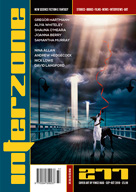
Interzone 277 cover

The latest issue of Interzone, 277, arrived last week.

As well as the usual fictional goodies and commentary on SF this one contains two of my reviews.

The Book of Hidden Things by Francesco Dimitri and Supercute Futures by Martin Millar.

More for Interzone

Another book for me to review for Interzone arrived today.

It is called Supercute Futures and was written by Martin Millar – born in Scotland but now living in London – and is said to be “a gloriously warped dystopian fantasy.”

The review ought to appear in Interzone 277.

I’ll need to get on to it straight away.

free hit counter script