The American Civil War

A film by Ken Burns. 1989 (remastered 2002.)

The titles on the actual films of course say just The Civil War. Still if they’ll forgive us our parochialism we’ll forgive them theirs.

In any case, the series is nothing short of exemplary. It is a magnificent blend of eye witness account, anecdote, written and printed sources, photographs, paintings, panoramas and music; all of which complement each other and add up to more than their sum. The haunting theme tune, Ashokan Farewell, – a relatively recent composition, though resolutely in keeping with the subject nevertheless, and which resounds throughout the series – is an inspired choice.

While not neglecting the battles – how could it? – it does not dissect them with a military historian’s scalpel. Its preferred use is of individual testaments from soldiers and civilians on both sides – including that of slaves – which grounds it superbly. It never loses sight of the human cost of the USA’s national tragedy, an understanding of which is probably essential to any understanding of that country. One of its consultants, Barbara Fields, makes the point in the last episode that the Civil War is still ongoing, not just in the US but anywhere where injustice and lack of freedom persist.

While watching it I was trying to think if anything in our national narrative approaches this conflict. In social effects, along with its attendant trail of corpses, graves and memorials, the grinding sense of endlessness, the hope for a higher purpose, the nearest would be World War 1. But even that, in its worst battles, did not achieve the casualty rates of the war between the States, which were horrendous and way, way beyond what any western army or its public at home could tolerate now.

The star of the films is undoubtedly Shelby Foote whose knowledge of the Civil War seems to be close to encyclopædic. In the eleven or so total hours he appears most frequently; always with telling anecdotes. In one, he describes waving Nathan Bedford Forrest’s sword above his head; about which his delight was obvious. He then relates giving that general’s granddaughter his opinion that Forrest had, along with Lincoln, been one of the two genuine geniuses of the war. There was a long pause before she replied to him, “We didn’t think much of Mr Lincoln in our family.”

His ability to inhabit the mindset of both sides is superb as are his analytical skills. Towards the end he says of Americans as a whole (I paraphrase a bit but this is the gist,) “We like to think of ourselves as a superior people. If we were a superior people we wouldn’t have fought that war. But since we did then it has to be the greatest war and our generals the greatest generals. It’s very American to think like that.”

Speaking strictly as a non-American I still say The American Civil War is probably the greatest war documentary you’ll ever see.

The Great War Generals on the Western Front by Robin Neillands

Robinson, 1999, 557 p (including ii p Contents and List of Maps, iv p Acknowledgements and Dedication, 19 p Index, 4 p Select Bibliography,) plus 8 p Photographs.
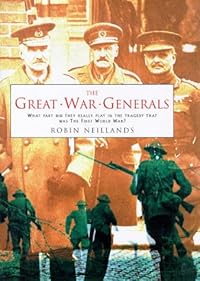
 The Great War Generals on the Western Front cover

The common perception of British generalship in the Great War – as put forth in many depictions of the conflict from at least Oh, What a Lovely War! through “lions led by donkeys” to Blackadder Goes Fourth and beyond – is of cavalry officers with little knowledge of infantry tactics in charge, of widespread incompetence and callousness, of throwing men rather than competence at the enemy, of safely staying well behind the lines. In this book Neillands sets out the evidence for and against these assertions and as a result comes down in favour of the generals. In many respects for me he was pushing against an open door. It has always struck me that if the British generals were so incompetent and useless how come we didn’t lose the war? Add to that the fact that the British (and Empire) force was the only major Allied combatant (setting aside the short – but still bloody – sojourn of the US Expeditionary forces) that did not suffer a large mutiny or rout and the questions ought to be why, if their leaders were so useless, were British soldiers so steadfast? Why were they so willing to follow orders – and keep doing so?

Despite its all-encompassing sub-title the book is chiefly focused on the British generals on the Western Front, though French and German generals are of course dealt with as necessary. Overall, however, it is more of a complete history of the British sectors of the Western Front rather than a summary of the doings of the generals who directed the efforts there.

Neillands states that it is only British generals that have been subjected to such criticisms as a group. No such opprobrium has been heaped on the French or German generals as a whole despite similar propensities to life squandering, particularly the Germans at Langemarck and the French in Nivelle’s offensive. Plus there’s always Verdun.

For all sides this was a new kind of war (though slightly prefigured by aspects of the American Civil War and the Russo-Japanese War.) None of the European agonists had been subjected to industrial war of this kind before, though in terms of numbers the French and Germans were prepared for it, the latter also in terms of artillery. All expected a war of movement – and a quick resolution. As it was the trench system came about by accident; in the attempts of both sides to outflank each other in the “Race to the Sea.” And throughout defence held the upper hand.

Like all British armies at the start of a war the BEF was inadequate to the coming task in numbers and equipment; lacking in machine guns and especially artillery. Its astonishing proficiency in rifle fire could not make up for this. It would take time – years – to provide enough artillery ammunition, to recruit, to equip and to train not only the soldiers but also the staff officers necessary for the army to function efficiently (and of these the staff officers take much longer to train.) Until that came about the generals, like the soldiers, had to do the best with what they had, and to learn the techniques and tactics required to succeed. Plus they were fighting Germans; dogged professional soldiers who never gave in easily, the best army in the field – certainly until the end of 1916 (when the British perhaps took over the mantle.)

Among other beliefs Neillands describes as myths is that all British troops on the first day of the Battle of the Somme moved forward in line and at walking pace. There was in fact a large variation in tactics, the generals on the ground being largely responsible for their own formations’ procedures. The sentence attributed to Lieutenant-General Kiggell, after Passchendaele, “Good God, did we really send men to fight in that?” has no provenance and is likely to be apocryphal. Neillands finds it incredible that any general faced with all the reports from the front, aerial photos, requisitions etc could have been unaware of the conditions. Quite why Third Ypres was nevertheless persisted with is a question harder to avoid.

Some criticisms are easily dispatched. Much fewer than half of the British generals were originally from cavalry regiments while an average of one general a week was lost to enemy action, hardly indicative of distance from the front. They were not hidebound tactically but learned from earlier reverses. However, in response to British innovations in attack the Germans continually adopted new defensive tactics and provided new problems to solve.

Neillands contends that the difficulties of prosecuting such a war have not been sufficiently acknowledged by the critics. The generals were from the outset instructed by the British Government to co-operate closely with their French allies. This in many respects tied the hands of both British Commanders-in-Chief, Sir John French and Sir Douglas Haig. Sometimes this necessary support, as at Loos, led to attacks the British generals did not favour. At the Somme and Third Ypres the necessity to divert German resources to relieve pressure on the French (from Verdun and the consequences of the French mutiny respectively) more or less demanded action.

The static nature of the trench system, the opportunities it gave the Germans to develop defence in depth (from Second Ypres in 1914 till their spring offensive in 1918 the Germans did not launch a major attack on the British Army anywhere along the line,) was a large factor in preventing a breakthrough. Allenby was not a notable success on the Western Front but in a war of movement in Palestine was able to show his capabilities more readily.

The main problem affecting the war’s conduct, though, was communications; which could not be relied on. Amid the smoke of battle, lines of sight were obscured; wireless technology was neither robust nor portable; telephone lines – even buried metres deep – were prone to severance by shellfire; carrier pigeons inadequate. The problem was never properly solved even by the war’s end.

Nor are any alternative strategies entirely obvious. Short of abandoning the war (so allowing Germany to keep its gains) – a course which the Allied Governments never contemplated – there was little option but to carry on.

Another factor affecting the generals was that Prime Minister Lloyd George never trusted them, Haig in particular. Neillands holds Lloyd George partly responsible for the British being forced to retreat by the German “Michael” offensive of March 1918 as he had held troops back in Britain rather than reinforcing the front. The overwhelming force of their initial attack would have caused problems in any case but even in its unstrengthened form the army, though it retreated, nevertheless did not break; the Germans were held.

In passing Neillands decries the “Pommie bashing” of latter day Australian and Canadian historians who variously claim the British “establishment” was biased against their own commanders and treated colonial troops as cannon fodder. While acknowledging the quality of these troops and the abilities of the Canadian General Currie and the Australian General Monash in particular, he shows most British divisions – and not a few generals – were equally effective.

Some criticisms are harder to defray. Typically there was a failure to exploit initial success quickly (in the case of Cambrai a disbelief in the extent of that success and a lack of preparedness for it) and an all too prevalent tendency to keep bashing away when an attack slowed down, in the belief that the Germans were weakening and “one more push” would prevail.

Yet the final victories – and they were victories, the Hindenburg line was breached, the British Army ended up as far advanced from the trench lines as Mons (where its participation in the war had started) – are not given nearly as much attention as the earlier “failures”. That is an indictment of those who give more weight to the generals’ shortcomings than to the achievements of the men under their direction. It was the war, and its continuation, plus the inability of the technology of attack to overcome that of defence that was the problem.

This is a book that, while not ignoring their faults, attests to the good faith of the British generals of the Great War, men doing their best amidst adverse circumstances.

Pedant’s corner:- “Field Marshal Sir William, Robertson’s father” (no comma,) “Seventy-eight British generals were lost their lives” (no “were”,) “led to the way it in which it was conducted (the way in which,) “over 9, 000,000” (there were frequent occurrences in the text of this extraneous space when a large number was cited and the practice wasn’t consistent,) a missing comma before a quote (x 5,) mache timetables (march timetables?) “we have go back” (have to go back,) “the infantry were mustered” (was mustered,) “Lieutenant-General Sir, Henry Grierson” (no comma,) “including the German and Soviet armies” (Soviet armies? Pre-1917?) ulster (Ulster,) “The force of France were already in trouble” (forces,) “and and” (only one required,) “in orders to denigrate” (in order,) “Readers are invited to look again at the message French sent to Smith-Dorrien again” (only one “again” needed,) “the true state of affairs were brought to the attention” (was brought,) General Franchet d’ Espery (d’Espery, x2,) “gave Haig time assess the situation” (to assess,) “just how grievously the Haig’s command had suffered (no “the”,) “the artillery … were…. their stocks of ammunition” (was…. its stocks,) Bellewaarde (Bellewaerde?) “the BEF were now set upon” (was set upon,) “smoke screen screen” (only one “screen” required,) to cut of the wire (off,) earlier in his book (this book,) any battalions fire plan (battalion’s,) “might wander of their axis” (off,) “that the Rawlinson’s attack” (no “the”,) a missing comma. “This family were not wealthy” (His family was not wealthy,) a missing full stop x 5, XV Corps’ (Corps’s,) with with (only on “with” needed,) “and the defences the Germans were building…… was like nothing seen before” (were like nothing seen before,) “four-battalions-to-a-brigade. Dominion division” (“four-battalions-to-a-brigade Dominion division”,) “the bombardment rose to a crescendo” (a crescendo is the rise, not its climax,) “First Army were …. Third Army were …. Fifth Army were …. (in each case “was”,) “to be launched to on” (no “to”,) “force their forces along the coast, either to withdraw eastwards” (no comma.) “Zero hour for was set” (Zero hour was set for.) “Given his a well-earned reputation” (no “a”,) “three years earlier. Currie had been” (no full stop,) Lieutenant General Sir Kavanagh (Lieutenant General Sir Charles Kavanagh.) “The cavalry were to be commanded” (was to be,) “Tuesday 20, November” (no comma,) Hidenburg Line (Hindenburg, elsewhere correct,) the Middlesex Regoment (Regiment,) General Cardona (Cadorna,) “the main theatre in this war the Western Front” (war was the Western Front,) “that the he had always wanted” (that he had,) “the enemy were preparing an attack” (was,) narrow-gange track (gauge,) “the German armies in west” (in the west,) “for the politicians understand” (politicians to understand,) the United State (States,) “to wait and attack, again in 1919” (no comma.) “This is not the say” (not to say,) Austrain (Austrian.) “The learning curve …. and only starting to rise” (started,) “against the Bolshevik” (Bolsheviks,) “he was named. Presidential Chief of Staff” (no full stop.)

The Anglo-Boer Wars by Michael Barthorp

The British and the Afrikaners 1815-1902. Blandford Press, 1988. 176p

Boer

After coming across two memorials to the “South African War” on my recent trip down south (see two of my five previous posts) I decided to read this book at long last.

While purporting to be a complete guide to the Anglo-Boer disagreements of the nineteenth century, which mainly focused on the differing attitudes of Boers and British to the rights of the majority population of the Cape, Barthorp merely sketches the early history and does not devote much space to the First Boer War – for a good account of which see the book of that title by Joseph Lehmann – and concentrates mainly on the military aspects of the Second rather than the political (which is explored more fully in Thomas Pakenham’€™s The Boer War.)

Both of the conflicts were characterised on the British side by the usual early lack of troops, muddle, disorganisation and, typical of the colonial era, underestimation of the enemy. In both wars the courage of the rank and file British soldier was never in doubt while the Boers were always adept. The political will at Westminster to carry on in the first war was lacking and so peace – with independence for the Transvaal and Orange Free State – came quickly.

Due to the influence of Cecil Rhodes and Sir Alfred Milner the same was no longer true in 1899 and the second war was prolonged. After initial reverses the British began to prevail when Lord Roberts – not long from his triumphant march from Kabul to Kandahar (some areas of conflict never change) – took overall command. Eventually the greater weight of British numbers and materièl as well as increased ability to deal with their more mobile enemy pushed the Boers into avoiding set piece confrontations and to rely on guerilla warfare – at which they were particularly effective. Even Kitchener’€™s blockhouse system failed to contain them.

In this context Barthorp mentions the collection of Boer non-combatants into camps and the subsequent toll of disease and death but does not see this as a great influence on the morale or effectiveness of the Boer commandos, though it was a propaganda calamity for Britain. He notes the eerie similarity of the battles of Majuba and Spion Kop in the two wars – both eminently avoidable battles for the British and both bloody defeats. He also gives General Buller more credit than I have seen him afforded elsewhere.

The book has occasional maps but a few more would have made certain of the troop movements clearer than the text manages.

Like some Boers a few British officers fought in both conflicts. Many of those engaged in the second war (French, Rawlinson, Gough, Ian Hamilton, Smith-Dorrien, Allenby, Mahon, Haig) and one of the Boers (Smuts) went on to have prominent roles in World War 1, though perhaps failing to learn fully the lessons of the up-to-date weaponry employed. A photograph of the British dead in the enfiladed trench at Spion Kop is reminiscent of one of the sunken road at Antietam in the American Civil War. 21,000 of the 450,000 Empire troops who were engaged overall died (62% from disease.) This explains the war memorials. There were 52,000 other casualties. Estimated Boer troop numbers vary from a curiously precise 87,365 to a rounder 65,000, with some 4,000 dead. An additional 20,000 Boers incarcerated in the camps also died.

While gaining independence in 1881 and then losing it in 1902 the Boers could curiously be said to have won in the second case also since in 1910, a scant eight years after the treaty of Vereeniging which ended the Second War of Independence, as the Boers called it, the Union of South Africa (including not only the Transvaal and the Orange Free State but also the erstwhile British dominated Cape Colony and Natal) was granted full independence within the Empire. The Boers swiftly came to dominate it and in 1948 completed the process by leaving the Commonwealth.

Barthorp notes a final irony. That while the Boers’€™ attitudes remained unchanged those in Britain who were most against fighting them in the nineteenth century had political heirs who were most forward in condemning the Republic’€™s policies regarding the black population in the latter twentieth century. (The book was published before the release of Nelson Mandela and majority rule.) He fails to point out the corollary, though. Those in favour of fighting the wars had political heirs who were against any interference with, or even criticism of, the apartheid state.

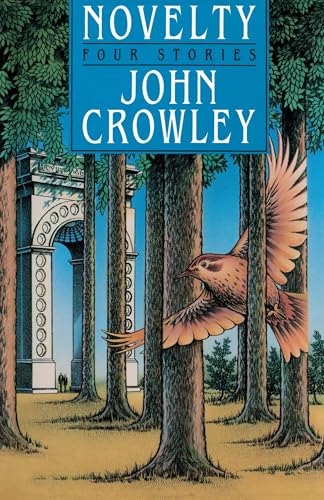
Novelty by John Crowley

Doubleday, 1989, 235 p.

This is a collection of four pieces of Crowley’s shorter fiction.

The Nightingale Sings at Night is a fable outlining a creation myth garnished with a touch of Just So story. It tells how Boy and Girl (later to become Man and Woman) were the first to name things in the world made by Dame Kind in times when the Moon could talk, and did so slyly. And it tells us why the nightingale, who only ever had this one idea, came to sing only at night.

As its title might suggest, Great Work of Time is a tale of time travel, hinging on whether – or not – Cecil Rhodes was assassinated at his house Groote Schuur, in 1893. A society calling itself the Otherhood was set up after a provision in his will in order to preserve the Empire to which he was so attached. The story starts with Caspar Last in 1983 inventing a method of time travel which involves what our narrator (as in Heinlein’s “‘-All You Zombies-‘” despite superficial appearances, there is really only one) calls orthogonal logic – past and present do not lie before and behind the present but at right angles to it. Yet this story could start anywhere – or anywhen – and is mainly concerned with the life of Denys Winterset, the President pro tem of the Otherhood (all its presidents are pro tem) who is contacted in Khartoum on a journey north on the Cape to Cairo railway, enticed into the Otherhood and given the job of assassinating Rhodes. In the Otherhood’s timeline the Empire was prolonged, the Great War wasn’t so great since it ended in 1915 with the Treaty of Monaco and as a consequence the Holocaust never happened. The story roams hither and thither across the Empire’s history including to time’s end in a forest in the sea. The writing here is wonderful and Crowley’s altered worlds are enticing.

In Blue is a story set, post Revolution, in a kind of eutopia based on coincidence magnitude calculations and the act-field theory (which predicts the occurrence, within any given parameters of the field, of coincidences of a certain magnitude.) Whatever you do, whatever comes about in the whole act field, is by definition what act-field theory predicts. All possible disproofs were themselves provable parts of act-field theory as was everything else. Our protagonist, Hare, meets a woman who thinks there is no such thing as act-field theory but that as long as everybody else believes in it, then it does work. A beautiful expression of the type of double-think which exists in authoritarian societies.

Novelty relates the struggle of a writer to come to terms with his theme, the contrary pull people feel between Novelty and Security

Pedant’s corner:- “A theatrical costumer” (costumier,) “the place where the Nile had its origin” (the text implies this origin is the Victoria Falls, which are on the Zambezi, not the Nile,) railroad (I know it was written by a USian and for a USian publication but Brits don’t use that word. It’s a railway. Similarly we had ‘drapes’ for ‘curtains’,) the American civil war” (it’s a proper noun so, American Civil War,) “the year of grace IV Elizabeth II” (I’m not sure why that ‘IV’ is there – unless it’s to denote the fourth year of the reign,) “I apologise for the hugger-mugger” (hugger-mugger is used here in the sense of secrecy, clandestine, not the usual one of close-packed, disorderly confusion,) question marks omitted from three pieces of direct speech which were questions, “the probability of any two snowflakes’ being exactly alike” (that apostrophe after snowflakes is surely not needed.)

Napoleon’s Last Campaign in Germany – 1813 by F Loraine Petrie

Arms and Armour Press, 1977, 406 p, including Index, plus iii p Introduction by David G Chandler, iv p Author’s Preface, four sheets of Maps and Plans, iv p Contents. First published 1912.

 Napoleon’s Last Campaign in Germany cover

The Author’s Preface notes the Napoleonic Wars as an evolution, the time of change from war as involving only the clash of armies to something which involved whole nations instead.

The main body of the book follows the course of the campaign of 1813 from Napoloeon’s initial invasion to its culmination at Liepzig, the largest engagement of the Napoleonic Wars, with a brief description of the minor battle at Hanau in its aftermath. The essence of the tale is that the Russian adventure in 1812 had severely weakened Napoleon (not least in a deficit of cavalry in comparison with before, but also with many new recruits to be assimilated into his armies) if not his personal reputation as a master of war. His aura was still such that during the armistice in mid-1813 the Allies formed a pact not to engage separately the army of which the Emperor was directly in charge unless and until they had united and had a large superiority in numbers. This stricture did not apply to his Marshals who according to Petrie were very well-versed in tactical matters but a failure to train them in strategical considerations meant they were lacking at crucial junctures.

The decline in Napoleon’s abilities from his glory years is illustrated by contrasting his switherings in this campaign with his decisiveness at Jena seven years earlier. There was a fatal conflict of Napoleon’s priorities as Emperor, and dominator of Germany, compared with his military objectives. Here he tended to try to protect the land he held, specifically the city of Dresden, over his previous focus on destroying his enemies’ armies in the field. Petrie also quotes the man himself as saying experience in war does not count for much, that he thought himself as insightful in his youthful campaigns in Italy as he ever was later. His early battles were of course smaller affairs over which he could exercise a large degree of control. Noitwithstanding the fact that armies in 1813 were much more densely concentrated than in later times, by the time of Liepzig this sort of close oversight was perhaps beyond any one person.

It amused me when at one point Petrie wrote, “These extensive expeditions of considerable bodies of cavalry in the French rear are a peculiarity of this campaign which is the only instance of their employment on a large scale in a European War. Similar raids played a considerable part in the American Civil War of fifty years ago. In this case, as in 1813, the raids were generally carried out in a country the inhabitants of which were often sympathisers with the raiders, to whom they supplied food, forage, and information. Moreover, there were few or none of the modern facilities for sending information to the other side. It seems more than doubtful what success such raids could hope for in these days of telegraphs in Europe. (My emphasis.) Petrie notes a like raid by Petrushenko in the then recent Russo-Japanese War which, “can hardly be deemed a great success, and it was only possible to carry it out at all owing to the route being taken through an area devoid of telegraphs.” The thought of such wires being cut in the furtherance of raiding activities does not seem to have occurred to him. And didn’t the Boers in the also recent South African War in effect also use tactics like this? Of course the presence of technologies such as the telegraph, telephone, and radio, did not negate the opportunity for operations behind the lines in later wars.

The language of the text can be a little precious. Petrie uses unnecessary formulations such as “We left Oudinot, at 11 am,” “We now return to Ney,” etc, and there is the usual alphanumeric soup of divisions and Roman-numeralled corps. The four sheets of maps (seventeen diagrams in total) are more or less useless not only since they require awkward folding out but also because they are affixed to pages towards the end of the book, nowhere near the parts of the text they are meant to illuminate. Their appearance is also too cluttered.

Pedant’s corner:- “This broke down one” (broke down once,) England (The United Kingdom,) “6 per cent. on the then population” (of the then,) throu (through,) Friederichs’ (Friederichs’s,) many ionstances of names ending in s being treated this way – Dolffs’ (Dolffs’s,) Reuss’ (Reuss’s,) even one where the final s is not sounded and the possessive therefore positively demands “s’s” – a missing full stop, “unable note Bulöw’s advance” (unable to note,) Probetheida (Probstheida,) “came to nought” (nought = the number zero, ‘came to naught,’)|Naumburg (elsewhere Naumberg.)

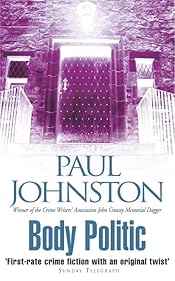
Body Politic by Paul Johnston

NEL, 2003, 349 p

The Body Politic cover

The first publication of this novel was in 1997 when the date in which it is set, 2020, was a considerable time away. That makes it read a bit oddly in 2016.

Edinburgh – like many other parts of the UK – is independent, home to a never-ending tourist drawing festival, from which the city derives most of its income. It is run by the Enlightenment Council of City Guardians, which comes across as a sort of muted cross between a local Council, the Committee of Public Safety and a Kirk Session. The city’s citizens lead a circumscribed existence, unruly beards are obligatory, television, private cars and crime are banned, as is blues music – a problem for former city guardian Quintilian Dalrymple who at the novel’s start is asked by Katharine Kirkwood to find her missing brother. Before long however, a body is discovered whose murder bears remarkable similarities to those of the Ear, Nose and Throat Man from several years before. Dalrymple, as the expert on the previous crimes (and instrumental in their ceasing,) is roped back in to the Enlightenment’s police force (called guardians) to investigate. What follows is the usual tale of corruption, red-herringry and interconnectedness; though carried off with great skill. The crime element is pretty standard fare (as far as my reading of the genre goes) the bureaucratic hassles associated with the policeman’s/policewoman’s lot lent an air of strangeness by the unusual background. Various villains are unmasked, the murderer not whom you might expect. Kirkwood’s brother’s disappearance is peripheral to that aspect of the plot and only really exists to provide Dalrymple with a love interest.

Despite its (altered) future setting this cannot really be considered Science Fiction. In form and content it is more of a crime novel than anything else, there is no speculation involved. Quite why it appeared on the Herald’s list of “100” best Scottish Fiction Books, I’m not sure. I can only think that the Enlightenment might be supposed to be a peculiarly Scottish conception. It has Calvinistic undertones but the things it tolerates – encourages even – have traditionally been frowned upon at best and more usually excoriated.

Somewhat prophetically there is the line, “The USA had reverted to the self-obsession that’s a hallmark of their history.”

Pedant’s corner:- “didn’t use to mind” (didn’t used to,) had lead to (led to,) reponse (response,) “I wanted to sit down badly” (how can anyone sit down badly? – I think Johnston meant “I badly wanted to sit down,”) Mary, Queen of Scots’ (Mary, Queen of Scots is singular so; Mary, Queen of Scots’s,) “The USA had reverted to the self-obsession that’s a hallmark of their history,” (its history; unless you’re talking pre-American Civil War when the United States were referred to in the plural.)

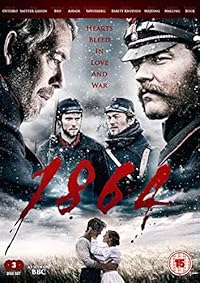
1864

 1864 cover

When this Danish TV series – the most expensive production in Danish television history – was first trailed on the BBC and I saw the blue uniforms I thought it would be about the War Between the States (known on this side of the Atlantic as the American Civil War) as the date fitted. I was immediately interested. I’ve read a lot about that conflict and watched the Jim Burns TV series several times. Looking more closely I realised that I didn’t recognise the painting shown on the trailer or the figures within it (I most likely would have for an American Civil War painting) and of course the uniforms’ details weren’t quite right.

I was therefore even more intrigued when it dawned the series was about the Second Schleswig War as that was something I knew vaguely about from History, at school. Once read, who can forget the comment the UK Prime Minister at the time, Lord Palmerston, made about the intricacies of the Schleswig-Holstein question – which in the series was uttered to that fine actress Barbara Flynn, in the person of Queen Victoria – that there were only three men who ever understood it; the Prince Consort, who was dead, a German professor who had gone mad and Palmerston himself, who had forgotten all about it?

As presented in the series, the war seems to have been provoked by Denmark in a fit of collective insanity. The programme, which has been criticised for historical inaccuracies (it would be difficult to portray any conflict televisually without some of that I’d have thought) certainly presented the Danish Prime Minister, Monrad, as an utter nutter. There seemed to be an element of hysteria in the air that prefigured the Germany of 1939. (Then again there was widespread welcome to Britain’s declaration of war in 1914, so no need to point fingers; except the UK hadn’t sought that conflict – at least not directly.)

However the dire results of the Second Schleswig War for Denmark meant that, to that country’s credit, no Danish military action outside its frontiers again took place until the NATO bombing of Kosovo in 1999.

Scenes were shown from both sides of the conflict and also the sidelines as Palmerston affected to intercede. The subtitles were no intrusion (1864 went out in the BBC 4 European detective slot on Saturdays at 9 pm.) As near as I could tell each nationality in the series spoke in its own language. (I have a smattering of German but no Danish except what I could glean from the dialogue’s similarities to German, English and, occasionally, Scots.)

For the series the necessity of introducing a human aspect to the conflict in the shape of estate manager’s daughter Inge and the two brothers Laust and Peter, with whom she has a special bond, allowed the introduction of those perennial literary concerns, love, sex and death. There was love to be sure, but not much sex – only four scenes as I recall, three of them having not much to do with love, plus another featuring boys attempting to masturbate – but enough death and destruction to slake anyone’s desires. The battle scenes were impressive – and visceral.

Overall the series was magnificent television, well worth checking out if you didn’t catch it, but I thought the elements of mysticism involving one of the soldiers from the village were unconvincing and the framing device wherein a disaffected young woman from our century sent to his house for a form of community service helps read out Inge’s memoirs to an old man (who is Inge’s grandson) was perhaps unnecessary, though it did give the sense of consequences cascading down the years and a contrast to the privations of the soldiers of 150 years earlier.

When I last looked in the BBC shop, the DVD of this was out of stock but the Blu-ray was available.

Antiques?

On Saturday (9/11/13) I was once again at an antiques fair at the Royal Highland Centre, Ingliston, Edinburgh.

One of the items for sale was this impressive object:-

Life Size model of Stonewall Jackson

A life size model of American Civil War Confederate General Stonewall Jackson. Yours for £600!

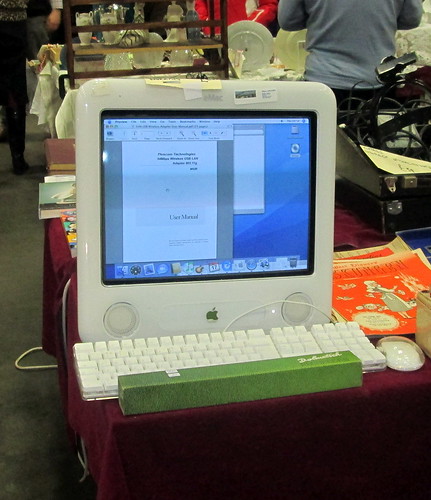
Also for sale was this extremely ancient piece of technology:-

Antique Computer?

What? Computers are antiques now?

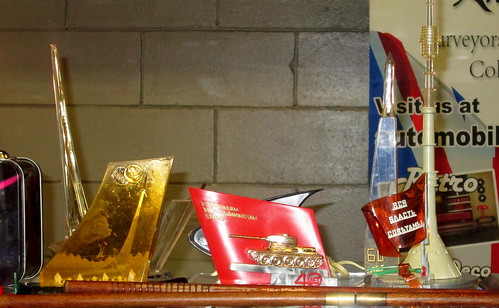
Also some Soviet iconography:-

Soviet Memorabilia

Two models of the USSR memorial to space exploration, a huge badge in the shape of a Soviet tank plus a tower of some sort.

Harry Harrison

Another of the prominent Science Fiction writers of my youth and young adulthood, Harry Harrison, has died.

He was probably known best for his Stainless Steel Rat books and also for the stories of Bill, the Galactic Hero, whose title gives a flavour of Harrison’s sardonic wit. In these books Harrison played against the usual conventions of the SF action adventure.

Ouside the narrower SF world his most familiar work – via the film Soylent Green starring Charlton Heston – is probably the novel Make Room! Make Room!, one of the first to touch on overpopulation as an imminent problem. Harrison said the film, “at times bore a faint resemblance to the book.”

He was also one of the earliest purveyors of Altered History. His A Transatlantic Tunnel, Hurrah! was published in 1972, with his Eden trilogy, where dinosaurs never died out, following in the 1980s. The Stars and Stripes trilogy (1998- 2001) imagined a British intervention on the American continent during the American Civil War leading to war between a Reunited States and Britain. (The US won. Of course.)

He edited more than a few important SF anthologies with English SF author Brian Aldiss with whom he also helped introduce serious criticism to the genre.

Henry Maxwell (Harry) Harrison: 12/3/1925 – 15/8/2012. So it goes.

The Western Front by John Terraine

Hutchinson, 1964. 231p.

This is a book I got at a library sale years ago and have only just got round to reading. Rather than an overview of the Western Front as a whole it turns out to be a series of essays Terraine wrote between 1957 and 1962 which were finally collected in book form in 1964.

In the introduction Terraine is at pains to emphasise that the casualty rate in World War 1 was by no means unprecedented. Starting with Waterloo and taking in the Crimea, The American Civil War and the Boer War he illustrates that, for those with eyes to see, in a time of increasingly industrialised warfare high casualties were inevitable once the fighting started. This was a theme he developed fully in his later book The Smoke And The Fire.

World War 1 was unique, though, in the prolonged timescale of the battles and the static nature of the Western Front. (Other fronts had movement but sustained equally high, or even higher, percentage casualties.) The carnage of the Second World War eclipsed even that of the First, but Britain escaped most of it.

The focus of the book is, however, more on the personalities on the British side than the battles themselves; in particular in the antipathy between Lloyd George and his top commanders. Now, Terraine is a military historian and it is not surprising that his sympathies should lie with the generals but the evidence he presents for Lloyd George’s unhelpfulness is convincing.

His assessment of Douglas Haig as being far from the stolid and hidebound figure of the popular imagination is well argued. His highest praise, though, is reserved for the all but forgotten British general Herbert Plumer.

There is also a discursion into the baneful effect the cult of Napoleon had on the French military mind – and on others. In Terraine’s view Napoleon was anything but the tactical and strategic genius he is usually taken for and, moreover, was exceedingly careless with the lives of his men. The yearning for “something else,” the strategic or tactical genius who might have been able to circumvent the Western Front’s defences was always a chimera. None of the generals, on either side, had a quick and easy solution. In the end, by applying the lessons learned throughout and the integration of new tactics and weapons like the tank, it should not be forgotten that the war was won, and it was won on the Western Front. And that within the three months of late summer and early autumn of 1918.

While Terraine mentions it briefly, the most important assessment of the implications of the war is outwith the scope of this book. Britain was unable to wield sea power effectively (with the launch of the first modern battleship, Dreadnought, and the subsequent naval arms race its dominance had in essence been lost.) The development of the mine and torpedo and the advent of the submarine made a surface fleet almost useless in any case. As a result Britain was sucked in by force of events to becoming a land power; from 1917 onwards – arguably from the Battle of the Somme a year earlier – the major contributor to the Allies; fighting strength and the instrument of final victory.

Had the navy been able to ensure safe passage across the North Sea (rather than keep secure the shorter distance to France) an amphibious landing might have been attempted in Northern Belgium and the Western Front’s flank turned. Whether that would actually have led to an earlier German defeat is another matter.

free hit counter script