Archives » 2012 » March

Nardini’s, Byres Road, Glasgow

I hadn’t been to Glasgow for a while before last Sunday.

Imagine my surprise when I came upon this in Byres Road:-

Nardini's, Byres Road, Glasgow

This wasn’t a Nardini’s the previous time I was in Byres Road but I can’t remember what shop occupied this building up to then.

They have tried to make it look Deco, certainly. The lettering is Deco; and the top glazing. The interior lighting is like the ones in the re-opened Nardini’s in Largs.

Since it is new I can’t really include it in my Glasgow’s Art Deco Heritage series. I wonder if anyone in the future will think it’s 1930s.

The Game Is Altered by Mez Packer

The Game Is Altered cover

Tindal Street Press, 2012.

My review of this book has been sent to Interzone, nearly three weeks before deadline!

I’ll let you all know when it’s due to be published.

Art Deco Drawings

On Sunday I was over in Glasgow. (The good lady was at something called Creative Stitches in the SECC. While she was there I hied myself off to the new Transport Museum called the Riverside Museum. No photos: she had the camera and my mobile is so old it doesn’t do photos. Not that I ever use it anyway.)

The Riverside has a modern architectural design which reminds me of a cardiogram and is full of cars, trains, trams etc with a West of Scotland interest, plus there’s a tall ship moored on the Clyde alongside. Worth a visit.

Anyway afterwards we took in an antique centre/warehouse where I spotted some architectural drawings from the 1930s. They seem to have been produced by a third year student at an architectural college. Very Deco.

By this time the camera was available to me.

This one was for a lakeside restaurant.

Art Deco Architectural Drawing 2 close up

The others were for Sports Centres.

Art Deco Architectural Drawing 1(ii)

Art Deco Architectural Drawing 1(i)

Art Deco Architectural Drawings 1 (iii) close up

I don’t know if any of these buildings were ever erected.

The person selling the drawings wanted £45 for the three Sports Centre drawings; which I thought was a bit steep for bits of paper peeling at the edges. (I couldn’t get close enough to the lakeside restaurant one to see its price.)

Fuller pictures of the drawings are on my flickr.

Arbroath War Memorial

Arbroath War Memorial

Cenotaph-like, this is an imposing structure on a hill above the southern approaches to Arbroath, overlooking the Firth of Tay and the North Sea.

WW1 names are on the front and back, WW2 on the sides. There is also one name from 1972 on the plaque added on the lower left.

Arbroath 2-0 Dumbarton

SFL Div 2, Gayfield Park, 10/3/12.

I shouldn’t have gone to this game. I have never seen us win at Gayfield. The hoodoo continues.

First off, Arbroath are the best team I have seen this season. They were neat, tidy, passed the ball well and played some very good stuff. (I have yet to see Cowdenbeath, that joy is due in a fortnight.)

But the very early stages were even, an Arbroath move after Scott Agnew misplaced a pass needed a good save from Stephen Grindlay to prevent a goal then we came into it for a bit. In fact we scored. You won’t see it reflected in the score-line but Mark Gilhaney cut in and smashed the ball over the keeper, off the bar and down. I was probably among the six best placed people in the ground to see that it had crossed the line. The ref and lino were way behind things though and could not be sure so didn’t give it. That might have made a difference but I doubt it.

Shortly after that Brian Prunty was taken ill, tried to play on but eventually had to go off, which maybe unsettled us as Arbroath proceeded to dominate.

Their first came from a cross when three of their players were left free in the box. Another sweeping move a few minutes later saw a headed goal. I’ll need to see Lichties TV to decide whether Grindlay could have come for it. (At half time I heard an Arbroath fan say the wind had held the ball up for their forward. At Arbroath the elements are always against us.)

The second half was not much of anything. We huffed and puffed but made only one half-chance. Late on we went 3-4-3 and became ridiculously open at the back. Arbroath carved out one great opportunity and I had resigned myself to 3-0 but Stephen Grindlay pulled off an unbelievable save.

Scott Agnew had a poor game in midfield, debutant Craig Dargo had some nice touches but put the half-chance over, Prunty’s replacement Ally Graham might as well not have been on the pitch, sub David Gray turned his man a few times and got his crosses in but didn’t seem able to head the ball.

Any chance of us winning the championship disappeared on Tuesday night. With this game so did any chance of second. I hope two defeats in a row hasn’t put the heads down.

On this evidence, though, we will not win in the play-offs (if we are in them.)

Never Invade Afghanistan

Apart from providing the phrase for the category under which I have posted this (though the attribution is apparently disputed) 1950/60s Prime Minister Harold Macmillan also outlined the first rule of politics, “Never invade Afghanistan.”

I’m not quite sure exactly how many times British forces have been embroiled in that country over the years but the present conflict is at least the fourth. They have not usually turned out well.

I knew when the Soviet Union sent troops there in 1979 that they would be kicked out. I always suspected that our latest foray there would result in tears. As it does.

Why did – why do – our politicians not know? What are their advisers for?

Or did they just not listen?

The First Afghan War (1839-42) was particularly disastrous for the British as it encompassed their greatest defeat in Asia until the fall of Singapore in 1942. A withdrawal from Kabul through passes clogged with snow resulted in a massacre.

There is a relatively well-known painting “Remnants of an Army” by Elizabeth Butler which was said to depict the sole survivor. In fact around forty of the 16,000 who set out managed to survive.

I remember hearing a radio programme about the retreat which used a line from Thomas Campbell’s poem Hohenlinden, “The snow shall be their winding sheet,” as its title.

The Second Afghan War (1878-80) was the one that turned Major General Frederick Roberts into a national hero, Lord Roberts of Kandahar, when he force-marched his troops to the relief of a British force beseiged there. Nevertheless the British eventually withdrew.

The Third Afghan War (1919) was a smaller affair and resolved little but still had many British casualties.

One of the few survivors of the retreat from Kabul in the First Afghan War described it as “… a war begun for no wise purpose, carried on with a strange mixture of rashness and timidity, brought to a close after suffering and disaster, without much glory attached either to the government which directed, or the great body of troops which waged it. Not one benefit, political or military, was acquired with this war. Our eventual evacuation of the country resembled the retreat of an army defeated.”

Nothing much changes.

Reelin’ In The Years 34: Me And You And A Dog Named Boo

I don’t know exactly what it is about this song. I know some folk hate it but for some reason I’ve always liked it.

Lobo: Me And You And A Dog Named Boo

Lobo’s follow up hit I’d Love You To Want Me has not worn as well, I fear.

Lobo: I’d Love You To Want Me

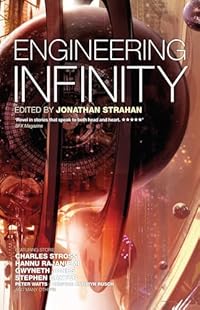
Engineering Infinity edited by Jonathan Strahan. (Solaris, 2010.)

Reviewed for Interzone issue 233, Mar-Apr 2011.

Engineering Infinity cover

According to Strahan’s introduction this anthology is a collection of stories roughly categorisable as hard SF, adding the disclaimer that the term is now a slippery concept hence the stories are inevitably broader in scope than might once have been implied. Whatever his claim that they all invoke the sense of wonder, most exhibit a tendency to be didactic in their narrative styles.

The tone is set early with “Malak” by Peter Watts, the tale of an unmanned airborne war drone that learns from its experiences.

Kristine Kathryn Rusch’s “Watching the Music Dance” deals with the effect of enhanced abilities for children on their dependency and psychological development.

The ghosts of the Soviet space programme are being made real in “Laika’s Ghost” by Karl Schroeder, mainly set in the former cosmodrome in Kazakhstan.

Stephen Baxter’s “The Invasion of Venus” is peculiar in that everything that happens, including the disappearance of the planet Neptune, occurs off stage. Apt, in that humans, and Earth, are of no consequence to the eponymous invaders.

Hannu Rajaniemi’s “The Server and the Dragon” has an intergalactic AI on some inscrutable purpose creating a baby universe as its plaything before being suborned and consumed by a message packet it receives. Extremely dry in the telling, a knowledge of quantum physics and cosmology might be advantageous here.

Charles Stross’s “Bit Rot” is a generation starship type story where the ship is “manned” by cyborgs who are suffering the deleterious aftermath of a gamma and cosmic ray burst. Stross references Tom Godwin’s “The Cold Equations” but overall the story is more reminiscent of John Wyndham’s “Survival.”

In “Creatures with Wings” by Kathleen Ann Goonan the remnants of humanity eke out their lives in what could almost be a zoo which the protagonist leaves to achieve enlightenment. Though Goonan tries to finesse it the story has too large a disjunction when these survivors are taken from Earth by the creatures of wings of the title.

“Walls of Flesh, Bars of Bone” by Damien Broderick & Barbara Lamar is the story from which the collection’s title may have sprung. A man sees himself on a film shot in 1931. The story moves on swiftly to become a concoction of quantum entanglement, self-interference of particles, Bayesian probability, spatial displacements and time travel.

Robert Reed’s “Mantis” concerns the realness (or otherwise) of our experiences and how to tell whether or not we live in stories. The SF gloss involves two way CCTV type screens called infinity windows.

The title of John C Wright’s “Judgement Eve” evokes Edgar Pangborn but unfortunately Wright is no Pangborn. The story, involving angels and Last Judgement, aspires to the condition of myth or Biblicality. As a result the “characters” become cyphers, the prose overblown, the dialogue bombastic and syntactically archaic.

In “A Soldier of the City” by David Moles the eponymous soldier volunteers for the revenge attack on the habitat of the terrorists who attacked his city and killed the goddess whom he loved.

The somewhat loopy protagonist of “Mercies” by Gregory Benford, made rich by inventing a logic for constructing unbreakable codes, invests in and then uses quantum flux technology to “jogg” to nearby timelines in order to execute serial killers before they set out on their sprees; thus becoming himself the object of the same fascination.

In Gwyneth Jones’s ”The Ki-Anna” a man travels to a distant planet to discover the circumstances surrounding his sister’s death and encounters the obligatory strange and disturbing ritual practices.

John Barnes’s “The Birds and the Bees and the Gasoline Trees” features a humaniform who has swum Europa’s oceans and stridden the beds of Titan’s methane seas unravelling the unforeseen consequences of humans trying to offset climate deterioration by seeding Earth’s Southern Ocean with iron from meteorites.

Hard SF? Sense of wonder? In an uneven collection a few stories fail to hit these marks. Enough do, though.

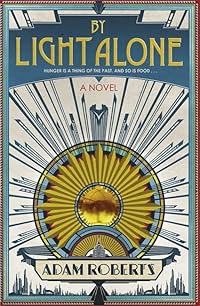
By Light Alone by Adam Roberts

Gollancz, 2011, 407p

 By Light Alone cover

I recently read Roberts’s Stone and was fairly impressed but have so far missed out on his more recent BSFA award nominated novel Yellow Blue Tibia and the earlier quite well received New Model Army. When By Light Alone popped up on this year’s BSFA Awards novel list I decided it was time to sample more.

In By Light Alone global warming has raised sea levels to the extent that a portion of “our” world has been submerged. A wall shields New York from the raised waters. More importantly the Neocles bug has enabled humans to photosynthesise, to be capable of producing blood sugars merely by breathing and drinking water. “Proper” food is scarce, a luxury available only to the rich, who take great care not to be inoculated and differentiate themselves as much as possible form the poor underclass “longhairs” – now kept jobless as there is no need to pay them. These spend hours exposing their fanned hair to the sun for sustenance.

A rich New York family on a skiing holiday in the Caucasus region has their daughter kidnapped. It is nearly a year before she is returned, changed. The novel explores the effects of the kidnapping on all involved. It is divided into four sections, each with a different viewpoint character.

The first and third parts are seen respectively through the thoughts of George Denoone, the father, and Marie Lewinski, the mother. (They are married but she has kept her own name.) The treatment in these two sections is more like a “mainstream” novel than SF. They reveal the pair and their acquaintances to be thoroughly tedious and self-regarding people, and hence fail to engage the reader’s sympathy. Of course they are meant to be aloof, being rich, and to be unwittingly treating their servants with disregard, but crucially we are not made to feel their emotions. It is as if we are seeing them all through a veil. George in particular is an extremely passive and unthinking character, annoyingly so. Indeed so disengaged is he that, in what is effectively an info dump, another character has to explain to him the ramifications of the Neocles bug.

The second section gives us the returned daughter’s viewpoint, which is more immediate and engaging. It is not until the fourth section, though, (pg 261!) that the novel starts to pick up. The focus here is on Issa, a longhair in the Caucasus. Some of this part of the book reminded me in its tonal qualities of Chris Beckett’s The Holy Machine (which is a much better novel.) Even though this section is explicitly tied into the rest at the end – by a connection fairly obvious from the off – overall By Light Alone does not fully cohere, feeling disjointed and unbalanced. It is really four shorter stories juxtaposed; not a unified whole.

I also had some problems with the scenario. Roberts does recognise the need of pregnant women for nutrition beyond mere sugars; indeed he makes this almost a plot point as they take jobs to gain the necessary food to bear a child. The males are presented as useless, not even drones. However, trace elements are necessary for everyone; not just the pregnant. The odd insect or soil which longhairs are said to eat at times would not suffice to assuage this. He also has the longhairs quickly lack energy in the absence of sunlight. Were the process in fact so inefficient it would not be worthwhile. After all plants survive throughout the hours of darkness quite well, their cells respire just as animal cells do. Indeed plants produce surplus sugars – and build them into starch.

Roberts plays on the fact that throughout human history the default state is that of poverty. The plight of the jobless longhairs is presented as an extension of this. (It is hardly Roberts’s fault but a reminder that “the poor are always with us” is not the most uplifting message to be hearing in a time of recession/austerity.)

In addition more attention could have been paid to minor detail. A character named Ysabella has her name spelled in four different ways inside the first twelve pages, though admittedly two of these are diminutives.

Roberts’s explicit referencing, twice, of a certain Arthur C Clarke phrase is a nod to the SF constituency but the SF elements of the book tend towards the perfunctory. While I am all for bringing more rigour in characterisation and the like to the SF novel By Light Alone might perhaps be falling between two stools. I really cannot see it being among the five best SF novels of last year.

Kirkcaldy (And District)’€™s Lost Art Deco Heritage. 3. The Fidelity Garage.

When I first moved to Fife there was a Thirties building in Kirkcaldy on the corner of Abbotshall Road and Wemyssfield.

You had a great view of it as you came out of the library or museum, on the other side of the road at the bottom of the War Memorial Gardens. A perfect example of Art Deco garage construction, complete with white rendered concrete, curved walls, glass bricks, the lot, this was the Fidelity Garage, run by Norman Rollo as I recall. It was lovely, if in need of some attention.

A few years after I took up residence here this distinctive building was (shamefully, to my mind) demolished.

This is what it was replaced with.

Site of Former Fidelity Garage, Kirkcaldy

A bog standard, rectangular-canopied petrol station of little or no architectural merit.

The Fidelity is given a mention on the Scottish Architects website.
I have tried to find pictures of the Fidelity on the internet, with no success. What a pity.

free hit counter script