Archives » 2010 » October

The Salon, Hillhead, Glasgow

When in Glasgow’s west end during the summer (see my Kibble Palace post) I took the opportunity to photograph the local cinema, as was, The Salon. It’s a nice building.

I went there quite a few times when I was a student. Gone With The Wind is one I remember particularly well. The good lady hadn’t seen it and so I took her. She wasn’t all that impressed by the film partly due to the bum numbing experience but also the fact that the story and acting weren’t of the best. She wouldn’t have been disposed to like it anyway, though, given that the book was my mother’s favourite and my mother hadn’t ever taken to her. Never did: even after we were married. Strange woman, my mother. (I can get away with that since she died a long time ago. So it goes.) But I have to agree; it’s not a great film, perhaps not even a good one.

This is the cinema entrance on Vinicombe Street as it looks now.

The side alley was cluttered with bins and such on the day.

The other side presents to much better effect.

There seems to be a sort of church architecture to the rear of this as you go down Cranworth Street. You can see it to the left above and to the right below.

This is the view of the building from Cresswell Street.

Photos of the cinema now and in its heyday can be seen on the Scottish cinemas website.

Open Mic

An open what?

When did the abbreviation for microphone change?

I always remember it being rendered as mike. Now it seems mic is the option du jour.

I read mic as “mick” and so wonder what on Earth an “open mick” could be. On the other hand an open mike would give me no problems at all.

Czech Republic 1-0 Scotland

Synot Tip Arena, Prague, 8/10/10

This was grim: and we got what we deserved. I hope Jim Chapman wasn’t watching, it might have given him wild ideas.

I joked to a work mate today we should play 10-0. What we got was a remarkably similar formation, 4-6-0. I would have been better off – and more excited – watching paint dry.

If you don’t play any forwards you can’t get the ball upfield. If you can’t get the ball upfield you can’t score. And that’s the whole point of the game.

Okay, if you don’t concede you don’t lose. But you can’t win.

Craig Levein’s tactics today ensured that Scotland would not win.

Was he using this as some sort of a trial run for playing Spain? (I know he denied it after the game but watch what formation he sends out against Spain in Spain. If he’s still there. )

If so it was at the least unwise. (I doubt whether we have the players capable of sustaining this system.) And the Czech Republic didn’t look very great shakes, not all that incisive going forward even after we had to come out a bit and, though they were never really under pressure, insecure at the back . They also appeared very get-at-able when Scotland went 4-4-2.

This could have been an opportunity for a win (unlikely but possible.)

And it was spurned.

Friday On My Mind 27: Mr Armageddon (With a side slice of Rudi’s In Love)

“I am father of a thousand children, mother of a thousand million more.”

Perhaps the fade out goes on just a bit too long.

The Locomotive: Mr Armageddon

It’s astonishing that this piece of brass heavy psychedelia came from the same band as the ska influenced Rudi’s In Love – a hit a year earlier.

Compare and contrast.

The Locomotive: Rudi’s In Love

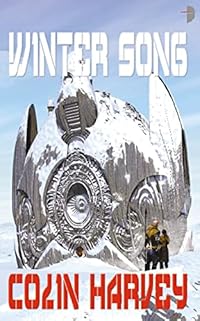
Winter Song by Colin Harvey

Angry Robot, 2009. 373p

Winter Song cover

This is the freebie book I received in a BSFA mailing nearly a year ago. In it Karl Allman’s spaceship is attacked and destroyed and he has to descend with the help of only a protective gel to the surface of the nearest habitable planet, Isheimur, which has been partly terraformed and is inhabited by a group who live and speak in the manner of Icelanders. He is found broken-legged and unconscious and nursed back to health by the local Isheimuri whose chief thereafter regards him as under an obligation to repay this care and attention by working for him. Allman, of course, wishes to escape back to space. These scene setting chapters contained a prodigious quantity of relatively crude info-dumping.

Harvey makes much of the Isheimuri’s life on the edge – poor soil, thin air, lack of food, freezing temperatures, isolation etc – yet in the first part of the book Allman consumes seemingly more than adequate meals and the area teems with flocks of sheep. The Isheimuiri even have horses (which I always thought require a lot of fodder.) Hmmm.

The setting also gives Harvey the opportunity to portray illiberal politics, especially of the sexual variety, which he does attempt to gloss at one point; but all rather unconvincingly.

The narrative is shared between Allman, various Isheimuri and a hasty download from Allman’s ship which co-inhabits his brain. The ship download’s viewpoint, given the name Loki, a nod to Norse mythology – is narrated in the second person; and does not work well. The rest, more thankfully, are in third.

Other aspects of the writing also leave a lot to be desired. The viewpoint often shifts within a narrative section – a distracting authorial/editorial error. Sometimes a passage will contain information the viewpoint character cannot know. On occasion one will inform others about something the author (and we) know, but the character does not.

Even at the sentence level there are many infelicities. Take this sample phrase. “… he had an inner cauldron of anger that flared up at the slightest obstruction to life’s normal flow of life” (page 166.) Life’s normal flow of life? Wouldn’t the simpler usage “life’s normal flow” be more natural, and sufficient?

And parse this sentence if you will. (If you can.) “Arnbjorn and Orn pushed themselves to his father’s side.” Add in the fact that the “his” has no antecedent in a prior sentence and this becomes almost incomprehensible. It is certainly far harder work to read than if “their” replaced “his” or there were a sole subject of the verb, and “themselves” were “himself.”

We also have a terraforming machine that can “break down molecules.” Fair enough. But it also breaks “cerium and samarium from the ores down at sub-molecular level” (Eh?) “into nitrogen and oxygen, which it emits into the atmosphere.” The second part of this is scientific claptrap – nitrogen and oxygen as gases are molecular! The first also has holes – cerium and samarium are not molecular; neither are their ores, nor would they ever be, on or off Earth – and requires a power source so limitless that anything could be synthesised and so food, or any other, shortages would not be a problem; which, of course, vitiates the whole Isheimur scenario. And Harvey gives the impression (page 176) that carbon dioxide is dangerous to humans. It isn’t. Not at the levels indicated here.

Once an author loses our trust in this way it cannot be regained.

Perhaps I was now looking for flaws; because I certainly found them. Harvey has Allman say that the planet’s “magnetic field has just ‘flipped’ from warming to cooling” – more claptrap; a globe’s warming/cooling does not depend on its magnetic field orientation – and just over a page later, “carbon dioxide and water vapour will form a protective layer” (they would disperse throughout the atmosphere) “and seed the ozone layer with water and debris, thereby raising the temperature.” Well make your mind up, man! Is it the magnetic field change or the water/debris in the ozone layer which will cause the warming? In reality of course it would be neither.

The last section betrays a misunderstanding of the trajectoral dynamics of a spaceship under deceleration. Harvey has the engines of the Winter Song, a long-derelict ship once abandoned at Isheimur’s pole but which Allman has somehow managed to get to fly again, being switched on and off in an attempt to relieve strain on them while he tries to slam a comet – which the ship is pushing along with it – into Isheimur. (Don’t ask.) Such a procedure would result in the target being missed, not by a little but by a very long way indeed. It wouldn’t even get near the planet, still less hit it in a precise location. It’s as if a spaceship can be driven in exactly the same way as a car, and its arc were on a defined piece of roadway rather than being a complex interaction between gravity, acceleration and momentum.

Note that in all of the above I have not touched on the cardboardness of the characters, who are straight out of stock casting and provide us with no surprises, nor on Harvey’s habit of trying to create tension through exceedingly unsubtle cliffhangers.

I see from the book’s endpaper that Harvey has had four previous novels published. If this farrago is anything to go by that demands the question; how?

There is also, starting at page 412, an extract from Damage Time by Colin Harvey, headlined as Coming Spring 2010, which I didn’t read.

Needless to say, I shan’t be buying it.

Not Friday On My Mind 4: Somebody To Love

Not a suggestion of psychedelia or strange substances on this one; just Grace Slick belting out a thumping rock track.

Jefferson Airplane: Somebody To Love

Kibble Palace

During the summer we took a trip to Glasgow to roam around my old haunts in the West End. (I spent seven years at The University, Glasgow, doing my B. Sc. and Ph. D.)

Actually we frequently go across, the Kelvingrove Museum and Art Gallery is always worth a visit; so was the Transport Museum till its recent closure preparatory to a move and Byres Road is always interesting.

The Botanic Gardens are just over Great Western Road from Byres Road.

I took some photos of the big glasshouse known as the Kibble Palace. It’s hard to get the whole thing in one shot. You can still see the BBC Scotland sign on the building over the road behind it. It’s a while now since they decamped down to Pacific Quay, over the Clyde from the SECC and Armadillo.

Below is the main dome from the side nearest the Kelvin river.

This one was taken through the railings separating the Gardens from Queen Margaret Drive.

There were loads of people about. There usually are. The Botanics is a well-loved Glasgow haunt.

“For You, Ze Var Is Ofer!”

Sorry about the gratuitous bit of national stereotyping in the title of this post but I couldn’t resist it. It felt like a staple piece of dialogue from the war films which constantly seemed to be on TV when I was young and became something of a joke. But it wasn’t necessarily so.

It was occasioned in this instance by the news that the reparations Germany was due to pay to the Allies as a result of the Treaty of Versailles at the end of World War 1 are finally to be paid off.

It’s only taken 92 years. (It was strung out a bit by the repudiation of the Versailles Treaty in the 1930s by a certain regime and a subsequent contretemps which engulfed all Europe, most of North Africa and the Atlantic shipping lanes and also had its counterpart in the Pacific.)

Mind you, it was only a few years ago that Britain finally paid off its Lend-Lease debts to the US which arose from that second encounter. A nice piece of business for the US as it ensured Britain would be crippled by debt and wouldn’t present much of a post-war industrial rival.

Dumbarton 1-3 Airdrie United

League goals against predictor:- 150

SFL Div 2, The Rock, 1/10/10

League goals for predictor:- 18.

It’s not getting any better is it?

Friday On My Mind 26: I Can See For Miles

I’ve already featured The Who’s I’m A Boy but that was before I started this category.

It was a toss up between this and Pinball Wizard for the single from The Who that is my next favourite from the 60s. I Can See For Miles just shades it.

The Who: I Can See For Miles
center>

free hit counter script