Archives » 2010 » August

Durham 1

After Newcastle we scooted down to Durham (passing Antony Gormley‘s Angel of the North on the way.) The main attraction there is, of course, the Cathedral. I’d seen it before from the train, dominating Durham’s skyline.

This is a side view I took from the south.

Durham Cathedral from side

This one is from the north: a stitch of two photos as I couldn’t get back far enough to get the whole thing in.

Durham Cathedral

Just to the right of the cathedral entrance in a grassy area there was a large stone cross.

We crossed the grass to investigate and it was another memorial to the South African War, if not quite as ornate as the one in Newcastle (see two posts ago.)

Boer War Memorial, Durham

The cathedral itself is impressive while more intimate than York or Canterbury. It apparently costs over £60,000 a week to maintain it.

The stone columns supporting the structure are carved with different patterns. The chevrons were the most attractive. The shrine to St Cuthbert is a bit over the top though. Its canopy has iconography you would more expect to see in an Orthodox context rather than C of E. (But it would have been constructed in the RC era I suppose.)

On one wall there were lists of previous abbots, deans and bishops. I noticed one Thomas Wolsey, Cardinal, in the latter. He seems to have been the only Bishop of Durham who was also a Cardinal. The early names were all single. When did the practice of adopting surnames come into being?

The part of the cathedral I found most moving was the side chapel devoted to the Durham Light Infantry (DLI.) There were lists of battle honours dating back to beyond the Napoleonic wars. Books of remembrance of both World Wars were open at the relevant week’s dates showing the names of those DLI who died on the corresponding days in the war years, and where they fell. I saw no blank days for either war. So it goes. Several small crosses with poppies were laid in a niche. There was one for a former DLI soldier with the dates 1910-2010 and annotated “Veteran of Kohima.” Kohima was a particularly vicious battle on India’s border in World War 2. He did well to survive it, and to reach such an age.

There was also a memorial to miners who had died in pit disasters and such, not the sort of thing usually found in cathedrals I think. And a modern piece of stained glass showing the cathedral’s and Durham area’s history.

There’s a lot to see.

House Of Suns by Alastair Reynolds

Gollancz, 2009, 502 p.

It was apparent from early on that the title of this book was going to be a pun.

The Gentian Line builds stardams. Using ringworlds constructed by a lost civilisation known as the Priors they surround suns completely. Not even a supernova can get through. These suns, then, are housed.

The galaxy-spanning society where the novel is set contains many Lines known as Houses who employ stasis technology in their aeons long trips around the galaxy. The Lines’€™ members are called shatterlings, clones of their respective founders – but of both sexes – each with their founders’ memories. The Gentians’€™ founder, Abigail Gentian, had a strange, artificially extended childhood, brought up in near isolation on a small asteroid enclosing a tethered black hole, with only the game of psychological immersion known as Palatial for diversion.

The shatterlings Campion and Purslane – all the Gentians have names derived from plants – are aberrant in that they are lovers. They are late for their Line’€™s reunion, an important gathering where all the members’ memories of their latest “€œcircuit”€ of the galaxy are collected and shared. Before they arrive they receive the news that most of the Gentian Line has been destroyed in an attack. The novel works through their attempts to find out why, the significance of the mysterious occlusion of the Andromeda galaxy, and of the hidden Line called the House of Suns.

The book is split into eight parts each of which begins with a section which follows Abigail’€™s childhood. Thereafter succeeding chapters are, in turn, narrated from the viewpoints of Campion and Purslane. At first it is difficult to make sense of this as Reynolds does not differentiate their voices clearly enough. The other “characters,”€ some of whom are machine intelligences, step forward Cadence and Cascade – a King Crimson allusion? – are also not well delineated, even the elephant-like Ugalit Panth.

What Reynolds does give you is plot, in abundance. 500 pages of closely packed print is pushing it a bit, though.

Newcastle upon Tyne 2: Art Deco plus

Newcastle’s Northumberland Street does still have a couple of deco frontages. This is a Peacock’s now. Was it once a Woolies? Again the photo is a stitch.

Peacock's Newcastle Upon Tyne

I had thought this one might have been a Burton’s:-

Possible Former Burton's Building Newcastle Upon Tyne


I think now, due to the clock, it was once a Marks and Spencer but it may have been something else. In any case I searched flickr and the picture below is what came up for Burton’s. It looked like one of the art deco buildings I had seen in the book of old Newcastle (see first link in this post):-

34.jpg

I saw no sign of this building on present day Northumberland Street. The Marks and Spencer’s shop is now located in the Eldon Square shopping centre. We went in and browsed but there was nothing worth buying.

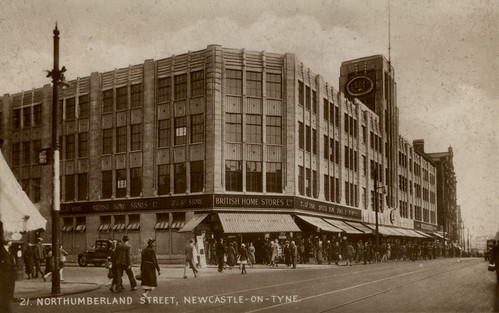
The photograph below (from flickr via a postcard) was exactly the same as the other art deco building I had seen in the book of old Newcastle:-

052780:British Home Stores Northumberland Street/Blackett Street Newcastle upon Tyne Unknown c.1932

I did notice a newer Bhs further along Northumberland Street. The building in the postcard was apparently demolished to make Monument Mall. I doubt that’s as aesthetically pleasing as the former Bhs was.

Right at the end of Northumberland Street we came upon this very tall monument.

Boer War Memorial, Newcastle

It was erected in memory of the dead of the “South African War” as the inscription has it. This is more often known as the Boer War but more accurately was the Second Boer War.

There are quite a few such memorials around. One is on the parapet of Edinburgh’s North Bridge. I have a piece of crested china which is a reproduction of the memorial in Hull to the dead of the same war and I have seen another similarly patterned piece with a different town’s crest. The next day (in Durham) we encountered another tall memorial to the South African War.

On the way back to the car we passed Newcastle’s civic centre. It’s a much more modern building with a tower surmounted by a circular top with horses’ heads and a finial showing the three castle symbol that also appears on silver objects assayed in Newcastle when the city still had an assay office.

Civic Centre, Newcastle Upon Tyne

The castle motif also appeared on the railings surrounding the civic centre.

Railings, Civic Centre, Newcastle Upon Tyne

*Edited to add:- for some idea of the memorial’s scale see this link. Its surroundings have changed somewhat since the postcard photos in the link were taken.

Newcastle upon Tyne 1

After leaving the riverside we climbed the hill from the Tyne towards the shops and (eventually) found them.

We went into one of those North of England town extensive inside markets where we browsed a second hand bookshop and I flicked through a book on old Newcastle and discovered Northumberland Street had had some Art Deco buildings on it but my knowledge of Newcastle’s street geography was minimal.

We moseyed around for a while and came upon this unexpectedly on rounding a corner where Debenham’s is (ie not on Northumberland Street.) I couldn’t get the whole thing in one shot so this is a stitch which is why there’s a black strip at the top and it looks bendy.

Newcastle Co-op cropped


It’s the Cooperative building; deco in that monumental almost Stalinist way.

Here’s a detail.

Corner of Co-op Building, Newcastle Upon Tyne

There’s a close up on one of the towers on flickr which shows up the trianguloid windows. Plus another of the side of one of the clocks where you can see COOPERATIVE written round the face.

Just off Eldon Square there is this building:-

Rear of Fenwick's, Newcastle Upon Tyne


I found this different angle on flickr:-

Fenwick's Art Deco...

Just on a bit we got to Northumberland Street. The Fenwick’s frontage there predates Art Deco. Again this is a stitch as I couldn’t get back far enough to frame it all in one shot.

Fenwick's Newcastle Upon Tyne, Art Deco

Forfar Athletic 4-1 Dumbarton

League goals against predictor:- 150*

SFL Div 2, Station Park, 7/8/10

Oh.

Dear.

This was a game we dominated (in terms of possession and territory) for most of it. Yet looking at the score you’d think the opposite.

We didn’t, of course, make much of the ball when we had it.

I feared the worst as soon as they scored – on their first foray up the park. Terrible defending all round and Stephen Grindlay didn’t cover himself in glory. We then got a quick penalty for the ball striking a Forfar player’s hand which Chaplain put away. We were on for about 7-7 at that rate. The same player then had a great chance, rounding the keeper, but put it wide of a gaping goal (with his wrong foot, but still.) I was reminded a bit of Fergus Tiernan’s miss in the opening game three seasons ago at Firs Park. The season turned on that moment, I think – and we all remember how it turned out.

Another reminder of that day was that today Stephen Grindlay made a great imitation of Peter Shaw. Both the second and third Forfar goals went right through him. He wasn’t the only one to blame in each case but he was a common factor.

The front two, Maxwell and Campbell, linked up well at times but didn’t really penetrate. Chaplain was ineffective at right mid, Nugent wasn’t any better than Chissie at right back and Chissie was out of position again at left back. And we had neither width nor pace. Why no Del Boy from the start? By the time he came on it was too late.

The sad thing is Forfar didn’t have to be good to win this. They only had to turn up and sling in crosses. A glance at the Sons TV footage of pre-season would probably have told them this.

Unfortunately there will be good teams in this division. I’m not at all sanguine about Livingston at home next week.

* It ought to be 144 but I thought I’d go for a nice round number. Judging by today it’s an underestimate anyway.

Long.

Hard.

Season.

Tyneside (2)

Halfway across the Millenium Bridge I took the shot below of the other four bridges which span the Tyne between Newcastle and Gateshead.

Bridges over the Tyne, Newcastle

The four bridges are respectively;-

The Tyne Bridge – the iconic one arched like Sydney Harbour Bridge,

the Swing Bridge low down on the river,

Stephenson’s High Level Bridge which carries both road and rail traffic,

the Queen Elizabeth II Metro Bridge whose structure you can just make out behind the High Level Bridge.

Zoom of the left hand tower of The Tyne Bridge.

Tyne Bridge Tower

Also on the Gateshead waterfront is the Sage Gateshead, a performance and conference venue, one of those bulbous constructions seemingly in vogue at the moment.

This photo is from the Baltic Gallery.

Gateshead, The Sage

This is from the Newcastle side of the river.

The Sage, Gateshead


It looks a bit like a slug from this angle.

Friday On My Mind 18: This Wheel’s On Fire

Great mellotron on this. And a glimpse of Simon Dee! (Or Cyril Henty-Dodd, if you will, who is sadly no longer with us. So it goes.)

Julie Driscoll, Brian Auger And The Trinity: This Wheel’s On Fire

Tyneside (1)

Last week the good lady and I took ourselves off to North East England for a couple of days.

We’d meant to make the trip a couple of weeks ago but a certain news event there gave us pause.

We actually passed through Ponteland – which has a brick Art Deco town hall but there wasn’t an easy place to stop to photograph it – and saw signs for Rothbury. I can’t say I’d ever heard of either until early last month.

First stop was Newcastle (upon Tyne.)

Well, it was actually Gateshead where we parked adjacent to the Baltic Centre for Contemporary Art. This is the view from the west side of the building.

Baltic Art Centre, Gateshead


And this is from the Millenium Bridge.

Gateshead, Baltic Arts Centre

The interior of the gallery is impressive – they’ve done a good job of converting the original flour mill but the contents left me cold.

One of the exhibits was art work by John Cage, more famous for musical compositions (or more accurately for 4 minutes 33 seconds of silence.) His pictures consisted of muddy daubs, streaks and circles. The good lady opined that he must be a genius; he can take the piss in two disciplines, music and art.

The Tomas Saraceno spider web left me cold (as did the fish tanks with spiders in them.) Cornelia Parker’s circle of squashed brass/silver instruments was quite effective – especially when viewed from the floor above.

I’ve enjoyed visits to the Scottish National Gallery of Modern Art on Belford Road, Edinburgh and its companion the Dean Gallery over the road so I’m not a complete philistine but this was distinctly underwhelming.

Then it was over the Millenium Bridge to Newcastle. The first picture is from the walkway just by the Gallery.

Millenium Bridge, Newcastle/Gateshead


The second is from the Newcastle side further up the river.

Newcastle/Gateshead, Millenium bridge 2


I quite like modern bridges like this. The Clyde Arc (or Squinty Bridge) in Glasgow is another in similar vein.

War Memorials

In Great Britain there are War Memorials – mainly to the Great War and the Second World War – in even the smallest towns and villages. Sometimes when you’re driving along in the countryside there will be one at the edge of a field; covered in names even though there appears to be no habitation worthy of the name round about.

I’ve also come across them on walls in churches, police and railway stations (does anyone know what happened to the memorial at Dumbarton East when they demolished the old buildings?) and Post Offices commemorating the former workers who “gave their lives.”

It’s always striking that the number of dead for World War 1 outstrips that of World War 2 – perhaps a reflection of the fact that, after 1916 till late 1918, the greater burden of the Allies in the Great War lay on Britain and its Empire, while in WW2 most of the fighting after 1941 was done by the USSR and the US.

I spent a fortnight in Germany 30 years ago and was tremendously saddened by the war memorial in the town where I was staying. The sacrifice seemed even more poignant because they lost (and, of course, in WW2 had no shred of excuse nor reason to fight.)

I have already posted pictures of Kirkcaldy’s War Memorial.

There is another war memorial in Kirkcaldy, though, one which is fairly unusual.

It is to the local dead of the Spanish Civil War; members of the International Brigade who came from Fife or the Lothians. That conflict preceded and presaged the greater anti-fascist fight of WW2. Arguably had France and Great Britain taken the government side in that war then the later, bigger war might have been averted. But Britain at least was in no mood to fight (think of all those names on the WW1 memorials) and was also unprepared (no Spitfires for example.) This was still more or less true by the time of the Munich crisis in 1938. But failure to stand up to him on both those occasions and also during the remilitarisation of the Rhineland in 1936 and the 1938 Anschluss encouraged Hitler to believe we never would.

Here is the memorial in situ. It stands just off Forth Avenue, quite near Kirkcaldy railway station.

Spanish Civil War Memorial

The main plaque is inscribed as below.

Plaque

These are the names just above the plaque.

Memorial front names

There are more on the plinth below the shield.

Memorial top names

This is the shield. The mounted knight is an old emblem representing Fife.

Memorial shield

It’s strange to think that had the Western European powers fought in Spain and helped the Spanish Republic to victory, a Nazi Germany would, paradoxically, likely have survived long past 1945.

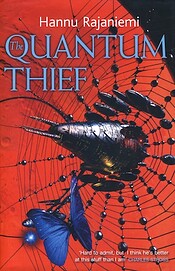
The Quantum Thief by Hannu Rajaniemi

Gollancz, 2010, 267p

My review of this book has been delivered to Interzone. I’ll let you know the publication date in due course.

Btw, the cover image is arresting and ought to shift some copies.

free hit counter script