Would you Eat Curres?
Posted in Dumbarton, Linguistic Annoyances at 20:30 on 21 February 2024
Aladdin Hot 4 U in Dumbarton High Street:-
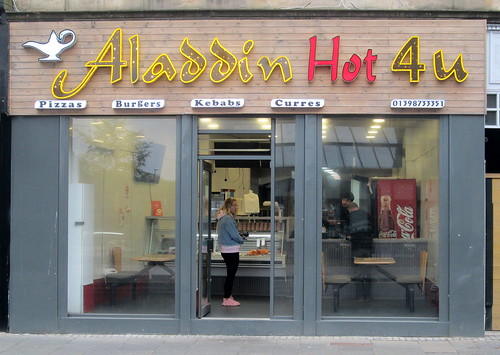
They claim to sell not only Pizzas, Burgers and Kebabs but also Curres.
Posted in Dumbarton, Linguistic Annoyances at 20:30 on 21 February 2024
Aladdin Hot 4 U in Dumbarton High Street:-
They claim to sell not only Pizzas, Burgers and Kebabs but also Curres.
Posted in History, Linguistic Annoyances at 12:00 on 8 September 2020
Whoever cobbled this together (Chris Green?) is a man after my own heart:-

Posted in Linguistic Annoyances, Politics at 20:00 on 6 December 2019
The Lib Dem leaflet is up front with its STOP BREXIT STOP INDEPENDENCE BUILD A BRIGHTER FUTURE cover.
Inside, it does foreground rebuild our economy, invest in our schools and tackle the climate emergency before anything else. Not the correct order to my mind, but still.
The local candidate’s puff has one of its sentences broken into two “… too often is overlooked. Making sure that…” I suppose this could be construed as imparting emphasis to the second part but it’s clumsy at best. There is also a cavalier attitude evident in the scattershot placing of full stops in the bullet point statements on its last two pages. Eight are present, six missing.
Could do better.
Posted in Politics, Linguistic Annoyances at 20:00 on 5 December 2019
There have been three more General Election leaflets put through my door.
Another from the SNP – no literacy errors.
There was one such error in the Tory leaflet. (Their candidate’s main aim is listed as to stop another independence referendum. The local economy, schools, public services and young people’s employment prospects are apparently of lesser concern.)
The error was contained in a bar graph purporting to show the Tories are in a position to win in my local constituency. Its y-axis was labelled “% increase/decrease in vote GE here in Glenrothes” which is simply gibberish. “% increase/decrease in GE vote here in Glenrothes” would have been more sensible.
The overall graph was a huge attempt to mislead though. Its bars showed the % increase or decrease in the parties’ votes in 2017 compared to 2015. The Tories 11.8% increase appears huge while Labour’s 4.1% and the Lib Dems 1.1% look tiny. On it is emblazoned the words “Labour and the Lib Dems are just too weak to beat the SNP here,” with an arrow from those pointing to the bars, as if % increase is the actual % of total votes.
This is, of course an utter distortion. In 2017 the Tories had 7,876 votes, the Lib Dems 1,208 and Labour 14,027. In other words the Tories had half the votes Labour did. The SNP meanwhile had 17,291 votes.
Assuming everything else stayed the same, in the somewhat unlikely event of the Tories doubling their vote (a 50% increase – about five times the one they achieved last time) they would still only just beat Labour into second place and not come near the SNP total.
The graph (or rather the words describing it) is tendentious nonsense and a deliberate attempt to mislead. Its use and depiction in this way is a piece of mathematical illiteracy, albeit cunningly deployed. Even without all the other stuff about the Tories which I dislike that would have been enough to put me off them.
I’ve ranted too long. Lib Dems another time.
Posted in Linguistic Annoyances, Politics at 20:00 on 3 December 2019
Well.
Today the SNP General Election leaflet came through my door.
It too contained “the Government have” when a single entity not the series of individuals it consists of was the actual subject of the verb and so “the Government has” ought to have been used. (I nearly said ‘making it up’ there instead of ‘it consists of’ – but this Government makes things up all the time.) I fear that, like the Apostrophe Society’s throwing in of the towel, “the Government” treated as a single entity has succumbed to “ignorance and laziness”.
More to the point, in the SNP leaflet we had a comment on the mandate it stated the SNP had to hold a referendum on Independence. It read, “It would be unacceptable for anyone to attempt to instruct that.”
I can only parse that by interpreting it in the sense that, “to obstruct that,” is meant.
“Instruct” for “obstruct” isn’t a close enough resemblance to be a malapropism. It’s just a bizarre substitution.
There were no actual spelling mistakes though.
PS. Re my previous election leaflet post: I have come on reflection to the opinion that “unpresidented” for “unprecedented” isn’t a malapropism. It’s more like a homophone.
Posted in Linguistic Annoyances, Politics at 20:00 on 2 December 2019
You may be aware the UK is in the middle of a General Election campaign. It is possibly the most important of my lifetime and one which has the potential of embedding a harrowing future.
In that context the following is quite trivial, but it still annoyed me.
I have only received one leaflet so far – from the Labour Party. While it does show photographs of the local candidate and Labour’s Scottish leader there is absolutely no sign nor mention within it of the UK leader, one Jeremy Corbyn.
It also has three linguistic irritations.*
1:- “Only the Labour Party will bring unpresidented investment into the UK.”
I suppose there is an outside possibility that this is a reference to T Ronald Dump’s intentions towards the UK and its NHS in any negotiations of a trade deal after Brexit. More likely that view is too generous and it is in fact a malapropism.
2:- “A Labour Government through their Green Industrial Revolution policy…”
Now, the word ‘Government’ can be a noun of multitude (which would take a plural pronoun) and I accept that this is the way in which most people use the word nowadays.
However, in this case it refers to the Government as a whole and not as a collective and so requires a singular pronoun, ‘its’.
3:- “the fact they have not recuited or trained enough staff.”
Recuited? (Recruited, please.)
I hope the literacy (and/or proofreading) standards of any other campaign leaflets I receive in this election will be somewhat higher than this.
Or is that expecting too much?
*Edited to add: Make that four. By the time I’d come round to compiling the post I’d forgotten the leaflet also spelled truly as truely.
Posted in Linguistic Annoyances, Doctor Who, Curiosities, Kirkcaldy at 20:00 on 5 December 2018
Yesterday I spotted in a charity shop in Kirkcaldy the legend, “Theives will be prosecuted.”
My immediate thought was, “So do thieves get away scot-free, then?”
On Monday I saw in the Guardian that for the first time there would be an episode of Doctor Who on New Year’s Day this year.
No. That would already have happened. The clue is in the name. New year.
The episode will actually be broadcast next year.
Posted in Linguistic Annoyances, Politics at 12:00 on 18 November 2018
There was an interesting article in Friday’s Guardian about the thought processes that led to some people – English people – seeing the EU as a domineering menace. Written by Fintan O’Toole, it was headlined The Paranoid Fantasy Behind Brexit with a subheading saying, “In the dark imaginations of English reactionaries, Britain is always a defeated nation – and the EU is the imaginary invader.” It’s well worth reading.
O’Toole argues the misguided logic of the Brexiteer mindset seems to be that Britain somehow actually lost the Second World War (or both World Wars if you will) as the European countries did much better than us economically after it. Thus it is that Brexiters come to make comparisons of the EU with Hitler as the EU is conjured to be a dark, disguised continuation of a project to subdue the UK, a delusion in which they revel. Invasion fantasies such as Len Deighton’s SS GB and Thomas Harris’s Fatherland (even though that was set in Germany) can also be seen as manifestations of the idea.
The piece reminded me of an article in The New European from January last year which states that the English aren’t team players; they just don’t like having to take other poeple’s views into account. Insouciant dismissals of the imminent Irish border problem on Brexit are only confirmation of that sort of attitude as is the Westminster Government’s lack of acknowledgement of the concerns of the devolved administrations in Wales and Scotland.
The avid Brexiters like to characterise those who have views differing from theirs as traitors and enemies of the people.
They have it arse-backwards.* They are the real traitors, they who are the real personification of treason as their prescriptions and nostrums are neither in the interests nor the well-being of the country. They it is who have cultivated the seeds of dissension, stoked anger and proposed an entirely spurious remedy for the ills which beset the UK; a remedy which will only exacerbate those problems and, far from increasing Britain’s influence and standing in the world, will only lead to their diminution – a process which is now well under way. And their fantasy of a minimally regulated polity would be nothing but a complete disaster for those they claim to be championing.
(*Shouldn’t that phrase actually be arse-forwards? As in arse-about-face. Surely an arse already points backwards?)
Posted in BBC 2, History, Linguistic Annoyances at 21:00 on 12 November 2018
As an addendum to yesterday’s busy day we watched the film They Shall Not Grow Old shown on BBC2 last night.
The colourisation of the archive black and white footage brought an immediacy to some familiar images, a more visceral appreciation of the conditions the war was fought under, a greater humanisation of its participants; bringing it home that they were exactly like us, even at a distance of one hundred years.
I only wish though, that the film’s title did not embody a misquotation of Laurence Binyon’s poem For the Fallen.
He of course did not write, “They shall not grow old as we that are left grow old,” but rather “they shall grow not old,” a more poetic rendering but also one that implies a different sort of growth, that the remembering would increase as time passed.
(I note in passing that the Lord Lieutenant of Fife made the same misquotation at Fife’s one hundredth anniversary of the Armistice Remembrance Service in Dunfermline Abbey on Friday 9th.)
Binyon’s poem is also almost always misquoted in its next line as “nor the years condemn.” He in fact wrote, “nor the years contemn,” a stronger meaning – and one borne out by the commemorations occurring during the last four years.
Posted in Linguistic Annoyances, Science Fiction, Television, Doctor Who at 12:00 on 8 October 2018
Last night I watched the first of the new Doctor Who series on BBC TV. It was okay as far as it went but I’m not sure it will have won over any of the easily disgruntled unreconstructed among us who thought the Doctor couldn’t be a woman. There’s no reason why the Doctor wouldn’t be able to change gender – after all the Master already has – but I didn’t think this episode was strong enough as an introduction to the new one.
Jodie Whittaker probably has the chops to make a good doctor but on this evidence I’ll be reserving judgement as to the story-lines.
A curious feature in this one was that there was no introductory theme music – not even after a few minutes in when the problem had been set up. Again I thought that was a mistake.
Then we had, “Half an hour ago I was a white-haired Scotsman.”
No. Half an hour ago you were an alien with two hearts from the planet Gallifrey. You still are. Half an hour ago you may have had a Scottish accent but you were never a Scotsman.
You also said, “I would of.”
You can reboot yourself right there. The correct phrase is “would have” or at a pinch “would’ve”. Don’t do it again.
