Archives » Kirkcaldy

War Memorials

In Great Britain there are War Memorials – mainly to the Great War and the Second World War – in even the smallest towns and villages. Sometimes when you’re driving along in the countryside there will be one at the edge of a field; covered in names even though there appears to be no habitation worthy of the name round about.

I’ve also come across them on walls in churches, police and railway stations (does anyone know what happened to the memorial at Dumbarton East when they demolished the old buildings?) and Post Offices commemorating the former workers who “gave their lives.”

It’s always striking that the number of dead for World War 1 outstrips that of World War 2 – perhaps a reflection of the fact that, after 1916 till late 1918, the greater burden of the Allies in the Great War lay on Britain and its Empire, while in WW2 most of the fighting after 1941 was done by the USSR and the US.

I spent a fortnight in Germany 30 years ago and was tremendously saddened by the war memorial in the town where I was staying. The sacrifice seemed even more poignant because they lost (and, of course, in WW2 had no shred of excuse nor reason to fight.)

I have already posted pictures of Kirkcaldy’s War Memorial.

There is another war memorial in Kirkcaldy, though, one which is fairly unusual.

It is to the local dead of the Spanish Civil War; members of the International Brigade who came from Fife or the Lothians. That conflict preceded and presaged the greater anti-fascist fight of WW2. Arguably had France and Great Britain taken the government side in that war then the later, bigger war might have been averted. But Britain at least was in no mood to fight (think of all those names on the WW1 memorials) and was also unprepared (no Spitfires for example.) This was still more or less true by the time of the Munich crisis in 1938. But failure to stand up to him on both those occasions and also during the remilitarisation of the Rhineland in 1936 and the 1938 Anschluss encouraged Hitler to believe we never would.

Here is the memorial in situ. It stands just off Forth Avenue, quite near Kirkcaldy railway station.

Spanish Civil War Memorial

The main plaque is inscribed as below.

Plaque

These are the names just above the plaque.

Memorial front names

There are more on the plinth below the shield.

Memorial top names

This is the shield. The mounted knight is an old emblem representing Fife.

Memorial shield

It’s strange to think that had the Western European powers fought in Spain and helped the Spanish Republic to victory, a Nazi Germany would, paradoxically, likely have survived long past 1945.

The Open, St Andrews

I’m not a golfer, but it’s impossible to live in Scotland and not be aware of the sport. Even more so in Fife where every wee town seems to have its own course. Lundin Links – barely a blink as you drive through it – has two; one which is usually used for Open qualifying and the other, Lundin Ladies’.

St Andrews, of course, is littered with them, demand for the Old Course being so great as to be unsatisfiable. So, in addition there are the New Course, the Eden Course, the Jubilee Course, the Castle Course, the Strathtyrum Course and the Balgove Course – and those are only the ones run by the St Andrews Links Trust.

The Open Championship – if you’re being parochial you’d call it the British Open – is underway at the moment and so the place is transformed. You can’t move in the town normally for golf shops etc. so goodness knows what it is like at the moment. So much of a distraction is the tournament that St Andrews’s other modern attraction – the University – shuts down for the duration.

Myself and the good lady caught the preparations last week. A small army of mowers was shaving the first fairway.

Mowers

On the sand just where the Swilken Burn finally flows into the North Sea there was a spectacular piece of driftwood. It almost looked like it had been sculpted.

Dinosaur?

Dinosaur "antlers"

From the links it looked like a sculpture of a cow but closer in more resembled a dinosaur.

You can see bits of the tented village in the second photo. It wasn’t quite in readiness but there were signs for banks and “Fish and Chips” and other stuff which I forget. It must be a huge money spinner – not all of it going to the town, sadly.

When the open is at Muirfield you can see the tented village from Kirkcaldy, gleaming whitely across miles of Forth estuary. The proprietors there call themselves “the Honourable Company of Edinburgh Golfers” but I believe they don’t allow women to be members – which may not be quite so honourable in this day and age.

Of course in central Scotland you are never far away from a course on the Open rota. Carnoustie is only across the Tay estuary from Fife and both Troon and Turnberry are on the Ayrshire coast, no more than a couple of hours drive away. (You just can’t avoid golfing puns in a piece like this.)

St Andrews is a favourite place for myself and the good lady but we’ll be giving it a miss this week. I’m sure you see more of the action on the TV anyway. I’ve caught some of yesterday’s and today’s play and I’ll be watching the climax on Sunday. At least I’ll be out of any wind and rain.

The Links Market

Once a year Kirkcaldy Prom gets taken over for just over a week by what is known as the Links Market. It’s a name that’s now inappropriate. While it was once apparently a market, with stalls selling clothes and such, now it’s nothing more than a travelling fair.

"Market" 1

"Market" 2

The locals seem to think it’s a big thing. (Well it does claim the distinction of being Europe’s longest street fair.) Local children apparently save up all year for the opportunity to splurge all their cash within an hour or so. The football authorities also make sure Raith Rovers do not have a home game on the relevant Saturday. (Policing implications, doncha know. And Stark’s Park is only a long stone’s throw from the south end of the Prom.)

It even attracts interest from folks who live in Cowdenbeath and Dunfermline – “Ur ye goin’ tae the Links, sur?” – and probably Methil and Leven for all I know.

It’s actually a bit of a nuisance. Quite apart from the phenomenon known as market weather (or bucketing down as it is also called – mercifully suspended for this year, although it did rain overnight and earlier today) the road along the prom is closed off for the duration – plus a few days either side for setting up and taking down the rides – which leads to congestion on neighbouring streets, not to mention the fact that right now the air outside my house is thick with the amplified sounds of the fairground (even though the Prom is a few hundred metres away and they’re supposed to turn the volume down on Sundays.)

I’ve said before how boring Kirkcaldy prom usually is. This is a picture taken from the south end on a dreich day.

Kirkcaldy prom looking north(ish)

Here’s a photo taken today from near the same spot.

"Market" from south

“The Market” might be a relatively big travelling fair but the fuss the locals make anyone would think no other town ever had a “Shows” (as we used to call them in Dumbarton – two a year, April and August, held on Dumbarton Common) turn up on their doorstep. Hell, Burntisland – only 4 miles from Kirkcaldy – has a permanent fairground site – at least during the summer months.

Still it’s only up and running Wednesday to Monday. Everything’ll be back to normal in a couple of days.

Kirkcaldy’s Art Deco Heritage 7. St Clair Street.

St Clair Streeta

A minor piece of deco this one. I think it used to be a bank at one time. It’s mainly the upper story styling that marks it out.

The windows are typical of the thirties. They might even not have been replaced though there is a hint of plastic about them. If they have it’s been done sympathetically.

Nice deco fanlight, too.

Links Street, Kirkcaldy

A while back I mentioned the Coptic Church in Kirkcaldy.

It’s in Links Street, in a part of the burgh known as Linktown, which used to be a separate entity but in 1876 was amalgamated into the Lang Toun along with three other burghs and, subsequently, Dysart.

The building is now known as St Mark’s. I suppose it was previously a Church of Scotland kirk of some description.

Coptic Church

Further along Links Street are some newly built houses on one of which is a mural.

There is also an explanatory panel whose photo I have expanded to make it readable.

Links street mural

Links street panel

Still on Links Street, but nearer Kirkcaldy proper, is another church which has had its usage changed. It’s now a play centre for young children; birthday parties and such.

Sulphur Again

I was checking my blog’s stats earlier this week.

It never fails to amaze me that a high number of visits to this blog seem to arise from my post about Mary Campbell Smith’s poem The Boy In The Train.

There are lots of hits for Art Deco too, which actually tend to predominate.

However what caught my eye this time was someone looking for the spelling of sulphur.

I accessed the search page they’d used and found this blog entry. Its last line is a beauty.

I do hope Jon Edwards from the RSC has looked at it (and at my reply to his comment on my take on the subject here.)

I note also that I was 22nd equal in the general blog category in the Scotblog Awards and 67th equal overall. Four votes plus a panel nomination was all that took. (I’ll need to tout for votes next year.)

No Longer A Gap In The Mercat

Well, not that one anyway.

The Woolies store in Kirkcaldy was L-shaped. The back part was the first to be taken over: by clothes retailer Peacocks – now looking like they’re in administration themselves what with the 70% off signs for their January sales. They moved in a few months ago.

peacocks

Relatively recently the other part of the Woolies shop – which had originally been a Tesco’s before they took over William Low’s and moved their operation to the Low’s site in the Postings shopping area – morphed into something called Home Bargains, which is best described as Woolies with added food.

home bargains

The half-price sale sign on the right edge of the picture is actually for a JJB Sports shop which is up some stairs and in which I’ve not set foot.

The Mercat is an indoor mall, hence the darkness of the photos, taken as they were around 5pm on a winter’s evening.

Edited to add:- Peacock’s isn’t in administration, just having a sale.

Time Of The Season

I know Christmas starts in about August for some shops (especially with the Children’s Annuals coming out then) but most nowadays have the decency to get at least Halloween, if not Bonfire Night, out of the way before setting out the bunting and the baubles.

(That’s the only bonus about the commercialisation of Halloween. It fends off Christmas for a bit. When I was a lad there wasn’t much “ghostly” tat, apart from perhaps paper masks or witches’ hats, on sale in the run up to All Hallows Eve. Certainly no pumpkins and none of the peculiar orange and black creations that seem to be the marker these days. We had our guising costumes made for us by the sweat of mother’s brow – or sewing fingers.)

In Kirkcaldy, Santa visits the Mercat and the town’s Christmas lights are switched on halfway through November but at least the latter has some point to it, as it brightens up the dark winter afternoons.

Yesterday, though, the 27th of November, in my local corner shop I saw for sale not Christmas stuff, oh no, but creme eggs.

Creme eggs! In November. The leftovers from last Easter have barely cleared away.

It takes all the anticipation away.

Year round creme eggs. It’s just not right.

Kirkcaldy War Memorial

I took these photos on Sunday afternoon (Remembrance Day.) The wreaths from the morning’s memorial service are prominent. Among the wreaths from the local Council and councillor and various military and civilian organisations there was one from the US Marine Corps.

WW1 Memorial

Kirkcaldy War Memorial on Remembrance Day 2009.

This part contains the (huge) list of names for the First World War. The War Memorial Gardens surround the memorial itself and are mostly behind from where this photo was taken.

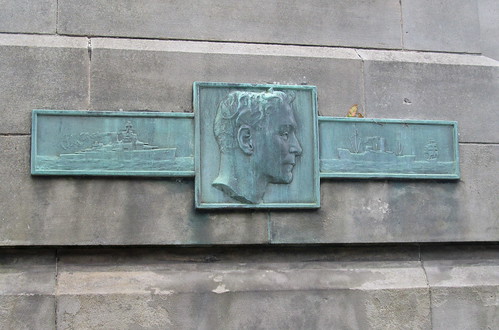
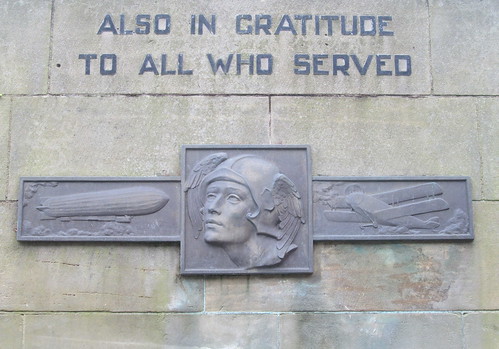
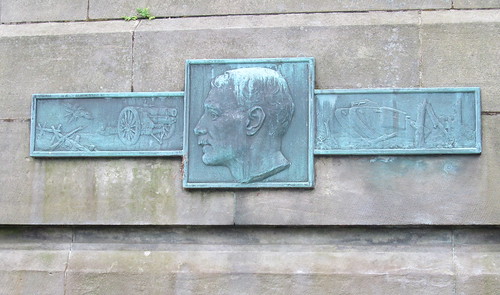
The central memorial pillar has bronzes on it displaying soldiers, seamen and airmen, ships, aircraft, airships etc. In this respect it resembles larger memorials I have seen such as the one in Plymouth (which is mainly dedicated to naval personnel.)

The building beyond the memorial contains Kirkcaldy Museum and Art Gallery and was built with money donated from the linoleum manufacturer family Nairn as part of the memorial to the dead of WW1.

WW2 Memorial

Built after 1945, this is to the right of the WW1 memorial and lists the names for the Second World War dead.

Small Memorial

This is to the right of the WW2 memorial and is a relatively recent addition. It provides a place for individual memorial poppies, as you can see, and also for commemoration of those who have died on active service since WW2. One time I looked there a poppy had been placed in memory of someone who had been killed in Basra.

Some years ago, when skateboarding was a newish fad and before special areas for it had been built in parks etc skateboarders used to use the tarred area in front of the memorial to do their thing. There were several letters to the local paper objecting to this as a mark of disrespect in part disguised by concern that they might be damaging the memorial itself.

I never saw it as disrespect. After all, wasn’t it precisely so that people could go about doing whatever they enjoyed within the law that those commemorated had given their lives for?

I also never noted any damage, even to the tarmac.

It’s mostly quiet these days of course.

Kirkcaldy Promenade

Despite being on the North side of the Forth estuary Kirkcaldy promenade is aligned almost North-South as the coastline takes a sharp bend northwards after Kinghorn. This is a photo of the prom from the north end (looking south-westish.)

Kirkcaldy Promenade

Boring isn’t it?

There is a dual carriageway road which goes along the whole frontage just to the right of this picture. Perfect for boy racers. They put in one of those “Your Speed Is …. mph” displays a few years ago. Nothing like encouraging them!

I noticed on Saturday, though, that a couple of pedestrian crossings have been erected on the first third which could break up the flow.

There is not a shop on the whole front. (Well, there’s a funeral director’s beside the car park over the road about halfway along. Also a pet shop [now closed] which used to be a sports shop, and before that an ironmonger’s, but that’s really in Tollbooth Street not on the prom.)

The sea wall was built in the 1920s to relieve unemployment. They could be doing with renewing it and for the same reason.

Here’s the plaque commemoraring it.

Plaque on Sea Wall.

For a bit of relief, though, here’s proof that Kirkcaldy is, after all, a Fife seaside town.

Malcolm's Wynd

Malcolm’s Wynd, with its steep steps, is more typical of somewhere like Pittenweem or Crail. You can imagine sailors in olden days rolling down towards the harbour to catch their sailing.

free hit counter script