Archives » 2013 » May

Blog Problems

I’ve been having some problems accessing my blog over the past few days.

I’ve asked my blog administrator to have a look at it. I’m here, so I hope it’s fixed now.

Thank you, Duncan.

A Wind-up?

I’m not sure if this video is of a genuine Dumbarton fan or not.

If she is, she may be in for a big disappointment when she sees the mighty Sons in the flesh.

More From Beveridge Park

About a week ago in the Beveridge Park I took these two photos of 6 cygnets and an army of goslings. You can see trailing from her mouth the weed the pen has pulled up from the bottom of the pond to feed the cygnets.

Cygnets Again

Geese and Goslings</center.

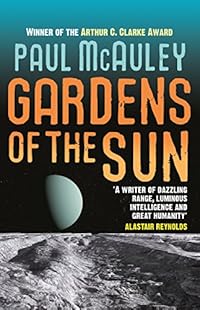
Gardens of the Sun by Paul McAuley

Gollancz, 2009, 440p.

In the aftermath of The Quiet War, the Outers -€“ humans altered to cope better with living in the further reaches of the Solar System – have been driven beyond the moons of Jupiter and Saturn. Parts of Gardens of the Sun are set in bubble habitats round Uranus, Neptune and Pluto or on wandering asteroids but the action, such as it is, also ranges back to Earth. This division of humanity – which also includes so-called Ghosts who follow a mystic claiming to have messages from the future – is the source of conflict in the novel. There are several sub-plots including the ongoing search for the gene wizard Avernus, one of the many characters from The Quiet War to reappear here, along with others such as Sri Hong-Owen, Macy Minnot, Loc Ifrahim, Felice Gottschalk and Cash Baker. The gardens of the title turn out to be habitats gengineered by Sri Hong-Owen to allow life to be easier amid the harshness of space.

Despite there being enough in this book to fill a whole series of novels, reading this one was hard going. The different characters’ stories are too remote from each other, even if some do overlap by the end, and are not in any case the main focus of the narrative which often reads like a history of the future (except with use of the pluperfect – usually a sign more is being crammed in than the story can bear.) It is in effect one long info dump and the scenes where the characters interact seem like addenda.

McAuley’€™s future environment is impressively detailed, though, as indeed was Kim Stanley Robinson’€™s in his 2312 which tended to neglect plot. It’€™s a pity we’re told most of it instead of being allowed to experience it.

Borussia Dortmund 1-2 Bayern Munich

Champions (sic) League (sic) Final, Wembley Stadium, 25/5/13.

For the first half hour this had sucker punch written all over it. Bayern barely featured. After Weidenfeller saved Manzukić’s header, though, things evened out.

Amazingly for a final, it was quite a good game; fairly open with both teams not afraid to go forward. Despite him setting up the first goal I found myself wondering if Arjen Robben was a luxury Bayern couldn’t afford. Then, of course, he goes and scores the winner.

I don’t suppose it was the wrong result given that Bayern’s goals were both from open play. The penalty wasn’t in dispute and Gündoğan put it away well.

Not quite a classic though. There weren’t enough swings in fortune for that.

Reelin’ In The Years 67: Après Toi

I missed marking the Eurovision Song Contest last week so thought I’d make up for it now.

Vicky Leandros, as Vicky, sang L’amour Est Blue in the year Sandie Shaw won the contest, 1967. However she triumphed with this belter in 1972. A song in French by a Greek singer representing Luxembourg. Only at Eurovision.

By the way, is there anyone else who hears a resemblance in the tune for each verse to a certain work composed by Andrew Lloyd Webber?

For some reason it must have been thought no-one in the UK would buy a song with a lyric in French, as Vicky’s UK chart entry came with the reworking of Après Toi as Come What May.

Vicky Leandros: Après Toi

Vicky Leandros: Come What May

Falkirk Stadium

Home of Falkirk FC. Quite an impressive one now that all but one of the sides is closed in. These photos are from April this year. The last time I was there some years ago it only had two stands. Still an improvement on the old Brockville though.

This is the Main Stand.

Falkirk Stadium

I took this one from the road just to the east.

Falkirk Stadium from Southeast

This one is from the west side (just.)

Falkrk Stadium from South (west)

The East Stand:-
Falkirk Stadium, East Stand

And the West Stand:
Falkirk Stadium, West Stand

This is the view across from the Main Stand.

Falkirk Stadium, View from Main Stand

Reelin’ In The Years 66: John I’m Only Dancing. RIP Trevor Bolder

Two days in a row. Yesterday Ray Manzarek, today Trevor Bolder, bassist for David Bowie in the breakthrough years and sometime member of Uriah Heep and Wishbone Ash. It makes you dread waking up in the morning.

The track I’ve chosen isn’t one of the most played from the Ziggy era but it shows off Bolder’s bass playing.

Trevor Bolder; 09/06/1950 – 21/05/2103. So it goes.

David Bowie: John I’m Only Dancing

Redshirts by John Scalzi

Gollancz, 2012, 309 p. Reviewed for Interzone 245, Mar-Apr 2013.

For the first two-thirds of Redshirts the thought recurs that it’€™s either the most intriguing piece of SF you have read in a long time or else a sad waste of dead tree. The set-up has replacement crew-members on a starship slowly noticing strange events occurring – especially to those who attract the attention of senior officers and are as a result assigned to accompany them on away missions, where, invariably, one of the minions is at best badly injured, at worst killed. So far, so interesting.

The trouble is that the main characters are barely worthy of the name, being more or less indistinguishable. Moreover we are treated to various mundanities of their lives normally omitted in fiction. Yes, they are supposed to be walk-on parts in a different narrative, a bad Science Fiction TV series from our time, and hence might be expected not to be fully fleshed – but they are the main characters in ours and doesn’€™t the reader always deserves more? Moreover, dialogue is rendered as “Dahl said,”€ “€Duvall said,”€€ “€€œHester said”€€ etc making it feel like a shopping list. In addition the prose rarely rises above the leaden and workmanlike.

And yet the text plays games with narrative and with the reader, features characters who become aware of themselves as players in a story and who take steps to alter their fate. There is even a false ending, allowing Scalzi to address the reader directly.

Viewers of a certain 1960s US TV SF series – which bears a superficial resemblance to the scenario here – may have noticed certain …. illogicalities. Scalzi clearly enjoys laying out the faults, the playing fast and loose with the laws of Physics, the lack of internal consistency, the black box resolutions, which can plague such an enterprise. It is generally not regarded as a good idea for a Science Fiction novel explicitly to refer to SF, yet given the subject matter here it would be remiss not to. Indeed the plot of Redshirts depends on it.

After the amended ending – and making up the last third of the novel Redshirts as an entity – we have no less than three codas, subtitled first person, second person, third person, each narrated in its subtitular mode, respectively by the writer of, and two of the actors in, the TV series. These comment on, illuminate and extend what has gone before. The writer is not cheered by criticism distinguishing between bad writing and being a bad writer, the two actors find their destiny in life. While the codas’€™ styles are disparate, and thus a welcome relief, the last still has dialogue framed like a shopping list. Crucially though, the characters in them feel real.

In the main narrative Scalzi shows he can do bad writing very well. (Now there’s a back-handed compliment.) If you don’€™t know what’s to come in the codas, though; if you’€™re not, say, reading Redshirts for review, that could be a fairly large hurdle to overcome.

Friday On My Mind 82: RIP Ray Manzarek

Sad to hear this morning of the death of Ray Manzarek, keyboardist with The Doors, who came to notice in the UK with Light My Fire. Despite showing off Manzarek’s playing it only reached no. 49 in the charts on its first release in 1967.

Their biggest UK hit was in fact Hello I Love You (Won’t You Tell me Your Name?) which sounded as if it owed a lot to The Kinks’ All Day and All of the Night, though apparently The Doors denied the connection.

Their only other song to trouble the UK charts was the atmospheric Riders on the Storm in 1971.

Raymond Daniel Manczarek, Jr: 12/02/1939 – 20/05/2013. So it goes.

The Doors: Light My Fire

free hit counter script