24/12/12
Posted in Curiosities at 00:00 on 24 December 2012
Not a bad date for a birthday.
Except I’m not 24.
It even works well in USian (12/24/12.)
Posted in Curiosities at 00:00 on 24 December 2012
Not a bad date for a birthday.
Except I’m not 24.
It even works well in USian (12/24/12.)
Posted in BBC, Television at 20:13 on 23 December 2012
In the last episode of Waldemar Januszcak‘s excellent television series on the mostly unheralded art of the Dark Ages, where he covered the Vikings, the Carolingians and The Anglo-Saxons, he referred to Lindisfarne (Holy Island) as being off the North coast of Britain.
Tut-tut, Waldemar. That would make it in the Pentland Firth/Atlantic!
Lindisfarne is actually barely two-thirds of the way up Britain.
It is, however, off the North-East coast of England.
Posted in Events dear boy. Events, Politics at 21:08 on 22 December 2012
I note the US gun owners’ association, the NRA, has responded to the recent shootings in Newtown, Connecticut.
Their spokesman, Wayne LaPierre, variously blamed the shootings on lax enforcement of “gun-free” areas round schools, deranged individuals not being on a national data base, violent video games and the media. He decried the fact that school staff had to give up their lives to protect the children as they couldn’t defend themselves and went on to say, “The only thing that stops a bad guy with a gun is a good guy with a gun.”
It is perfectly true that a child in the US (and elsewhere) will witness tens of thousands of acts of violence between TV/the cinema/video games before reaching the age of 18. But they don’t all end up committing massacres. Plus, moreover, don’t such depictions help to create the climate in which the NRA finds fertile ground for recruitment?
(It is curious that these same children are not supposed to witness that most human of acts, of love/procreation, through the means mentioned before that same tender age. I somehow suspect Mr LaPierre would be against them viewing that sort of thing, though.)
Again; isn’t it possible that, even if the staff members had carried guns, they would still have been shot by the attacking gunman? He had the initiative after all.
And the only thing? Surely a better way to stop a bad guy with a gun is never to let him acquire the gun in the first place.
I recognise that the genie of gun ownership in the US is not one that can be easily put back in the bottle, there are simply too many of the things about.
The NRA’s remedy to gun attacks on schools, however, is to station armed guards, trained volunteers Mr LaPierre said, ex-police, ex-military etc, in schools.
Are you sure, Mr LaPierre? Are ex-military personnel, those who have seen combat, seen their comrades mutilated, blown up or shot, really the best people to protect young innocents? Aren’t veterans famously subject to trauma and mental problems, to difficulties reintegrating with civilian life?
So, Mr Lapierre, I ask. Who is to guard these volunteers?
Because I guarantee, I guarantee, that should this guarding of schools by armed volunteers come to pass, some day down the line one of these volunteers will run amok in his/her school with his/her gun. (Even if said volunteer hadn’t been in the police or military.)
What will Mr LaPierre’s remedy be to that?
Posted in 1960s, 1970s, Music, Reelin' In The Years at 18:00 on 21 December 2012
Another one from 1970, following on from last week’s 60s Boxtops song.
Joe Cocker is perhaps most famous for his reworking of the somewhat bland, almost throwaway, With a Little Help From My Friends from the Beatles’ Sergeant Pepper, making that song into something unforgettable (though eminently parodyable) and in his “Mad Dogs and Englishmen” incarnation also had a 1960s hit with the Leon Russell song Delta Lady, but they later also transformed the Boxtops hit The Letter.
Joe Cocker: The Letter
Here, for comparison purposes, is the version by the Box Tops:-
The Box Tops: The Letter
Posted in 1980s, Events dear boy. Events, Music at 11:00 on 21 December 2012
Apparently some people think the end of the Mayan Long Count means the world will come to an end today.
What, again?
Predictions of apocalypse are as regular as …. whatever passes for clockwork these digital days.
Quite why the end of a calendar means the world should end I’ve no idea. You just replace your old calendar with a new one.
And the long calendar didn’t predict the fate of the Maya. Their civilisation collapsed about 1,000 years ago, though their descendants survive and still speak Mayan languages.
World’s End?
World’s End is a pub on Edinburgh’s Royal Mile.
REM sang about the end of the world.
The World Ends?
Not with a bang, not with a whimper.
I feel fine.
REM: It’s the End of the World as We Know It (and I feel fine)
Posted in Andrew Crumey, Reading Reviewed, Scottish Fiction at 12:00 on 20 December 2012
Memory, Reason and Imagination. Dedalus, 1996, 203p.
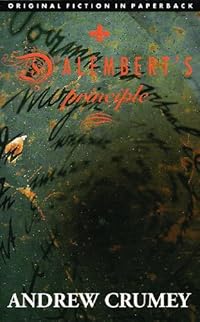
How to describe this extraordinary book? At one extreme it’s a triptych, at the other it’s three totally different narratives shoe-horned between one set of covers. The first, D’Alembert’s Principle, mixes the confessional with traditional third person and the epistolary to tell the story of Jean le Rond D’Alembert, a mathematician who studied the laws of motion and, along with Diderot, edited the Encyclopédie. The second is a Vernesque fantasy, The Cosmography of Magnus Ferguson, a work with echoes in its feel of David Lindsay’s A Voyage to Arcturus. The third is called Tales from Rreinnstadt and features the character Pfitz from Crumey’s previous novel of that title.
Three different tales, the first a beautiful evocation of D’Alembert’s life and love and whose three types of narration shouldn’t work in combination yet somehow do regardless, the second the conjunction of an imaginary travelogue through the then known (18th century) planets of the Solar System and the story of a man who seems to inhabit a sequel to a tale he has been reading about someone with his own name, the third a series of stories within stories within stories told by a character invented by the narrator of another book entirely (a book moreover which exists entirely outwith the covers of the one being read,) all reflecting on each other and on the nature of existence. Not for nothing is the sub-title of the overall D’Alembert’s Principle, Memory, Reason and Imagination. Yet reading it is never a chore, nor difficult. The prose flows as smoothly as anyone could wish.
Crumey manages in his fiction to use scientific concepts as metaphors without these seeming forced and to illustrate quantum mechanical ideas about the nature of reality in novelistic form, expressing them entirely naturally. (Or is it just that, as a scientist myself, these seem unexceptional?)
D’Alembert’s Principle is 203 pages of virtuosity and skill. The Introduction by John Clute – which, in case of spoilers, I took care not to read till after the novel itself – describes it as astonishing. Well, only if you have not read other novels by Crumey. This is the fifth of his novels I have read and they are, without exception, excellent.
Posted in Events dear boy. Events, Politics at 22:30 on 18 December 2012
Apparently the Metropolitan Police Commissioner has said about the Andrew Mitchell affair that “… there is more to this than meets the eye.” This is in response to the arrest and questioning of a police officer who apparently corroborated the original officers’ accounts of the confrontation but is now said not to have been there.
Well, the central facts of this case are undisputed. Andrew Mitchell has admitted to swearing at police officers – an act for which you or I would have had our collars felt in next to no time – yet has not been subject to arrest himself. Those police officers were moreover acting in the course of their duty in protecting the members of the Government of which he was a part yet were the victims of verbal abuse by a subject of their efforts. Mitchell, of course, disputes the officers’ version of his words.
I believe it is quite common for an accused person to give a different account of what transpired than the one the police put forward; indeed for accused persons to imply or state that the police evidence is embellished, perhaps even fabricated, and the result of collusion. Is it often the case that, as seems to be happening here, it is the officers’ account that is taken to be at variance with the truth?
Or does that only occur when it is former members of the Government, people still close to the Prime Minister, whose memory does not accord with those of policemen?
More to this than meets the eye?
You can bet there is!
Posted in Dumbarton FC at 12:00 on 18 December 2012
Scottish Cup, Round 4, The Rock, 17/12/12
Yes, a football game did break out yesterday, but it was much too far for me to travel on a night in the middle of December.
And it was busines as usual.
Three goals lost – with the added piquancy of a sending off against – and we are dumped out of the Cup. No new manager bounce.
At least we can now concentrate on the league, eh?
Posted in Dumbarton FC at 12:00 on 17 December 2012
It seems like we haven’t played since doomsday but it’s only just over three weeks.
I checked the BBC’s weather forecast for Dumbarton for today and it’s consistently above freezing so it looks like Ian Murray will be in charge for a game for the first time.
Who knows how we’ll play?
I fully expect us to win the Cup game but lose to Hamilton in the league.
Posted in Eric Brown, Reading Reviewed, Science Fiction at 12:00 on 16 December 2012
PS Publishing, 2012, 76p.

This is the latest in Brown’s Starship series of novellas set on the planet of Chalcedony (Delta Pavonis IV) following on from Starship Summer and Starship Fall.
The echoes of Michael G Coney are again less strong in this volume, Brown’s themes of religion and Art being once more prominent. His use of the name spindizzy to describe a colourful butterfly-like creature is merely one nod to other SF antecedents.
Narrator David Conway’s love-lorn life is about to be leavened by the arrival from Earth of Lieutenant Hannah van Harben as a new member of the local Police Department. His community of friends will also be disturbed by the empath, Darius Dortmund, famous for brokering a peace between two quarrelling alien races. Central to the plot is Matt Somers’s latest Art Exhibition, an exploitation of the emotional qualities of sacred stones lent to him by a race known as the Elan. To say how these elements come together would, however, be a spoiler.
It is unfortunate that all this had to fit into the confined word length of a novella. The exigencies of the plot do not allow enough exploration of the situation and everything seems to happen a touch hurriedly. This is perhaps an indication that Conway’s circle is a congenial group, pleasant to spend time with.
The gaps between episodes in the Starship sequence do help to foster an anticipatory feel. If ever published between one set of covers, though, they might not work as well in combination as stand-alones.
