Archives » 2012 » April

Oxford

On our last day away we visited Oxford.

You can overdose on mediævality there but you can’t go to Oxford and not photograph this if you see it. (The van does kind of ruin it though.)

Bridge of Sighs, Oxford, Oxfordshire

On a wall in High Street, Oxford, I noticed this plaque.

Boyle & Hooke Plaque, Oxford, Oxfordshire

It commemorates Robert Hooke, he of the eponymous law on elasticity, and Robert Boyle who formulated the Gas Law and was the first to use the word cell in connection with living things.

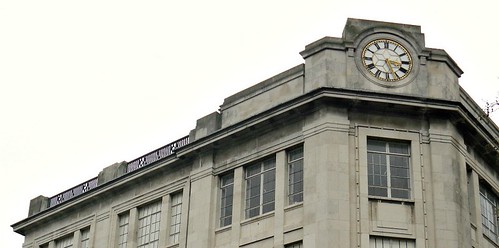
I didn’t stumble on Oxford’s War Memorial but there was some stunning Art Deco (to come in a later post.)

Wither by Lauren DeStefano. The Chemical Garden Trilogy.

Harper Voyager, 2011, 358p.

Published in Interzone 237, Nov-Dec 2011.

A genetically based cure for cancer has left a First Generation almost immortal barring accidents. However their children and grandchildren are not so lucky as a side effect – referred to as “the virus” – kills off males at 25 and females at 20. The societal consequences include a large cohort of children of these unfortunates being brought up in orphanages or left to fend for themselves. Efforts are being made to find a cure but these are opposed – sometimes violently – by groups who think there has been too much meddling already. “Gatherers” sweep the streets for young vulnerable females to provide subjects for research or suitable wives for wealthy young aristocrats. In addition a Third World War has “demolished” all of the world, except for North America (of course.) The rest is ocean dotted with a few islands.

At the novel’s start Rhine Ellery has been kidnapped and is being transported in a darkened van with other captives. At journey’s end the girls are subjected to a selection process. Rhine’s differently coloured eyes attract the selector and, as she is whisked off in a limousine, with two others, a naïve young Cecily and a more streetwise Jenna, she hears gunshots from the van. The three girls’ fate is to become prisoners in a vast establishment in Florida run by the First Generation researcher into the virus Housemaster Vaughn and to be “sister wives” of Vaughn’s son, House Governor Linden, whose present wife is 20 and dying.

Rhine is resolved not to succumb to this (albeit pampered) existence. She strikes up a relationship with a young servant, Gabriel, and despite being officially married, allows Linden no sexual favours. Cecily, happily, and Jenna, less so, provide his distractions in that regard.

There are irresistible echoes in this scenario of “The Handmaid’s Tale” but as in that novel the background leaves a lot to be desired and fails to convince.

While orphaned adolescents live in perpetual fear and Gatherers leave discarded victims to rot at the roadside there are still business expos, televised first nights and New Year parties where those and such as those turn up to be seen. People even go to the cinema. In most respects life outside captivity in the Big Houses is depicted pretty much as in our present day. How the Himalayas, for example, could be reduced to sea level yet Florida be above the waves is something of a puzzle and though hurricanes are to be expected Florida seems very wintry here. In addition the “virus” does not behave like a virus and a cure for cancer that’s also effective against ageing is just too pat. Why the lives of girls rejected by Gatherers are worth so little remains unexplained. Surely it is more likely they would be treated as a resource not to be wasted?

All of this is unfortunate as at the level of the writing “Wither” is very good. Though she seems unaware that “none” is singular DeStefano can otherwise turn a sentence and she relates the unfolding relationships between the sister wives deftly and that of Rhine and Gabriel delicately – though Housemaster Vaughn is a bit of a cardboard villain and House Governor Linden, despite his profession as a kind of architect, is too lacking in self regard. Scions of wealthy families are not usually noted for their reticence.

The resolution, when it comes, is a bit rushed and is achieved too easily but provides ample scope for continuing Rhine’s story.

The nature of the Chemical Garden of DeStefano’s planned trilogy is a mystery; unless there is a deep plot as yet unrevealed beneath the surface of the book. It would be good to think there is. On this evidence, though, that is unlikely.

Yet DeStefano shows promise. With a bit more rigour in her backgrounding she might be one to savour.

Dumbarton 2-1 Airdrie United

SFL Div 2, The Rock, 21/4/12

I wasn’t at the game but this was a potentially important result. Had we lost we were in real danger of not finishing in a play-off spot. As it is one, more win from two remaining will secure third place. Possibly even a draw might do depending on results elsewhere.

Since our ten game unbeaten run we had hit a bit of a slump and only one of our players (Craig Dargo at Cowdenbeath) had scored for us in six games since the 3rd of March! Our other two counters in that time were opposition own goals.

The result yesterday was all the more commendable since we fell behind early in the second half.

It is still possible for us to finish as low as sixth despite two of the teams in the next three playing each other next week (especially given our poor goal difference) but we would need to have a calamitous last two games.

We could relegate Stirling Albion next Saturday so they’ll be up for a scrap. Brechin (at home on 5th May) ought to have nothing to play for, though.

We could even lose our last two games and still finish 3rd.

In this Division, where anybody can beat anybody, you just never know.

Reelin’ In The Years 39: 2-4-6-8 Motorway

This is one of the few songs from the latter end of the 70s that will make it here as I never much went for punk and its aftermath.

However Tom Robinson partly surfed the punk wave and I was predisposed to his work as I had actually seen him performing on-stage at the Apollo in Glasgow when he was supporting someone or other – exactly whom I now forget – as part of an acoustic trio named Café Society (not, I think, the South African band Wiki links to.) The Café Society Tom was in were good, very good indeed. I wasn’t surprised when he went on to success.

The Tom Robinson Band was harder edged as this live performance attests.

Tom Robinson Band: 2-4-6-8 Motorway

Sporting Club Lisbon 2-1 Athletic Bilbao

Europa League (sic) Semi-final, first leg. Estádio José Alvalade, Lisbon, 19/4/12.

Not paint drying.

(Again, though, I only watched the second half.)

This was an object lesson on how a near miss can spur a team on and how an equalising goal changes a game. At 0-1 down Sporting looked out of it. At 1-1 they dominated, and scored another.

Should be interesting in Bilbao next week.

I see the other Europa League(sic) semi-final finished 2-4. That can’t have been boring either.

Art Deco in Gloucester

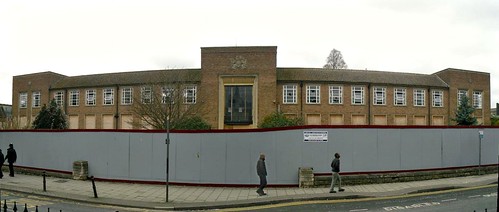
Almost the first interesting building we came across in and around the town centre was shielded behind hoardings but it was obviously a once important institutional building. It turns out it used to house the Gloucester College of Art and Technology. It’s not really bent, I couldn’t get far enough back for one shot so this is a stitch. I only just caught this one. It had signs on it saying it was about to be demolished. Such a pity that a use couldn’t be found for it.

Former Gloucester College of Art and Technology

I have found another picture of the building at Panoramio.

GLOSCAT

This site shows some of the detailing.

Also check out here which shows a few of the internal features.

The good lady thinks it’s a scandal that it’s all to go. So do I.

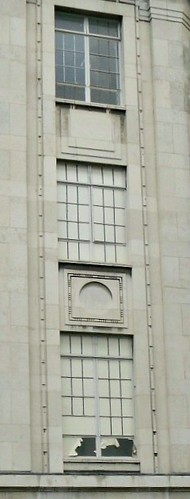
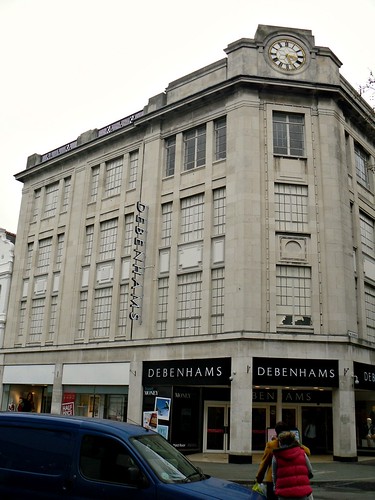
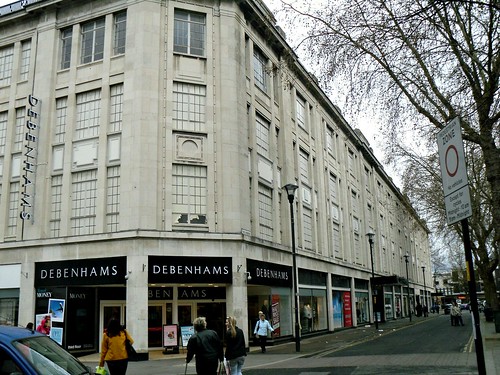
Gloucester was further well served in an Art Deco sense by a full-on Deco Debenham’s. It’s on a corner with a long frontage down the side street. Impossible to get in one shot. (Or a decent stitch.)

Debenhams, Gloucester, Detail
Debenhams, Gloucester 1

Debenhams, Gloucester 2

Debenhams detailing

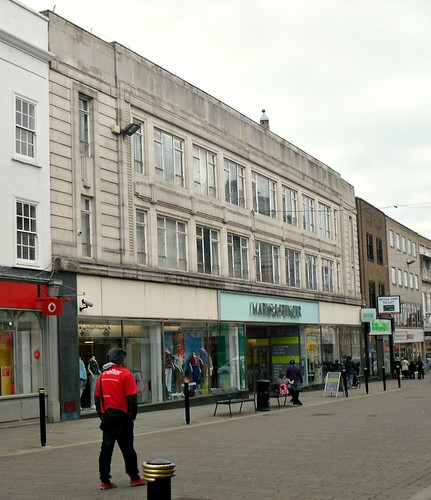
We also found a Marks & Spencer (again I couldn’t get far enough back for anything but a side shot)

Marks & Spencer, Gloucester

and a Halifax – very minor deco, and those wires in the way!

Halifax Building Society, Gloucester

Four Art Deco buildings, one an absolute belter, one a particularly sad sight, and we were only there for an hour!

Chelsea 1-0 Barcelona

Champions (sic) League (sic) Semi-Final, first leg. Stamford Bridge, 18/4/12.

Paint drying.

(I only watched the second half, but still.)

Gloucester War Memorial

Gloucester is only 12 miles on from Cheltenham so we carried on to there the same afternoon.

We chanced upon Gloucester War Memorial and managed to get parked nearby.

I like the restraint of this one and the fact it’s at the edge of a piece of parkland. Unfortunately the road is quite busy, though; but at least that means lots of passers-by will see the memorial.

The cenotaph-like stone is surmounted by a lion and is inscribed to the men of the Gloucestershire Regiment.

Gloucestershire Regiment War Memorial

The long low, curving wall with the central gap is dedicated to the men of Gloucester. Both top lines of names are for the Great War and the lower lines are for the Second.

Gloucester War Memorial

German War Birds by ‘Vigilant’

Greenhill Books, 1994, 264 (+ xiv) p

Despite its title this book is not about the German aeroplanes of the First World War but rather the pilots who flew them. When originally published in 1931 it was the first book in English to deal with the German airmen of the time. Many of those names were familiar to me from other books on the war in the air (Quentin Reynolds’s They Fought For The Sky, Alexander McKee’s The Friendless Sky) but these mainly dealt with the Western Front. Here, as well as names such as Max Immelman, Oswald Boelcke, the Richthofen brothers, Werner Voss, Ernst Udet and Herman Göring, coverage is also given to other war theatres: Gunther Plüchow’s exploits in the far East, flying out of Tsingtao till it fell to the Japanese, Leutnant v Eschwege – dubbed “The Eagle of the Ægean Sea” by his Bulgarian Allies – whose base was Drama in Macedonia, “odd jobs” on the Eastern Front blowing up Russian supply railway lines, and in the Sinai doing the same to railways and aqueducts. These latter adventures at times read almost like Biggles stories, though not fiction and told from the opposite side.

The book is prefaced by an introduction (from 1994) by Norman Franks giving some historical context and two lists; pilots who achieved a “score” of 30 or more and all who were awarded the “Pour le Mérite” (“the Blue Max.”) It also has an odd typographical quirk where every semi-colon is preceded by a space ; as here. Was this a 1930s standard?

Since 1931 some of the incidents have been illuminated by more recent research. For instance, the famous “Red Baron,” Manfred von Richthofen, is now thought to have been killed by a bullet fired by an infantryman rather than Captain Roy Brown.

‘Vigilant’ (Claud W Sykes) when dealing with the Western Front has an irritating habit of referring to “English” aeroplanes or pilots when “British” would be more accurate but this is probably the term the Germans used and he is telling the tales from the German viewpoint. He is clearly much taken with the valour and chivalry of fliers on both sides and takes pains to point out that the German air force kept flying and fighting up to the armistice but the last sentence of his final paragraph, â”Im Kreig geboren, im Kreig gestorben.* Germany has no flying Corps and we all look forward to the day when no country will need one. But a few months before we celebrate the tenth anniversary of the armistice, two Germans, setting forth from a Dominion of the British Empire, flew the Atlantic from east to west. The third member of the crew was a British subject. Germany has still a future in the air!” reads somewhat chillingly now.

*Born in the war, died in the war. This refers to the fact that the German Flying Corps did not exist as such before the war and was forced by the armistice to hand over its aeroplanes and so did not outlive it.

Art Deco in Cheltenham, Gloucestershire

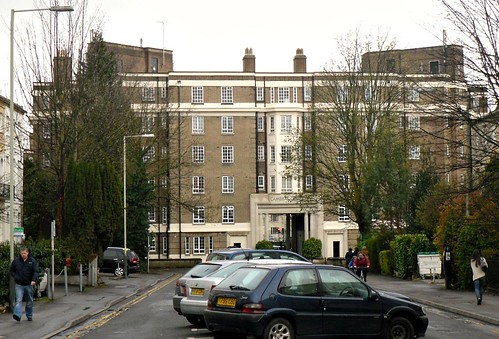
There is a nice block of flats called Cambray Court located in the centre of Cheltenham. Reminiscent of Kelvin Court, Glasgow.

Cambray Court, Cheltenham

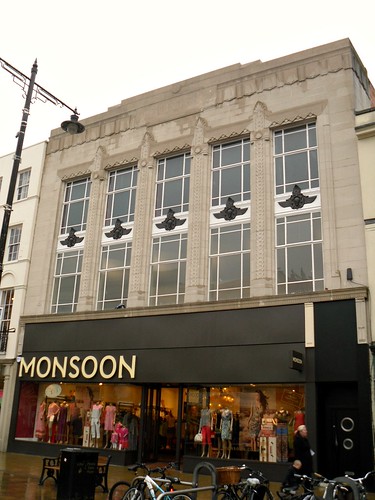
This is Monsoon. Originally a Burton’s. The link has some good pictures of the detailing.

Monsoon, Cheltenham

Now Poundland. Goodness knows what it was to begin with.

Poundland, Cheltenham

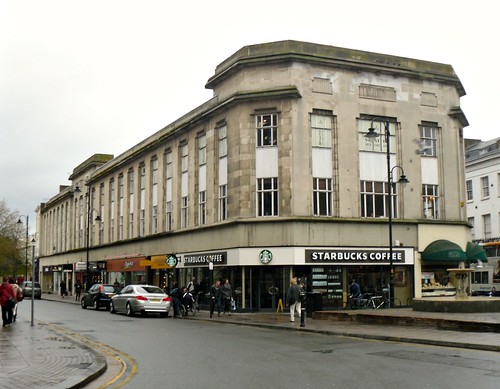
Starbucks. Ditto.

Starbucks, Cheltenham

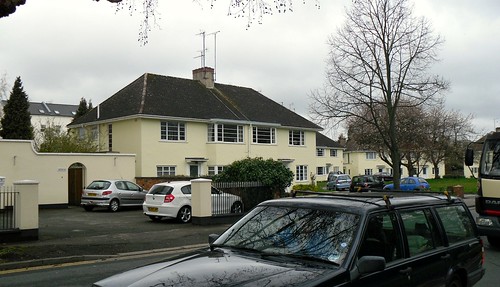
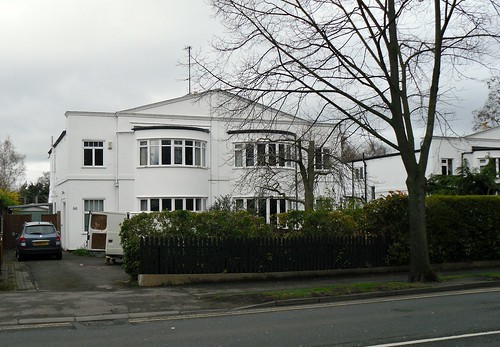
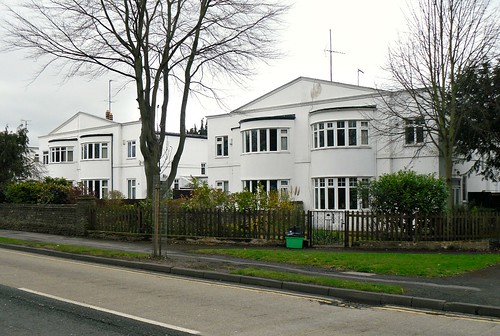
Art Deco houses on Evesham Road. Amazingly the original glazing seems to still be in place. (They look like Critall windows to me.) Compare and contrast with Silver End.

Houses, Cheltenham 1

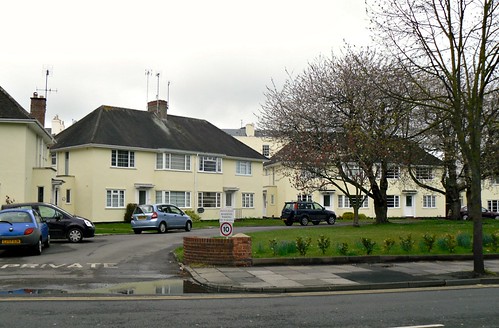
The upward curve on the wall at the side is nice on that first one. Three of this collection of 5 buildings are set in a little crescent off the main road:-

Houses, Cheltenham 2

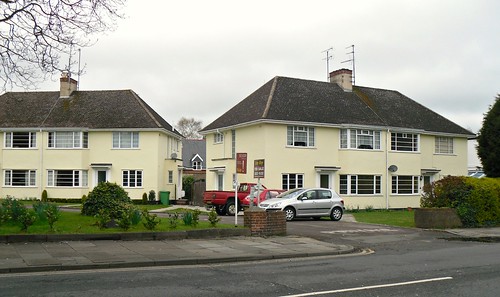
The last two semis of the five:-

Houses, Cheltenham 3

Cheek by jowl with the previous semi. Glazing replaced. (Eyes poked out):-

Houses, Cheltenham 4

The next house along has suffered a similar fate.

Houses, Cheltenham 5

Not a bad haul of deco in Cheltenham, then, for a three hour visit.

free hit counter script