Archives » 2011 » June

Forth Bridges

We took a stroll around North Queensferry last week. It wasn’t much of a stroll because it’s not very big. It must be the best location in the world for viewing iconic bridges, though. It lies slap bang between the two famous ones over the River Forth.

The following two pictures were taken from the same spot. The angle between the photos is about 600.

Forth Bridge

Forth Road Bridge from North Queensferry Harbour

They’re doing some repair work on the Road Bridge which, thankfully, you can’t see from the road.

Forth Road Bridge Repairs

The next time I drive over it will be more scary than usual now I know all that is going on below.

Pictures of the northern cable anchor point and a support pillar are on my flickr site.

Looking west we could see the trans-North Sea ferry berthed at Rosyth.

Ferry Docked at Rosyth

There was an aircraft carrier at the Royal Navy base too. I had thought we no longer had any of those, or was it just the new ones the Coalition Government planned to scrap? My camera isn’t quite good enough for the distance involved but it was definitely an aircraft carrier. It had that upward sweep at the bow.

Aircraft Carrier Docked at Rosyth

Learn The ******* Rules!

So it’s not just me!

I clicked through to this while looking at a comment Jim Steel left on facebook.

Ann Patty may be a kindred soul.

Her point about proof reading at publishing houses is a good one.

I would have had the same reaction as her to errors in a manuscript.

If an author doesn’t know the nuts and bolts of the language she/he is writing in it’s like an electrician not knowing how to wire a circuit (only a bit less dangerous.) I don’t feel inclined to trust her/him any more.

The thing is, misuses such as the lay/lie confusion are becoming so widespread that they are in danger of obscuring the valuable distinction between the two meanings and the chances are English will, in the future, be the poorer for it.

Friday On My Mind 58: Judy In Disguise (With Glasses)

Someone else who listened to Lucy In The Sky (With Diamonds) – but took the piss.

John Fred and his Playboy Band: Judy In Disguise (With Glasses)

Kirkcaldy’€™s Art Deco Heritage 10. Victoria Road

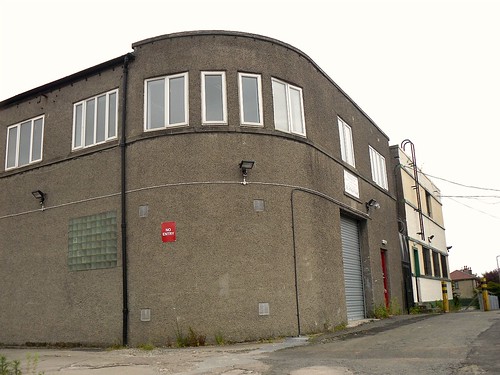
A little bit further along Victoria Road from the former Nairn and Williamson offices as you go towards the town centre is a fitness centre called Priory Park which has Art Deco features.

Priory Park, Victoria Road, Kirkcaldy

There are lots of horizontals and verticals, especially the chimney. The windows have been messed about with though so it looks a bit weird.

This shows the decidedly non-deco extension.

Priory Park, Victoria Road, Kirkcaldy full view,

Between the Nairn and Williamson offices and Priory Park is Priory View.

Priory View,Victoria Road, Kirkcaldy

There are some minor Art Deco features to this – or would be if the windows hadn’t been replaced. The building obviously needs some care and attention: starting with the missing roan pipes.

Too Loud A Solitude by Bohumil Hrabal

Translated from the Czech Příliš hlučna samota, by Michael Henry Heim.
Harcourt, 1990. 98p.

Like Closely Observed Trains this book is short, indeed barely a novella, but it is beautifully written (and well translated into USian.)

For thirty five years Hanta has been compacting paper in a cellar room overrun with mice. During this time he has salvaged hundreds of rare books and stored them in his flat where they take up all the space and even hang over his bed, like a sword of Damocles ready to fall.

Spiced up with reminiscences of Hanta’€™s early life and encounters with his suppliers and his boss there is a characteristic Eastern European air of strangeness about the novella which borders on magic realism but does not quite stray into it. While Hanta is working he sometimes has visions of various philosophers, plus Jesus and Lao-Tze, and ruminates on the fate of the mice caught up in his compactor, the battles between rats occurring beneath his feet and the necessities of having an “€œother”€ to confront.

The routine of his job is underlined by the repetition in nearly every chapter’€™s first line of his statement about thirty five years spent compacting paper. This could be a metaphor for the dreariness of life under a dictatorship, or just of a relatively uneventful life in general. Yet there is incident too, little sparks of colour, variation and human interaction.

The book is effectively a monologue, with little dialogue to speak of, presenting a bleak outlook on life – and, surprisingly for an Eastern European novel, absolutely no sex (although a gypsy woman does offer) – but Hrabal nevertheless engages our empathy and sympathy. Despite not having the same burden of history to freight the narrative Too Loud A Solitude easily stands comparison to Closely Observed Trains in terms of its examination of the human condition.

Not Friday On My Mind 10: Witch’s Promise

This isn’t actually a 60s track as it wasn’t released till 1970. But it feels like one.

Bizarrely there seems to be an extract from Blue Peter at the beginning of this.

However, one of the reasons I’m putting it up is that it features the inventor of bling at the end of the video.

Jethro Tull: Witch’s Promise

Yes. One James Savile esquire.

Ordinary Thunderstorms by William Boyd

Bloomsbury, 2010. 403p.

This is the latest in Boyd’s apparent taking up of genre fiction. Okay, An Ice-cream War was a historical novel as were The New Confessions and Any Human Heart but he is not generally considered a writer of genre. Yet having most recently tackled the spy novel in Restless, he now ventures into thriller territory. (I doubt he’ll be trying SF though.)

Returning a briefcase left at a restaurant where he was eating to a man with whom he had struck up a conversation, Adam Kindred stumbles into a murder scene. The victim is still barely alive and asks Adam to remove the knife from his body. Disoriented, Adam does so and the victim promptly dies. Suspecting the murderer is in the next room, Adam flees with the briefcase and thus becomes the prime suspect. So far, so very The Thirty Nine Steps. What follows deviates from that template but is still pretty much a standard thriller where Adam sleeps rough, takes up begging, attends the Church of John Christ, changes his name, links up with a prostitute and her son, then later with the policewoman who was first on the murder scene! – all the while pursued by the murderer at the behest of a big pharmaceutical company with a secret to hide. The secret is of course in the briefcase.

Put like that this sounds ridiculous. Not very literary is it? Admittedly the novel doesn’t touch the heights of earlier Boyd offerings like Brazzaville Beach, Any Human Heart or even Restless but it is very readable, rollicking along at a fine pace – and the characterisation is good.

It is also a signal reminder of how easy it can be to stay lost in modern society. Use no banks, mobile phones nor credit cards and you are virtually invisible; certainly hard to trace. Whether the novel much enlightens the human condition is something different, though.

The story is told from the viewpoints of several of the characters and Boyd does that mainstream thing of giving their histories. I know it’s supposed to add to roundness and provide motivation but it struck me that really – especially if this knowledge is essential to the plot – it’s just another species of information dumping.

Inevitably with multiple viewpoints some of the narrators are less engaging than others. I was at first irritated by that of the chairman of the research company Calenture-Deutz but it is a sign of Boyd’s skill that he is able to elicit sympathy and even compassion towards him.

The writing appears effortless, very little jars (but see below) and the stupidity of Adam Kindred at the start apart – don’t touch the knife! – is psychologically convincing. If you like thrillers with a bit of character meat to them give it a try.

Small rant alert:-
Within, we have the old homonym “vocal chords.” These are cords; as in small pliable cylindrical pieces of living tissue. They vibrate as air passes over them and so produce sound. They are not a set of musical notes sounded simultaneously. Does no-one proof read any more?

Reelin In The Years 6: Sebastian

I missed this when it was released as Cockney Rebel’s first single and didn’t come across it till the live version on the B-side of Make Me Smile (Come Up And See Me) – which it completely blew away.

By that time of course the original group had long since split and had morphed into Steve Harley And Cockney Rebel.

Ths was quite a brave release for a first single (if the 7 minute long track was issued.) The drums don’t appear till 2 minutes 46 seconds in!

As I recall the live version is even better than this one.

Cockney Rebel: Sebastian

Judge for yourselves, though I’m not 100% convinced this is a live recording. (But it does sound quite like the B-side I remember):-

Cockney Rebel: Sebastian (Live)


Dundee’s Art Deco Heritage 6: MacGregor and Balfour Building

Now known as North Tay Works – off Loon’s Road.

North Tay Works, off Loon's Road, Dundee.

Note the typical Art Deco verticals and horizontals and pastel colours. Designed by a local architect William M. Wilson, this was built for timber merchants MacGregor and Balfour in 1937-8 and added to at the rear in the 1950s. It is now B listed and known as North Tay Works. It is situated, up an alley really, off Loon’s Road in Dundee. This is a stitch of two photos. Somebody’s garden prevents getting the whole from the front in one picture. The windows are either original Critall ones or very sympathetic replacements.

There is very nice Deco styling to the doorway and note the curved windows.

North Tay Works,Dundee: entrance

The rear was apparently added in the 1950s but the curve is in sympathy with the 1930s. The glass bricks are in keeping too.

North Tay Works,Dundee: back left

It has had a recent revamp but unfortunately appears to have no occupant at present.

See more pictures on my flickr site.

Edited to add:- I have added a view of this building from Dundee Law in a later post.

Xenopath by Eric Brown

Tor, 2008. 358p.

After the events in the first of Brown’s Bengal Station series, Necropath, Jeff Vaughan hung up his telepathic implant and married Sukara. Two years later he has an undemanding but low paid job plus a baby on the way. A former colleague invites him to join her detective agency for good pay using the new improved, and hence less mentally debilitating, implants. For the sake of his wife and child Vaughan does not need much persuading. The subsequent investigation, farmed out by an overstretched police force, centres on the trademark murder of three people by laser.

A young orphaned girl, Pham, witnessed the latest killing and underwent a strange experience immediately afterwards. She now has a voice in her head which promises to protect her, a voice which is the consciousness of an alien.

As well as Vaughan and Sukara, the self-serving Dr Rao from Necropath also appears in this sequel. Perhaps it is the familiarity established from the previous book but here the characterisation seemed fuller – although there is too much emphasis on how Pham resembles Sukara’s dead younger sister Tiger.

As in Necropath, Vaughan leaves Earth – this time for the planet Mallory, where again the encounters he has are somewhat in the tradition of pulp SF. (A xenopath turns out to be a telepathic alien.) Vaughan’s departure has left Sukara in danger, though. The working through of the various plot lines and the tying together of the strands are effected efficiently.

Brown has something here. The Bengal Station setting is a grand conceit, a macrocosm whose levels Brown has barely touched and which could support many more stories; not all about telepaths. The society on Bengal Station seems to be modelled on India but the construction as a whole is really only glimpsed, and sometimes brings to mind memories of Babylon 5. I did wonder, though, whether relationships and attitudes in such a new environment would be quite so close a mirror of the old. But human nature is unchanging, I suppose.

free hit counter script