Archives » 2011 » April

BSFA Awards Winners

Over at Science Fiction Awards Watch the results of this year’s BSFA Awards have been posted.

The novel award went to Ian McDonald for The Dervish House and the short story to Aliette de Bodard for The Shipmaker.

Congratulations to all the winners.

Dumbarton 1-2 Ayr United

League goals against predictor:- 80

SFL Div 2, The Rock, 23/4/11

We needed something from this. We won’t get anything from the game at Livingston next Saturday nor from Forfar who’ve also beaten us three times already this season.

It’s too close at the bottom. We’re relying now on Alloa losing twice (or only getting one more point) as Stenny play free-falling Brechin and then Peterhead in their last game. I think they might win both those.

A play-off against a team with a lot of wins behind them in the Third Division looms.

The Western Front by John Terraine

Hutchinson, 1964. 231p.

This is a book I got at a library sale years ago and have only just got round to reading. Rather than an overview of the Western Front as a whole it turns out to be a series of essays Terraine wrote between 1957 and 1962 which were finally collected in book form in 1964.

In the introduction Terraine is at pains to emphasise that the casualty rate in World War 1 was by no means unprecedented. Starting with Waterloo and taking in the Crimea, The American Civil War and the Boer War he illustrates that, for those with eyes to see, in a time of increasingly industrialised warfare high casualties were inevitable once the fighting started. This was a theme he developed fully in his later book The Smoke And The Fire.

World War 1 was unique, though, in the prolonged timescale of the battles and the static nature of the Western Front. (Other fronts had movement but sustained equally high, or even higher, percentage casualties.) The carnage of the Second World War eclipsed even that of the First, but Britain escaped most of it.

The focus of the book is, however, more on the personalities on the British side than the battles themselves; in particular in the antipathy between Lloyd George and his top commanders. Now, Terraine is a military historian and it is not surprising that his sympathies should lie with the generals but the evidence he presents for Lloyd George’s unhelpfulness is convincing.

His assessment of Douglas Haig as being far from the stolid and hidebound figure of the popular imagination is well argued. His highest praise, though, is reserved for the all but forgotten British general Herbert Plumer.

There is also a discursion into the baneful effect the cult of Napoleon had on the French military mind – and on others. In Terraine’s view Napoleon was anything but the tactical and strategic genius he is usually taken for and, moreover, was exceedingly careless with the lives of his men. The yearning for “something else,” the strategic or tactical genius who might have been able to circumvent the Western Front’s defences was always a chimera. None of the generals, on either side, had a quick and easy solution. In the end, by applying the lessons learned throughout and the integration of new tactics and weapons like the tank, it should not be forgotten that the war was won, and it was won on the Western Front. And that within the three months of late summer and early autumn of 1918.

While Terraine mentions it briefly, the most important assessment of the implications of the war is outwith the scope of this book. Britain was unable to wield sea power effectively (with the launch of the first modern battleship, Dreadnought, and the subsequent naval arms race its dominance had in essence been lost.) The development of the mine and torpedo and the advent of the submarine made a surface fleet almost useless in any case. As a result Britain was sucked in by force of events to becoming a land power; from 1917 onwards – arguably from the Battle of the Somme a year earlier – the major contributor to the Allies; fighting strength and the instrument of final victory.

Had the navy been able to ensure safe passage across the North Sea (rather than keep secure the shorter distance to France) an amphibious landing might have been attempted in Northern Belgium and the Western Front’s flank turned. Whether that would actually have led to an earlier German defeat is another matter.
Friday On My Mind 55: Johnny Remember Me

Another of my brother’s early 60s favourites was John Leyton.

Leyton started out as an actor but quickly made a parallel career for himself as a singer. His recording success coincided with television roles but his chart appearances soon tapered off and his acting became more important. He had roles in the films The Great Escape – that seemingly perennially aired at Christmas TV movie – and Von Ryan’s Express among others.

Johnny Remember Me has that Telstarry sound I associate with Joe Meek as a producer.

John Leyton: Johnny Remember Me

His follow up singles Wild Wind and the unusually correct in its title’s grammar Son This Is She also bore the Meek stamp.

John Leyton: Wild Wind

John Leyton: Son This Is She

Elisabeth Sladen

I was saddened to read today of the death of Elizabeth Sladen who played Sarah Jane, one of the Doctor’s many companions in Doctor Who.

Sad too, that Elisabeth was only 63. It’s no age at all for these days.

I am by no means an inveterate Doctor Who fanboy but have watched the series from its inception up to the present day. Sarah-Jane was the first female companion to be more than just an adjunct to the Doctor. It was a pleasure to see her return to the updated show during David Tenant’s time as the incumbent. I must admit, though, that I didn’t bother with the spin-off Sarah-Jane Adventures; I don’t think they were meant for me anyway.

With the demise of Nicholas Courtney that means two fondly remembered Doctor Who characters’ actors have now gone in less than two months.

Elisabeth Claira Heath Sladen: 1/2/1946-19/4/2011. So it goes.

Twenty-first Century SF Mistressworks

Ian Sales has been at it again, this time with an extension to his SF Mistressworks meme. His latest list is of recent SF written by women. Some are by people I’ve never heard of (shame! shame! I’ve got a lot of catching up to do it would seem.) At least one, though, The Time Traveller’s Wife, I would not – did not – define as SF.

The usual indicator applies. I have read the ones in bold type.

1 Solitaire, Kelley Eskridge (2002)
2 Warchild [Warchild], Karin Lowachee (2002)
3 Natural History, Justina Robson (2003)
4 Maul, Tricia Sullivan (2003)
5 The Time Traveller’s Wife, Audrey Niffenegger (2003)
6 Spin State, Chris Moriarty (2003)
7 Dante’s Equation, Jane Jensen (2003)
8 Steel Helix [Typhon], Ann Tonsor Zeddies (2003)
9 Life, Gwyneth Jones (2004)
10 Nylon Angel [Parrish Plessis], Marianne de Pierres (2004)
11 The Courtesan Prince [Oka-Rel Universe], Lynda Williams (2004)
12 Survival [Species Imperative], Julie E Czernada (2004)
13 Banner of Souls, Liz Williams (2004)
14 City of Pearl [Wess’har Wars], Karen Traviss (2004)
15 The Year of Our War, Steph Swainston (2004)
16 Bio Rescue, SL Viehl (2004)
17 Apocalypse Array [Archangel Protocol], Lyda Morehouse (2004)
18 Alanya to Alanya [Marq’ssan Cycle], L Timmel Duchamp (2005)
19 Carnival, Elizabeth Bear (2006)
20 Mindscape, Andrea Hairston (2006)
21 Farthing [Small Change], Jo Walton (2006)
22 Half Life, Shelley Jackson (2006)
23 The Carhullan Army, Sarah Hall (2007)
24 Bright of the Sky [The Entire and the Rose], Kay Kenyon (2007)
25 Principles of Angels [Hidden Empire], Jainne Fenn (2008)
26 Watermind, MM Buckner (2008)
27 The Rapture, Liz Jensen (2009)
28 Zoo City, Lauren Beukes (2010)
29 Walking the Tree, Kaaron Warren (2010)
30 Birdbrain, Johanna Sinisalo (2010)
31 Who Fears Death, Nnedi Okorafor (2010)
32 Song of Scarabaeus, Sara Creasy (2010)

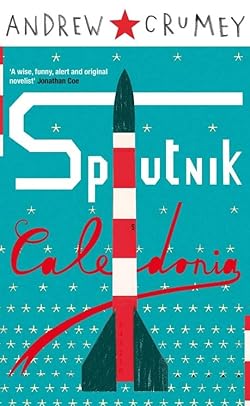
Sputnik Caledonia by Andrew Crumey

Picador, 2008. 553 p.

In the first part of the novel a shy boy called Robbie Coyle is growing up in a village called Kenzie in 1960s Scotland with the ambition of going into space. Since his father is an ardent socialist and anti-American Robbie therefore wants to be a cosmonaut. A frequent attender at his local library, he devours knowledge about the Soviet Union and discovers that “Russian is a language where some letters are written back to front and others are completely made up.” Quotes such as this display Crumey’s excellent ability to inhabit the world of a pre-adolescent. As he matures he starts to hear a voice in his head. The section ends with that voice saying, “I guess we’re not in Kenzie any more.”

The story then flips into a scenario of a Soviet-style Britain where a young adult Robert Coyle has been recruited into a space project to reach, before the wicked capitalists do so, what is possibly a black hole travelling through the solar system. The secret “Installation” where Robert is in training is suitably grim, the illustrations of the many compromises people have to make in such a society convincing, though whether dissidents could flourish there is another question. Perhaps this exists in the same British Democratic Republic which featured in the author’s Mobius Dick.

This central section could be considered an Altered History novel where the Jonbar Hinge lies in whether or not a man named Deuchar died while trying to rescue twins from drowning many years before the time the action is set. Yet its juxtaposition with the preceding and following parts, set in the “real” world, argues against this. And Crumey’s treatment of his subject matter does not have the feel of SF. The Soviet section can be read to be implicitly a figment of Robbie’s imagination. The subtlety of the point of divergence also marks this out from SF treatments of Altered Worlds. While Crumey pushes credibility a little by having characters in the central section behave and speak, or have the same names as, those in the book-end segments he does certainly avoid the trap into which Philip Roth fell in The Plot Against America of restoring the altered world to normal by the end.

The coda, a (present day?) exploration of the situation of Robbie’s ageing parents and a young boy who meets a mysterious stranger on a mission (which he is unwilling to explain) provides counterpoint and a resolution of sorts.

Sputnik Caledonia is excellently written and engaging, with convincing characters, but not quite as full of verve as Mobius Dick. I will look out for more Crumey, though.

Airdrie United 2-1 Dumbarton

League goals against predictor:- 80

SFL Div 2, Excelsior Stadium, 16/4/11

With thirty minutes of this one to go we were safe, ten points ahead of Stenny with three games left. At the end of it we are far from that happy state; only six points ahead. And our goal difference is worse.

They have Alloa, Brechin and Peterhead to play – one in the top four. We have Ayr, Livingston and Forfar – all in the top four.

We need points somewhere in that lot. Two of theirs are away, though, and the only away win they have was against us.

We find ourselves in the unusual position of wishing the team immediately below us to win on Saturday.

Election Bumph

More than several fliers with respect to the Scottish Parliament election (upcoming on May 5th) have landed on the doormat recently.

The usual suspects; Labour, Tory, Lib Dem, SNP, Green, UKIP. The last two of these were for the list vote only.

The UKIP one mentions their Scottish team; Donald, Brian, Mark, Mitch, Anthony, Otto, Bill.

Wait a minute. Otto? Otto?

Fine old British name; as the Pub Landlord might not have said.

Friday On My Mind 54: You’re Driving Me Crazy

One of the strangest manifestations of the trad jazz boom of the early 1960s was The Temperance Seven. Despite the band’s name it was in fact a nine-piece. It was said at the time that was because only seven of them were teetotal. Wikipedia suggests that actually none of them were; it may be a pun on one under/over the eight.

Most of their tunes, performed in 1920s fashion, featured a long musical introduction before the vocal came in. The vocal also tended not to be sung but rather voiced, Rex-Harrison style.

My eldest brother had a few of their records. The You Tube video for this one has some nice film of trams.

The Temperance Seven: You’re Driving Me Crazy

Another of their hits was Pasadena:

The Temperance Seven: Pasadena (Look out for the (two) false ending(s.)

This last one, Hard hearted Hannah, I include because the good lady’s aunt apparently used to belt out the song at family “do”s.

The Temperance Seven: Hard hearted Hannah

free hit counter script