Archives » 2011 » January

Friday On My Mind 42: I Don’t Know Why (I Love You)

As I recall (and this internet site corroborates) I Don’t Know Why was the A-side to My Cherie Amour but it got turned over so that that saccharine song became the hit. I still think this is a better track.

Stevie Wonder: I Don’t Know Why (I Love You)

Dumbarton 4-1 Alloa Athletic

League goals against predictor:- 110

SFL Div 2, The Rock, 18/01/11

League goals for predictor:- 18.

Howay the lads!!

Sorry. Wrong team.

Joking aside though, this was a welcome result.

However, it means that in one game we increased our goal tally in the league by 33 1/3%. We have seen a false dawn before this season. That also means that 50% of our league goals have come in just two games.

As I remarked to Onebrow on the phone when he informed me we’d gone two up (we both live too far away to attend evening home games) it needed to be two. He understood I meant that Stephen Grindlay was in goal and therefore Alloa would score. He has still not kept a clean sheet. I watched last Saturday’s highlights on Sons TV and despite his MotM he more or less threw the winner to Stenny.

I’ll begin to believe a corner has been turned if we can manage to score an away goal in sunny Methil on Saturday, especially if it is from open play.

But… our record at East Fife is dreadful and they hammered us there last time out.

The Death of Scottish Football? 4.

I see the changes those in charge of the SPL wish to push through seem to be closer to coming to pass.

The only difference to what most fans have overwhelmingly rejected?

That the SPL 2 will have 12 teams instead of 10.

Is that not just entirely typical of the cynical nature of these proposals?

What could be the reason (the only reason?) for increasing the projected number of teams in the SPL 2 in this way? Surely it can only be to try to persuade the present SFL Div 1 clubs to vote for it.

It would be laughable if it weren’t so tragic, nor so transparent.

These bullies still appear to maintain that only a top ten is financially viable.

Well; it was tried before and found wanting. It will be so again.

With the same stale old suspects on display time after time with four games against the same opposition every year, not including possible cup ties, attendances will continue to fall, the “product” (the football on offer) continue to decline in quality – even the much vaunted Old Firm games, the last one I hear was very poor; I had not the slightest interest in watching it – and the attraction of the SPL to TV companies will wane. Then the top ten will be stuck in a deeper bind than they are now.

Here’s a thought. Why don’t they just cut their coat according to their cloth, balance their books and forget about trying to compete with the top European clubs? We, and they, live in a small country on Europe’s periphery. Scotland is no longer a football powerhouse. (That it once may have been is a historical accident.) It’s time the SPL, especially the Old Firm, came to terms with that.

Note we have no indication of what promotion/relegation arrangements there will be between the new expanded SPL and the rump SFL the changes will leave behind.

Rest assured the access to the new SPL from the SFL will be restricted. The SFL clubs will be left to wither on the vine.

The SPL 2 clubs may wither faster though.

Come on SFL. Tell them to stuff it.

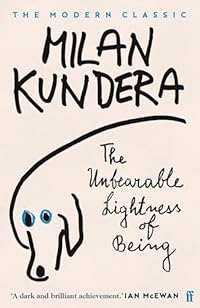
The Unbearable Lightness Of Being by Milan Kundera

Translated from the Czech, Nesnesitelná lehkost byti, by Michael Henry Heim.
Faber, 1995. 305 p.

This is a book to bring home how parochial and inward looking most fiction written in the English language is. There is no possible way that The Unbearable Lightness Of Being could have been written by a British or US author, or indeed any other anglophile. The mind set, the life experiences and especially the history it is written from are all too different. While the thrust of this book is by no means the same, I was reminded by its sensibility of the work of Bohumil Hrabal – not surprisingly also a Czech author.

The book is unusual in another sense; it breaks most of the rules that aspiring writers are advised to adhere to. A lot of the action is told to us rather than shown, Kundera addresses the reader directly, inserts his opinions into the narrative, tells us his interpretations of the characters. He also messes with chronology (admittedly not a major drawback, if one at all) and parenthetically gives us important information about some characters in sections which ostensibly deal with others. In parts, especially in the author’s musings on kitsch as the denial of the existence of crap – in all its senses – in the world, it reads as a treatise rather than an exploration of the human condition. That is, at times it is not fiction at all.

Kundera is highly regarded, so is this the essence of high art in fiction? That, as well as dealing with “important” subjects – or perhaps being considered to be circumscribed yet still endeavouring to tell truth to power (whatever truth may be) – the author should step beyond the bounds of narrative; of story?

The problem with such an approach is that it tends to undermine suspension of disbelief. The characters become too obviously constructs; the reader is in danger of losing sympathy, or empathy, with them; or indeed to care. It is a fine line to tread.

Where The Unbearable Lightness Of Being is not unusual is in its treatment of those novelistic eternals love, sex and death. Indeed at times it seems to be fixated on sex.

While the exigencies of living in a totalitarian state do colour the narrative, the treatment is matter of fact, oblique, almost incidental. The choices the characters make merely fall within the constraints of such a system. It is true, however, that something similar could be said for characters in any milieu. There are constraints on us all.

What I did find disappointing was that rather than finish, the book just seemed to stop. While the fates of the characters Kundera leaves us with are already known, this hardly seemed fair. “Leave them wanting more” may be an old showbiz adage but in the context of a one-off novel might be thought to be a failing.

Dumbarton 0-1 Stenhousemuir

League goals against predictor:- 120

SFL Div 2, The Rock, 15/02/11

League goals for predictor:- 18.

I was right to be nervous.

This was not good. Stenny hadn’t won away in the league before today and our record over the past six away games had been better than theirs (1 point rather than none.)

The club’s report suggested Stephen Grindlay was Man of the Match. If that’s the case we’re in deeper trouble than I thought.

The object of the game is to score goals and, as a corollary, not to lose any. We can manage neither of these basics.

Given our position it’s unlikely any players will want to join us at the moment so the transfer window doesn’t offer any hope.

I really think we’re stuffed, now.

From The Earth To The Moon.

The Signature Edition. HBO, 1998.

This box set was one of the presents I received in December. I think it was for my birthday, though, rather than Christmas. I missed it when it was transmitted in Britain.

The series is Tom Hanks’s eulogy to and elegy for the Apollo programme. Said actor appears only in the last episode in a frankly ridiculous and unnecessary role as assistant to Georges Méliès whose early film Le Voyage Dans La Lune, disgracefully stolen by Thomas Alva Edison for US distribution, was the first to depict such a trip. Hanks does, however, introduce the other eleven in a walking shot at the start of each. He has a writing credit for episode twelve and part wrote some of the others.

All aspects of the US end of the space race from Kennedy’s decision to initiate the endeavour to the last Moon mission are covered.

Cleverly, or annoyingly depending on your point of view, the episodes do not all focus on the hardware and the voyages in space; though they necessarily have their place. In broader takes on the times one episode reflects on the upheavals of 1968, one on the changing attitudes of journalists, and another focuses on the astronauts’ wives. NASA expected them to shield their husbands from any domestic worries while at the same time acting as clothes horses in public and generally being uncontroversial. (Few of the marriages managed to survive in the long term. But that could be true of most US marriages, of which I believe 50% end in divorce.)

In passing we have the casual smoking of the 1960s, the unconscious sexism, and the sheer scale of the programme’s achievement which was so very shortly after unappreciated.

That’s actually not quite right; it was so quickly unappreciated that it was regarded as a commonplace by the time the last three Apollo missions flew.

The most interesting to a scientist was the episode in which the astronaut’s training in geology was outlined, a training which bore fruit during Apollo’s 17’s landing when they found a piece of anorthosite, in which an unmanned probe would likely have failed.

Each episode is prefaced with Kennedy’s still inspiring, “We choose to go to the Moon. We choose to go to the Moon in this decade and do the other things; not because they are easy but because they are hard,” speech, making the series an homage to the men and women who took part in, supported, or built the equipment for the enterprise. In this it is perhaps a reflection of the belief that no such challenge faced Hanks’s generation, unlike those of their fathers (Apollo) and grandfathers (WW2.)

In all, it’s a worthy memorial to the participants in the Apollo programme and a sad reminder that in 40 years we haven’t gone back to the Moon.

I could have done without the syrupy music, though.

Edited to add:- There is a fifth disc containing trailers, behind the scenes and special effects “featurettes,” histories of famous astronomers and a history of the Moon; but I haven’t bothered to look at any of that one.

Friday On My Mind 41: Crimson And Clover

Tommy James And The Shondells big hit was MONY MONY, said, as I recall, to have been inspired by a neon sign for Mutual Of New York.

I always preferred this minor piece of psychedelia.

Tommy James And The Shondells: Crimson And Clover

There’s a longer (album?) version of this at http://www.youtube.com/watch?v=GpGEeneO-t0.

Football On Saturday?

Given the upturn in temperature Dumbarton may very well have a home game this week. (That is unless the forecast rain and any thawing snow don’t waterlog the pitch.)

That’ll be the first home game in nearly two months.

I’m getting nervous already.

Music For Another World edited by Mark Harding

Mutation Press, 2010. 270 p.

This is a collection of “Strange Fiction” with music as the linking theme. The stories range through various different types of SF and fantasy with some diversions into Horror. The authors mostly have low profiles though they all seem to have previous publications. In at least some of their contributions the relationship of the tale to the theme was tangential and most did not depend on music for their resolution. That is how it should be, though; a story has to work as a story after all, not fit an arbitrary arrangement.

To my mind the most successful tales were Richard J Goldstein’s Dybbuk Blues, concerning a charmed cornet and the fates of its players, Susan Lanigan’s The Accompanist, where the spirits of Robert and Clara Schumann inhabit the bodies of a teacher and pupil in a Music College, L L Hannett’s Breathing Life Into The Dead, about err…. breathing life into the dead and Gavin Inglis’s Fugue, where a driver crashes on a lonely road and hears a choir singing. Special mentions too to Jim Steel’s The Shostakovich Ensemble, a discography of a rock group from a Stalinist Britain, and Neil Williamson’s Arrhythmia, a kind of 1984 with added songs.

Nothing to do with the quality of the collection or its execution but one thing which irritated me was the occasional tendency for the font size to alter and then soon revert. I found it very distracting trying to decipher what the reason for this might be before concluding there was none.

As in all anthologies, or indeed collections, the quality was variable, but the stories here were never less than readable.

The Cost of Freedom

It was a US citizen, Thomas Jefferson, their third President no less, who said that, “The price of freedom is eternal vigilance.”

That may be the price, but what is the cost?

Looking at the shooting of US Congresswomann Gabrielle Giffords (and 23 others, six of whom died) then it might be said that the cost of freedom is the loss of human life.

US citizens have a remarkable range of freedoms, not the least of which is that of free speech. They also have the freedom to own and use weapons. Both of these are, I understand, constitutionally guaranteed (or at least people believe they are.)

The shooting of Gabrielle Giffords may, however, suggest that these two freedoms might be incompatible.

In June 2010 a website associated with prominent Republican Sarah Palin published a set of targets of Democrats who had voted for President Obama’s health-care reforms and highlighted each of their districts with the cross-hairs of a rifle.

Giffords’s Republican opponent in the recent elections, Jesse Kelly, went further, publishing as a campaign message, “Get on Target for Victory in November Help remove Gabrielle Giffords from office Shoot a fully automatic M16 with Jesse Kelly.” (The punctuation is his.)

Now this may have been a simple invitation to some “harmless” target practice with the candidate on a Saturday afternoon….. but it reads like incitement to murder. And Mr Kelly should have seen that possibility and therefore avoided the phraseology. On the other hand, perhaps he didn’t care.

Taken along with the crosshairs poster (see link above) his invitation becomes more of a (sorry about the pun) smoking gun.

There has been an unfortunate coarsening of political discourse in the US over my lifetime, to the extent that now the levels of vitriol are insane.

I mean that last word literally. (People have taken leave of their senses if they believe their present President is not a US citizen; or come to that, that he is a Muslim.)

I have mentioned this before when I predicted prior to his election that Barack Obama would be subject to non-stop hounding, and worse, if he were to be elected. What has occurred subsequently has, incredibly, surpassed those expectations of mine.

I repeat here that the problem seems to be that Republicans do not seem to accept the legitimacy of Democrats elected to office.

Democrats are somehow or other deemed to be un-American. (The echoes of McCarthy are not coincidental) and consequently demonised.

I realise that the problem of freedom and guns is not altogether new. And in my lifetime in the US political arena it has been Democrats, or those who could be thought not to be Republican, who have been the victims of assassination (the two Kennedys, Martin Luther King.)

President Reagan was shot, yes, but that did not seem to be a political act. Plus he survived.

Amazingly the same President Reagan seems to be the source of another quote about freedom:-

“Freedom is the recognition that no single person, no single authority or government has a monopoly on the truth, but that every individual life is infinitely precious, that every one of us put in this world has been put there for a reason and has something to offer.”

Note that.

Every individual life is precious.

It follows that you should not go around shooting people.

No matter what your disagreement with them.

The price of freedom is not only eternal vigilance, it is also restraint.
free hit counter script